



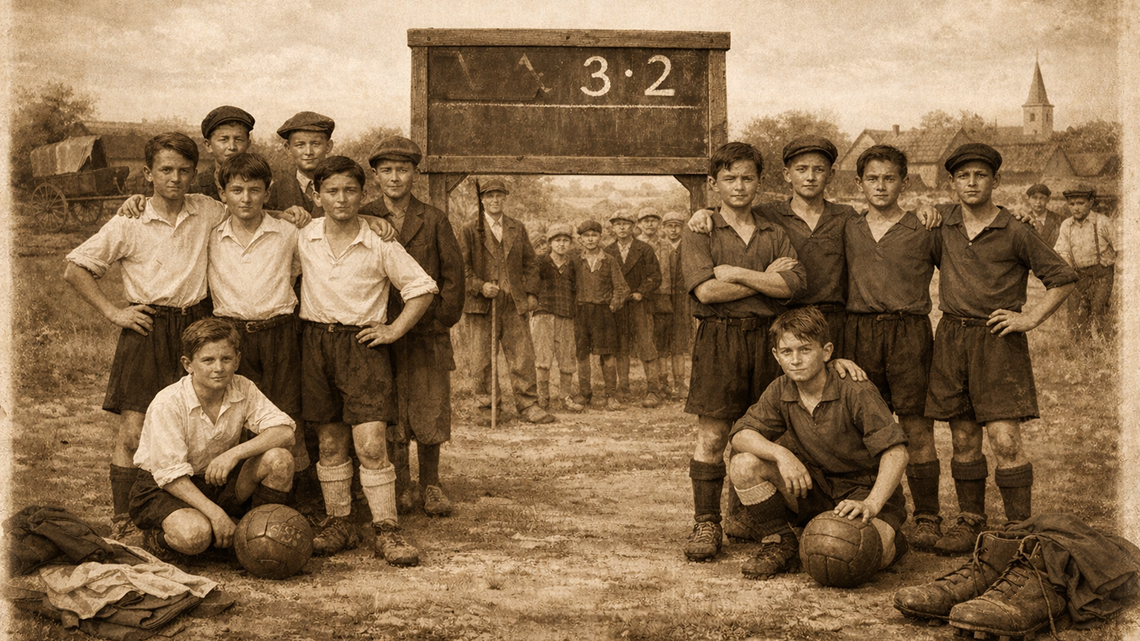
The children’s football clubs Zvezda and Banat in Novi Bečej effectively existed as early as 1932, rather than 1931 as later stated on Zvezda’s official memorandum. It should also be noted that during its first two years, Banat competed under the name Orao.
The boys’ loyalty to their clubs was exceptionally strong. Training sessions were held regularly, even though matches were played infrequently due to the lack of opponents of a suitable age. Mutual encounters between Zvezda and Banat were organized only two to three times per year. Particularly noteworthy is the fact that, even during the most difficult years of the great economic crisis, the boys consistently paid a monthly membership fee of two dinars.
From these modest contributions, both clubs gradually managed to purchase basic football equipment: jerseys – short-sleeved knitted shirts, football boots, and several balls. All players had their own shorts, which were of the same color. Zvezda played in white jerseys with black shorts, while Banat wore blue jerseys with black shorts.
Although simple, the kits were not cheap. A single jersey cost 15 dinars, a considerable amount when compared to the daily wage of 8 to 10 dinars. Nearly eight monthly membership fees were required to purchase one jersey, while football boots were several times more expensive. Nevertheless, true love for football knows no obstacles. Through small but significant sacrifices, enough funds were collected to obtain the most basic football equipment.
Such commitment and responsibility further strengthened the bond between the boys and their clubs. They felt – and truly were – the founders and builders of their teams, supporting them not only through play but also by financing all club needs themselves.
As already noted, the clubs had their own supporters among children, usually determined by place of residence. Children from Vranjevo supported Zvezda, while children from Novi Bečej stood behind Banat. Zvezda was founded in Vranjevo, with its headquarters located at the homes of Stanimir Blažin and Miša Glavaški. Banat was founded by Laza Mečkić and Vladiša Kiprović, and after the dissolution of the club Jedinstvo, its headquarters were located in the Kiprović pastry shop.
The first official matches between Zvezda and Banat were played in 1935. In March, Zvezda defeated Banat 3–2, while in the return match in April of the same year, Banat won 3–0.
Zvezda played a more attractive and technically refined style of football, but its players were physically weaker than those of Banat, which made their encounters consistently unpredictable in terms of results. While Banat was often forced to change its lineup throughout the year, Zvezda fielded almost the same eleven players continuously. Zvezda’s most frequent lineup included: Doka Vratan, Šmit, Hajdu, Majinski (Šuca), Blažin, Petkanić, Malešev, Mojić, Zavišić, Vlajovanov, and Glavaški.
These children’s clubs grew alongside their creators, who were at the same time their players. Club loyalty remained lifelong, despite the fact that transfers between clubs were not formally prohibited. Love for the club and the camaraderie that prevailed were stronger than any obligation. Although it occasionally happened that a player was left out of the team for various reasons and fell into youthful disappointment, this was never strong enough to result in changing clubs.
On March 22, 1936, Banat played an away match in Kumane, where it lost 4–1 to the local team Jugoslavija. Despite the defeat, Banat’s performance greatly impressed the spectators, especially considering that the team consisted of boys who could not physically match an adult squad.
Later in 1936, Banat also played in Dragutinovo against the first team of the local club Vojvodina, losing 4–2. The impression left by the boys from Novi Bečej was outstanding. On both away matches, the players were accompanied by their supporters. Many children walked to Kumane to cheer for their favorites, while for the trip to Dragutinovo, horse-drawn carts transporting the players were joined by around a dozen young supporters.
The boys were distinguished by numerous admirable qualities. In their desire to play football, they showed remarkable modesty and a willingness to make material sacrifices. This modesty is best illustrated by the cost of Banat’s trip to Kumane: 40 dinars, paid to the owner of the horse-drawn cart used to transport the players – a vivid testament to the spirit and dedication of those early, pioneering years.
Comments