



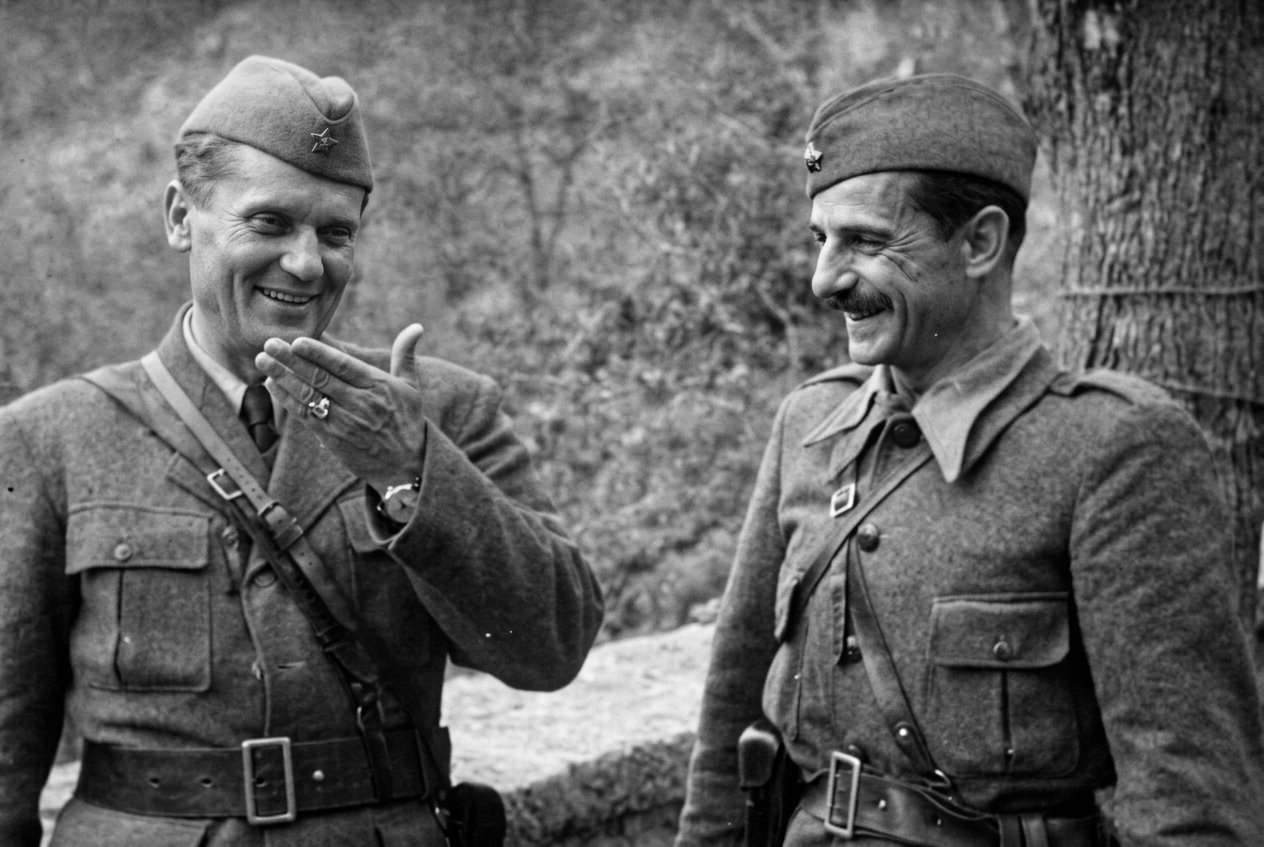
Konstantin Koča Popović (Belgrade, March 14, 1908 – Belgrade, October 20, 1992) was one of the most unusual and complex figures in the political, military and cultural history of 20th-century Yugoslavia. His life encompassed seemingly very different worlds: literature and Surrealism, philosophy, the revolutionary movement, the Spanish Civil War, partisan warfare, the highest levels of the Yugoslav military, diplomacy and state politics.
The Historical Archives of Belgrade, which preserve his personal legacy, describe him as a Sorbonne graduate, journalist, writer, one of the founders of the Belgrade Surrealist group, a participant in the Spanish Civil War and the Yugoslav People's Liberation War, a partisan general, diplomat, and political and state official in socialist Yugoslavia.
From a Distinguished Belgrade Family to Surrealism
Koča Popović was born in Belgrade on March 14, 1908, into a wealthy industrial family. He spent part of his early education in Switzerland and continued his studies in Belgrade and France. In Paris, he studied philosophy at the Sorbonne and came into contact with the European intellectual and artistic movements of the period. He graduated in philosophy in 1932.
Long before becoming known as a military commander and politician, Popović belonged to the circle of young Serbian intellectuals associated with Surrealism. He was one of the thirteen Belgrade Surrealists and worked closely with Marko Ristić, one of the most important representatives of Serbian Surrealism.
In 1931, Popović and Ristić published Nacrt za jednu fenomenologiju iracionalnog (Outline for a Phenomenology of the Irrational), an important work in the history of Serbian Surrealism. The original edition was published in Belgrade in 1931 by Nadrealistička izdanja. The surviving bibliographic record identifies Popović and Ristić as its authors and classifies the work under Surrealist literature and visual art.
Popović was also active in journalism and literature during this period. His early intellectual development demonstrates that his personality cannot be reduced to his later military and political career. Before the Second World War, he was part of a broader European cultural environment and regarded philosophy, literature and avant-garde art as important parts of his intellectual life.
From Surrealist to Revolutionary
In 1933, Popović became a member of the Communist Party of Yugoslavia. His political engagement increasingly brought him into the revolutionary movement. The Historical Archives of Belgrade confirm his party membership from 1933 onward.
His political commitment soon acquired a military dimension.
The Spanish Civil War
Between 1937 and 1939, Koča Popović volunteered in the Spanish Civil War on the side of the Spanish Republic. During the conflict, he attained the rank of lieutenant in the Spanish Republican Army.
The Spanish Civil War represented an important formative experience for many European left-wing activists and international volunteers. For Popović, it was his first major experience of modern warfare. He returned to Yugoslavia in 1939 with military experience that would become important several years later, when he entered the much larger conflict of the Second World War.
The records preserved in the Historical Archives of Belgrade are particularly valuable in this respect. His legacy contains notes concerning events in which he participated and people he encountered during the Spanish Civil War, as well as during the Second World War and his later diplomatic career.
The War in Yugoslavia and the Rise of a Military Commander
After the collapse of the Kingdom of Yugoslavia in April 1941, Popović joined the partisan movement. He took part in the uprising in Serbia in July 1941 and subsequently became one of the most prominent commanders of the Yugoslav People's Liberation Army.
His wartime career included command of several important formations, most notably the First Proletarian Brigade and later the First Proletarian Division and First Corps. In 1944, he became commander of the Main Staff of the People's Liberation Army of Serbia and later commanded the Second Army.
The First Proletarian Brigade was formed in Rudo on December 21, 1941, and Popović became its commander. The unit subsequently participated in numerous major operations during the war.
His wartime career was not limited to military command. Popović was also a member of the Anti-Fascist Council for the National Liberation of Yugoslavia (AVNOJ) from 1942 and a member of its Presidency from 1943.
The combination of his earlier military experience in Spain, his intellectual background and his wartime command responsibilities made Popović an unusual figure among the senior Yugoslav commanders.
From Commander to the Top of the Yugoslav Army
After the Second World War, Popović continued his military career in the new Yugoslav state. He became one of the leading officers of the Yugoslav Army and served as Chief of the General Staff from 1945 to 1953.
This represented a remarkable transformation in his career. The man who had once been involved in Surrealist literature and philosophy had become one of the highest-ranking military commanders in the country established after the Second World War.
His career illustrates the dramatic changes experienced by many European intellectuals and revolutionaries whose lives were transformed by the political conflicts of the first half of the 20th century.
Diplomat and Foreign Minister
After leaving the position of Chief of the General Staff, Popović moved into diplomacy and state politics. From January 1953, he became State Secretary for Foreign Affairs, effectively serving as Yugoslavia's foreign minister. He remained in that position until 1966.
This was a particularly important period in Yugoslav foreign policy. Following the break with Stalin and the Soviet leadership in 1948, Yugoslavia developed an increasingly independent international position and sought to maintain relations with both the Western and Eastern blocs while developing its own diplomatic initiatives.
Popović represented Yugoslavia at the United Nations and took part in important diplomatic activities connected with the emerging Non-Aligned Movement. According to the Historical Archives of Belgrade, he presided over regular and special sessions of the United Nations in his capacity as head of the Yugoslav delegation and participated in the preparatory meeting for the Conference of Non-Aligned Countries in Cairo and in the Belgrade Conference as a member of the Yugoslav delegation.
In 1966, Popović became Vice-President of the Socialist Federal Republic of Yugoslavia.
His Final Political Years
During the later years of his political career, Popović increasingly withdrew from active political life. The Historical Archives of Belgrade records that he resigned from his remaining official positions in 1972.
His withdrawal took place against the background of major political changes within Yugoslavia and growing disagreements among the country's political leadership.
During his later years, Popović continued to be an important source of historical testimony because of his writings, notes, correspondence and recollections. His personal papers provide researchers with first-hand material concerning several decisive periods of 20th-century Yugoslav history.
A Man of Many Biographies
Koča Popović is particularly interesting because his life cannot be placed into a single category.
He was a philosopherically educated intellectual and Surrealist, a writer and journalist, a communist, a volunteer in the Spanish Civil War, a partisan commander, a general, Chief of the General Staff, Foreign Minister and Vice-President of Yugoslavia.
Each of these stages left a mark on his biography, but none of them explains the whole of his personality.
His personal archive is therefore of exceptional importance. The Historical Archives of Belgrade preserve the Legacy of Konstantin Koča Popović and Leposava-Lepa Perović, containing personal documents, extensive correspondence, notes, awards, drawings, photographs, audio recordings and a library. The archival material also includes documents relating to Popović's Surrealist activities, his participation in the Spanish Civil War and the Second World War, and his later diplomatic career.
The archive's material was transferred over a period of years and has been available to researchers since 2005. The collection provides an unusually broad insight not only into Popović's life and work but also into the historical period in which he lived.
This archival material is particularly valuable because it allows historians to study Popović beyond later political interpretations, memories and legends surrounding his personality. His correspondence, notes, manuscripts, photographs and other documents provide an opportunity to examine his life through primary historical sources.
Konstantin Koča Popović died in Belgrade on October 20, 1992, at the age of 84. He left behind a biography that in many ways reflects the turbulent history of 20th-century Europe and Yugoslavia – from the avant-garde culture of the interwar period, through the Spanish Civil War and the anti-fascist struggle, the creation and development of socialist Yugoslavia, and the country's increasingly complex international position.
His life therefore remains relevant not only to the study of military and political history, but also to the history of literature, Surrealism, diplomacy and the broader social transformations that shaped the former Yugoslavia.
References and Sources
1. Historical Archives of Belgrade – Legacy of Konstantin Koča Popović and Leposava-Lepa Perović
The Historical Archives of Belgrade preserve Popović's personal legacy, including documents, correspondence, notes, photographs, awards, drawings, audio material and his library. The archive also provides biographical information concerning his education, Surrealist activities, participation in the Spanish Civil War, the Yugoslav People's Liberation War, his military career and diplomatic activities.
Historical Archives of Belgrade – Legacy of Konstantin Koča Popović
2. Hrvatska enciklopedija – “Popović, Koča”
The entry published by the Miroslav Krleža Institute of Lexicography provides biographical information concerning Popović's education, literary and Surrealist activities, membership in the Communist Party of Yugoslavia, participation in the Spanish Civil War, wartime command positions, membership in AVNOJ, his position as Chief of the General Staff, Foreign Minister and Vice-President of Yugoslavia.
Hrvatska enciklopedija – Popović, Koča
3. Koča Popović and Marko Ristić – Nacrt za jednu fenomenologiju iracionalnog (1931)
The original bibliographic record for the 1931 book, published in Belgrade by Nadrealistička izdanja, is preserved in the Pretraživa digital library. The record identifies Koča Popović and Marko Ristić as authors and classifies the work under Surrealist literature and visual art.
Pretraživa Digital Library – Nacrt za jednu fenomenologiju iracionalnog
4. Historical Archives of Belgrade – “100 Years Since the Birth of Konstantin Koča Popović”
The archival presentation of the 2008 centenary exhibition provides additional information about the contents of Popović's legacy, including documents, manuscripts, diaries, correspondence, awards, photographs, audio recordings and his library.
Historical Archives of Belgrade – 100 Years Since the Birth of Konstantin Koča Popović
5. Historical Archives of Belgrade – Exhibition “Konstantin Koča Popović”
The exhibition presented documents, books, objects and photographs from Popović's legacy and covered his childhood and education, Surrealist activities, participation in the Spanish Civil War and the Second World War, post-war political and diplomatic activities, and later years.
Historical Archives of Belgrade – Exhibition Konstantin Koča Popović
Primary and archival sources
For further research, the most important primary source base is the Legacy of Konstantin Koča Popović and Leposava-Lepa Perović preserved at the Historical Archives of Belgrade. According to the Archives, the collection contains personal documents, correspondence, notes, diaries, photographs, drawings, awards, audio recordings and a substantial library, making it an important source for studying both Popović himself and the historical period in which he lived.
Comments