



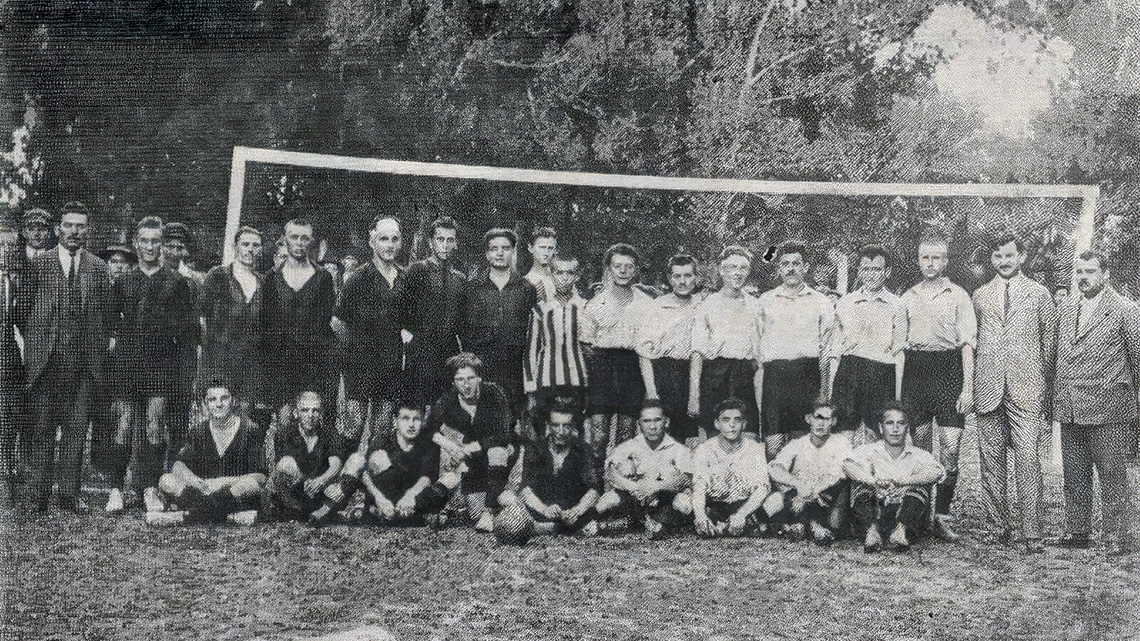
My intention with this book is to preserve the results, certain events, and deserving individuals responsible for the birth and development of football in Novi Bečej from being forgotten. I aim to revive memories of the past, the efforts, and dedication of individuals who, through their selfless commitment, sometimes under very difficult conditions, managed to sustain and ensure, albeit not always rapid, but continuous growth of football in Novi Bečej.
Thanks to these enthusiasts, football in Novi Bečej survived even in the most challenging economic conditions. They succeeded in providing football spectators with good entertainment and players with a space to showcase their skills, which were their only incentives for much of the past period.
It is essential for current and future generations to understand how their ancestors not only fought for competition success but often for the very survival of the club, so these sacrifices can inspire further effort for the advancement of football in Novi Bečej. By comparing the conditions in which they live and work today with those of the past, they should appreciate the sacrifices made by the Novi Bečej community to offer them better entertainment and competitive success.
There is a noticeable inconsistency in reporting results and data for certain periods, which is entirely understandable, knowing that almost no records were kept, not only in the early days of football in Novi Bečej but later as well.
A notable exception is the year 1943—1944, when detailed reports were written for each match, and these have been preserved to this day. An attempt was made to do the same for the period 1962—1975, but apart from results, team lineups, and top scorers, no further data exists. I mention this to justify any gaps or insufficient data for specific periods.
In some instances, I may have caused data inconsistency myself. For example, I gave my generation more space than it might objectively deserve. This is especially true regarding the number of biographies included.
I admit I succumbed to emotions, which often outweigh reality and reason, but I believe readers will forgive me for this.
I must also mention the lack of interest in collecting data and photographs from former Turul players and Hungarian sports workers. I tried to gather the necessary information (match results and league tables of the Hungarian Banat League from 1942—1944) from the Historical Archive of Zrenjanin, through the newspaper "Torontal." However, the Archive does not have "Torontal" from the World War II era. These issues were supposedly handed over to the District Court in Zrenjanin and have since been lost. Unfortunately, I could not provide more than what I already knew on this matter. That’s why I attempted to include a greater number of biographies for Turul players, as I knew most of them, and some were my personal friends.
Some notable players' biographies lack photographs because, at the time of the book's submission for printing, I did not have access to them.
Perhaps it is useful to introduce readers to how this book came about. More than ten years ago, in 1976 to be precise, Bora Kovačev initiated the project of writing the history of football in Novi Bečej. He collected the first two or three statements from the oldest living residents of Novi Bečej at that time, who could provide some information about the birth of football. A year or two later, in Ilija Koledin’s weekend house on the canal near Novi Bečej, Bora Kovačev, Ilija Koledin, and I, the author of this book, agreed to start writing the history of football in Novi Bečej.
The work was divided so that I would collect data and cover the first period, from the appearance of the first football to 1946, until I left Novi Bečej. The second period, from 1947 until the book’s release, was to be covered by a special group, who lived in Novi Bečej and followed football events during that time.
From the book, you will see how I obtained certain information. I note that I wrote the first version of my portion in early 1981 and submitted it to Bora Kovačev, Ilija Koledin, and Branislav Kiselički for review. They gave positive feedback, except for the chapter on World War II, where I perhaps depicted, somewhat extremely, the conflicts between the two clubs in Novi Bečej at the time: Turul and Zvezda. I accepted the criticism and rewrote the chapter in about twenty days, submitting it again for review. Unfortunately, the work on writing the history of football in Novi Bečej ended there.
The final version—covering the history of football in Novi Bečej from the appearance of the first football to 1946—I completed in 1982, had it bound, and waited for someone to show interest in publishing it or submitting it for print. However, just as there wasn’t enough interest for my other books in this regard, the same happened with this one. I must, however, correct this statement because the Novi Bečej Homeland Club provided the funds for the publication of my book 'Novi Bečej and Vranjevo Through History', which was published by the Jovan Veselinov - Žarko Workers' Home in May 1989.
Last year, 1988, I decided that the book should cover the entire period: from the appearance of the first football to the present day, as such a book would be more widely accepted by readers interested in sports. What’s perhaps even more important is that all the results and events in football up until today will be preserved from being forgotten.
Had the book only covered the period up to 1946, I’m not sure when the results and individuals from later periods would have seen the light of day. This may sound immodest, but it’s important to note that publishing books is becoming more expensive by the day, making it less accessible, and over time, memories of events and results fade, making them increasingly difficult to collect later on.
In order for the book to cover the period—from the origins of football to the present day—I had to gather the tables and results of Novi Bečej clubs in league competitions from 1947 to 1988.
With considerable effort, I managed to persuade Emil Stepančev and Stevan Đuričin — Bapa to describe the events in their own words and write biographies of prominent footballers from that period. I won’t mention how many times I traveled to Novi Bečej for this or how many phone calls I made with Bapa and Emil, and if Duško Vujackov hadn’t joined the effort, I’m not sure I would have been able to finish it at all.
Now that the work is done, I must acknowledge that all of them provided me with invaluable assistance. I was pleasantly surprised by the strong engagement, especially by what Duško Vujackov wrote. I can say with a clear conscience that the entire period from 1947 to 1989 is largely based on his accounts of events. Duško also wrote several biographies of individual players with great realism and knowledge of football skills.
Emil Stepančev, with his beautiful and ornate style, provided brief commentary on certain events from the period of 1956–1964. Emil also wrote several fine biographies of his teammates.
I would be unfair to Bapa if I didn’t mention his contribution. Besides providing a brief overview of the past for the period of 1960–1976, along with several biographies, he also contributed the record of Jedinstvo’s achievements during that period.
Mika Perić, along with Stevan Davidović, joined this work toward the end, but their contributions, especially those of Steva Davidović, deserve recognition for presenting the competitive results of the last two years, along with short biographies of individuals from Jedinstvo’s latest generation.
In the end, when such a task is completed, and the author looks back, it all seems much less difficult than it appeared during the process. Had I not had collaborators like Duško, Steva, Emil, Bapa, and Mika, my efforts would not have yielded the desired results, especially for the period from 1947 to 1989. I thank them for their help.
Belgrade, June 1989
Comments