



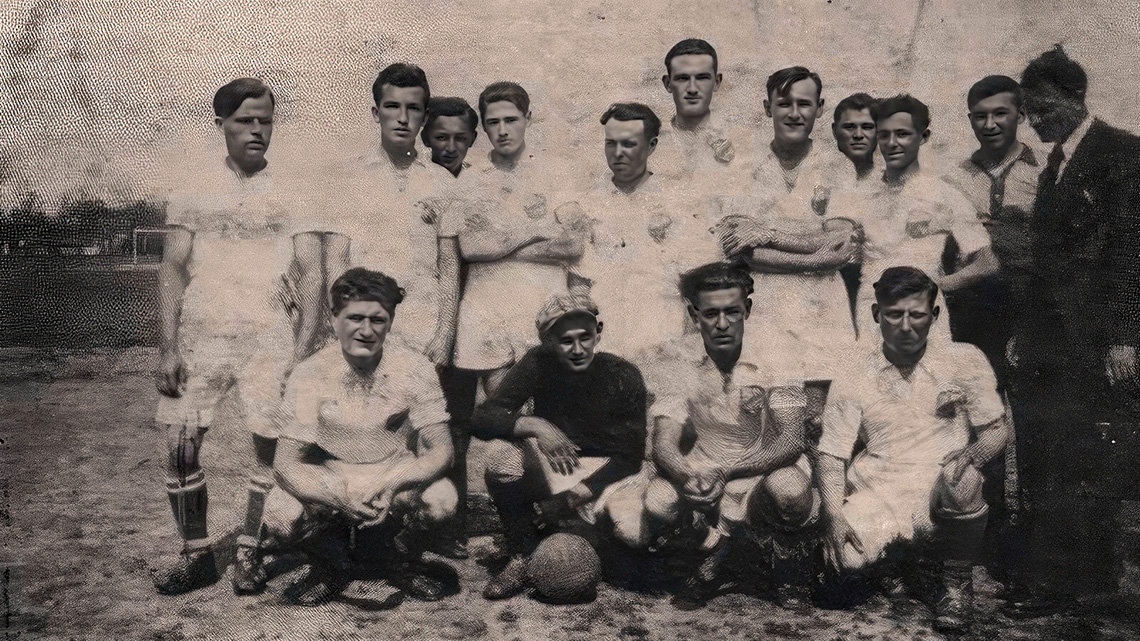
Football developed much faster after World War I than in the pre-war years. This is entirely understandable, as the years immediately following the war were a time of general enthusiasm, particularly in the economy, which served as a foundation for the development of sports as well. The development was faster in towns with Jewish and Hungarian populations, as the bourgeois class remained predominantly from these two nations even after the war. Clubs, officials, and players were mostly the same as before the war.
In the post-war period, Jews were the driving force behind sports activities in nearly every city of present-day Vojvodina. They had played a similar role before the war, but now their influence was even more pronounced, as the Hungarian community had been pushed back, and the Serbian population had not yet fully developed in education or had a significant presence in trade and crafts.
The involvement of Jews in football is evident from the fact that one of the first clubs in Novi Sad was Juda Makabi, in Veliki Bečkerec it was Kadima, in Subotica it was SAND, in Senta it was SAK, and in Pančevo it was PSK, all of which were predominantly led by Jews.
In Novi Bečej, Jews were also the key figures and initiators of post-war football activities. Along with the pharmacist Bizek, there was also the grain merchant Kenig, the owner of the brewery in Vranjevo Gerber, and others. They were not only part of the club's administration but also a significant portion of the players were Jewish. Thanks to their involvement, football in Novi Bečej had more favorable conditions compared to many other similarly sized towns. In the early post-war years, with high earnings in trade, maintaining a football club with modest expenses was a negligible sacrifice. However, football officials in Novi Bečej went beyond these modest conditions and established a relatively modern approach to players. More players were brought from outside, and besides employment, they were given special treatment, allowing them to take time off from work for training sessions.
After the war, TSE (Törökbecsei Sport Egylet) resumed its activities with the same management and players who had played before the war, joined by younger players who had matured for the first team. Goalkeeper Šipoš was still irreplaceable, with Šafranj as a full-back, and players like Štrebl, Reže Hauzer, Geza Farkaš, Laoi Farkaš, Tibor Štaud, and others. The club played matches against teams from nearby towns, such as Stari Bečej, Bačko Gradište, Mola, Ada, and even from Velika Kikinda and Veliki Bečkerec. A preserved poster from these early years advertises a match against the Molski Athletic Club.
The results of this first post-war club are unknown, but based on a report from Torontal on July 23, 1921, it appears the club had a solid lineup, as they drew 1:1 with VAC from Velika Kikinda in Kikinda, with TSE scoring the first goal through center-forward Farkaš from a cross by Štrebl.
Soon after this match in Kikinda, preparations were made by the end of autumn 1921 to merge the club, after ten years of existence, with the Sokolsko društvo (Sokol Society) in Novi Bečej and adopt its name.
Comments