



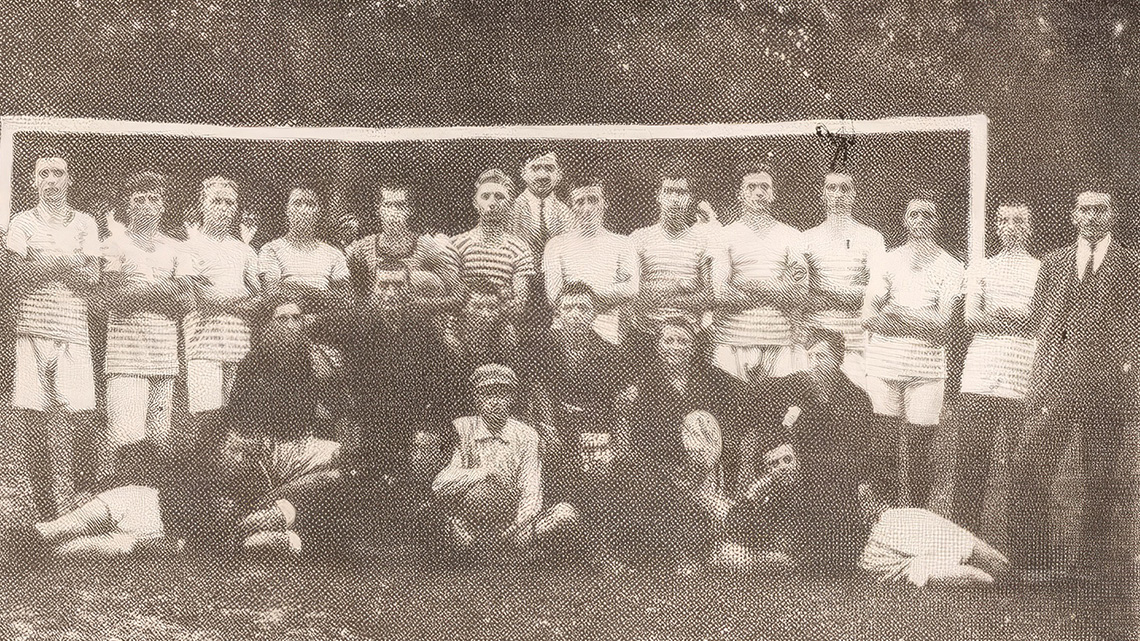
Football, as it is played today, emerged in England in the 1960s. University colleges in Oxford, Cambridge, Sheffield, and elsewhere revived football in 1840, but in a different form than it was played in London at the end of the 17th century. These few student clubs played football without any rules, and at that time, there was no distinction made between football and rugby.
The cornerstone for the development of football was laid on October 26, 1863, when the "English Football Association" was established, uniting all existing clubs. This organization created the rules of the game with 13 members. Since then, football has rapidly developed, and clubs have sprung up like mushrooms after rain. By 1871, the "FA Cup" competition had taken place. At that time, football was played with 14 players per team, and the goals were 5.5 meters high.
Professionalism in football emerged as early as 1883, and in 1885, it was confirmed by the governing assembly. It didn’t take long before it was established that the height of the goals was excessive, and in 1875, it was reduced from 5.5 to 2.44 meters. Soon after, a refereeing committee was established as a separate institution, and in 1890, the penalty kick was introduced into the rules of the game.
The first country on the European continent to adopt football was Switzerland. In Geneva, a large colony of Englishmen lived at that time, and the first club, "Servette," was founded in 1869. From Geneva, football spread to larger cities in Switzerland and then to neighboring countries—Austria, Germany, France, Italy, and so on.
By the 1880s and 1890s, football was being played in almost all major cities across Europe. It quickly "conquered" the entire world and became the most widespread sport. Clubs were founded, and matches were played. Football became a game for millions of people around the globe.
The popularity of football grows year after year. Not only does it "conquer" the most remote corners of the planet, but in countries and cities where it has been accepted for over a hundred years, it is becoming increasingly mass-oriented. More and more cities are building new stadiums and expanding existing ones. There is no similar phenomenon in modern history, not only in sports but in social games in general.
Football has overshadowed many sports, and for nearly an entire century, it has been regarded as the number one sport in Europe, and the same can be said for South America. It reached Asia and Africa later than other continents, but very quickly, after the independence of countries on those continents, football became the most popular sport with the most dynamic development.
It is no longer just a sport in the classical sense; it has become a powerful organization in the world at large, and in some countries, it has a significant influence not only on the education of youth but also on the entire superstructure and social life. It has become a powerful tool for economic and, even more so, political propaganda.
An extraordinary example in this regard is the twelfth World Cup held in Spain in 1982. The tournament took place at a time when international conflicts were swirling and threatening to escalate into large-scale wars. In such conditions, the President of the Italian Republic, Sandro Pertini, interrupted his state visit to France to attend the football matches of the Italian national team at the World Cup in Spain.
The final match between Italy and West Germany in Madrid was graced by the presence of the Spanish King Juan Carlos, who presented the trophy to the winner, along with the President of the Italian Republic Pertini, the Chancellor of the Federal Republic of Germany Schmidt, and many other high-ranking statesmen and politicians, including prime ministers, sheikhs, and prominent ministers.
Football has been and remains, like other sports, a means of fostering acquaintance and closeness among people of different countries. Frequently, footballers have been precursors to corresponding political and diplomatic actions.
Acknowledging such a role and the influence of football on moods and life around the world, it is necessary to highlight the development of football in the former Austro-Hungary, which included Vojvodina and thus Novi Bečej during the period of football's acceptance.
In multi-ethnic Austro-Hungary, this national diversity contributed to the rapid acceptance and development of football, a pace that few countries recorded at that time. Each nation wanted to demonstrate its strength, freshness, and superiority over others through football and healthy youth. Football provided extraordinary conditions for this, and for some nations at the time, it may have been their only opportunity to prove and assert themselves legally.
The fact that multi-nationalism was a factor in the rapid development of football in Austro-Hungary is evidenced by the fact that between the two wars, Austria, Czechoslovakia, and Hungary were by far the strongest footballing countries in Europe. In the 1930s, Italy joined them, but with "imported players" from Argentina, Uruguay, and other South American countries.
Thanks, among other things, to this circumstance, even though some nations were subjugated, football became popular in all corners of the Empire and quickly spread from larger cities to smaller ones and even to villages. By the beginning of this century, football was being played in almost every city in Vojvodina, which was essentially a peripheral province of Austro-Hungary. Thus, football was relatively quickly accepted in Novi Bečej, where it also appeared at the end of the nineteenth century.
Comments