



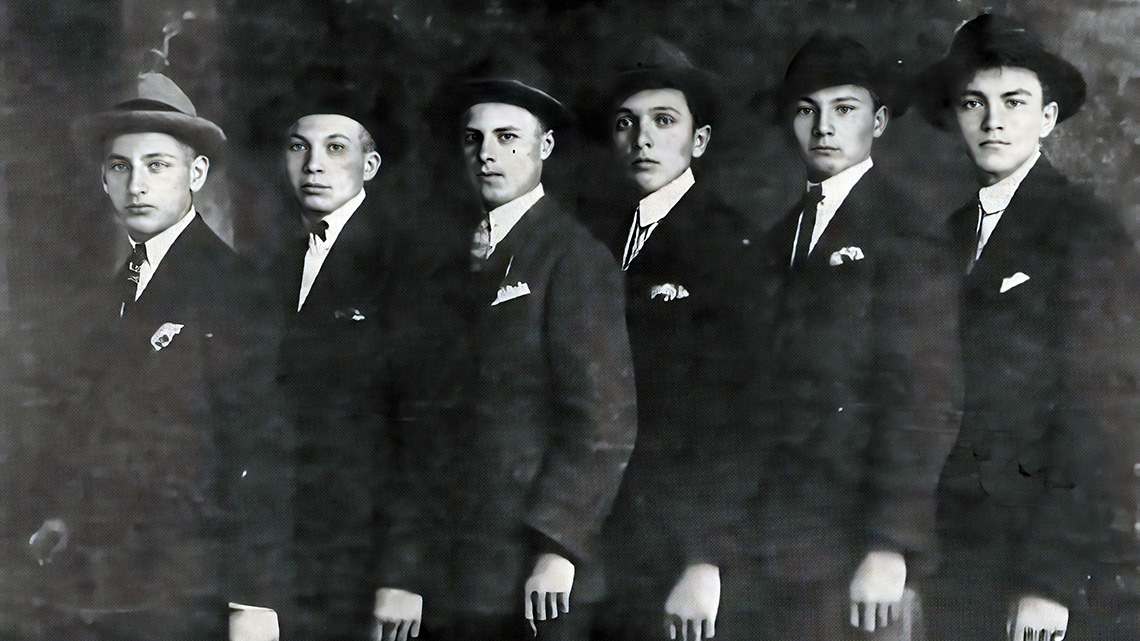
The people of Novi Bečej we spoke to know Soko as the club for Serbian youth who studied outside of the town. The club, however, has existed since the end of 1921. It was active until the autumn of 1927. In fact, at the end of 1921, the first TSE club, established in 1911, changed its name to Soko, and by the winter of 1923/24, it was renamed Građanski.
Soko continued to exist after the separation of Građanski, but under completely different conditions. Primarily, it was not registered with the Football Association, and "Torontal" reported on August 21, 1924, that Soko from Novi Bečej had not paid the necessary fee to join the Banat District, leading to a ban on clubs in the District playing against them. It became a student club, with its activities limited to the summer, during school holidays.
The years following World War I marked a turning point in youth education. Hungarian schools were replaced by primary and secondary schools with Serbian-language curricula. This created opportunities for broader education of Serbian youth. There was also an urgent need for Serbian teaching staff, which prompted many students from Novi Bečej to choose teacher training schools in Sombor and Vršac. In addition to the need for educational staff, there were no Serbian civil servants. All of this contributed to a rapid change in the national composition of students in the secondary schools of Novi Bečej.
These students, particularly from teacher training schools, came of age in the period when football was separated from the Sokolska society, forming Građanski. By the summer of 1924, they continued to play under the name Soko. At first glance, this appeared to be a continuation of the club founded in 1921, but as already mentioned, this was an entirely new structure, both in terms of players and administration. The first president of the Soko club was Žarko Čiplić, a teacher. Građanski was a club for the merchants and officials of Novi Bečej, while Soko became a club for students.
Serbs were increasingly involved in trade and crafts, which influenced further changes in the national composition of the bourgeois class in Novi Bečej. This also created the need for a space in football for Serbian youth who did not have the necessary skills to break into the Građanski team. Thus, Soko, as a club with modest ambitions, was well received.
In addition to Lalika Lenart, Deža Hauzer, and several older players who were reserves in the Građanski team, students such as Radivoj Markuš, Toša Pinćin, Jova Čiplić, Danilo Blažin, Boža Trećak, Ljubomir Ivančev, Milorad Majin — Bacika, Mališa Pavlović, Karči Štaud, and craftsmen like Draga Momirov joined the team.
As already noted, the slowdown in economic prosperity and the development of a more gradual economy led to the weakening of Građanski’s economic foundation, and with it, the club itself. By 1926, Građanski was barely surviving and ceased to exist in the winter of 1926/27.
In 1926, Soko had a fairly solid team, as, in addition to a few good players from the student ranks, Bata Teodorović from Veliki Bečkerek joined as goalkeeper, and Milan Tanurdžić — Isus, an already established player with Subotica’s SAND, also came. However, Soko was still weaker than Građanski, whose days were numbered.
In the autumn of 1926, Soko and Građanski played a true derby match, with a large number of new spectators and enthusiastic cheering. Građanski won 1:0.
In 1927, Soko achieved several significant victories, especially a notable 4:0 win over Radnički from Zrenjanin in Novi Bečej. According to Tanurdžić — Isus, who scored all four goals, Radnički was dominant throughout the match, but Soko scored goals from counterattacks. They also defeated Hajduk from Beodra, Tesla and Jadran from Stari Bečej, and played successfully in Čurug, Bačko Gradište, Molu, and Ada.
For Miša Kiselički, the unforgettable match between Soko and the newly formed Jedinstvo from Novi Bečej was a true derby. The crowd was split into two camps, and the match was lively and exciting. Soko won 2:1. According to Miša, this match was talked about for the next year as an unprecedented spectacle.
Comments