



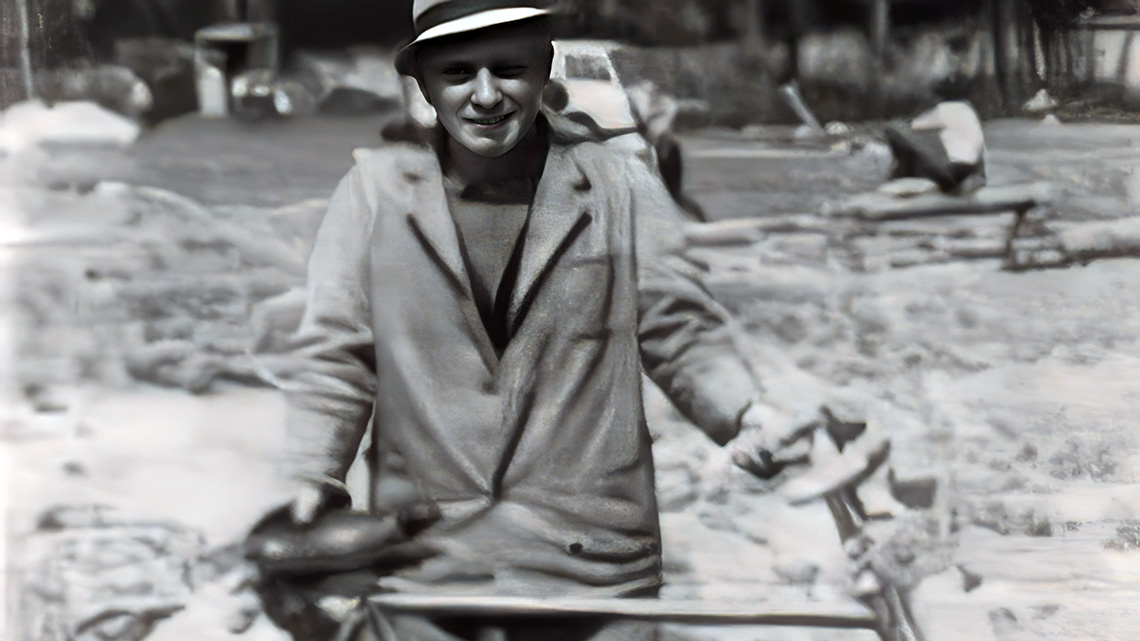
According to the accounts of Novi Bečej's oldest residents, who regularly attended football matches from their youth through to the present-day games of Jedinstvo, Građanski was the best football club in Novi Bečej before World War II. It is true that this strong team only existed for three years, but even such a short period left an indelible mark on the memories of its fans.
Emil Popović, born in 1904, attended all matches from 1924 until his death in 1981. He claimed that Novi Bečej only had a team as strong as Građanski during 1943 and 1944. The results achieved by Građanski were a great attraction for the audience.
Emil not only attended matches in Novi Bečej but also traveled with Građanski, and later with Jedinstvo, to neighboring towns, often by horse-drawn carriage or bicycle. He vividly remembered a match against Kadima from Veliki Bečkerek, in which Građanski triumphed with a score of 7:0. According to Emil, Građanski had several excellent players, and the team often played in the lineup:
Lakatoš, Kovačević (Čiča), Berger — Vig I, Nemet, Šimon — Laci Farkaš, Vig II, Jakubović, Geza Farkaš, and Proka Gaborov. Other players like Tibor Štaud and Erne Kraus also frequently appeared on the field.
A slightly younger witness, Gyrgy-Đurka Senaši, born in 1910, shared his enthusiastic memories of Građanski's games. Since his father worked as a municipal servant and their family lived near the town hall, Đurka became a regular football spectator from an early age. He followed all football events in Novi Bečej from 1920 onwards.
Đurka asserted that Građanski never lost a match in Gradište. Teams such as Soko from Stari Bečej, Srbija from Kikinda, and all clubs from Bečkerek would often lose in Novi Bečej, frequently by significant margins. He also recalled Kadima's 7:0 defeat against Građanski. Interestingly, these details aligned with those shared by Emil Popović, even though the two conversations were conducted separately. Both remembered Građanski's 7:0 victory over Kadima and other notable successes, such as a win over Subotica's SAND, one of Yugoslavia's top football clubs at the time.
In addition to the previously mentioned players, Đurka remembered Serenčeš and Nađ from Stari Bečej playing for Građanski.
Miša Kiselički provided a written statement about Građanski’s games, describing the club as excellent and composed of professional players. According to him, many of the recruited players were former members of Jude Makabi from Novi Sad. Thanks to this lineup, Novi Bečej's audience had the privilege of watching, as Miša put it, "great matches and displays of football mastery."
In championship matches, Građanski easily defeated all opponents, despite attempts to hinder its progress. Miša recounted an incident, also described by Senaši, that occurred in Kikinda during a return match between Srbija and Građanski, which Građanski won 1:0.
Following this victory, Građanski advanced to the final match of the Banat championship against Dušan Silni in Vršac. This game took place late in the autumn; although Kiselički mentioned 1926, historical records from the Zrenjanin archive confirmed it was October 19, 1924. While the exact date faded in memory, the events on the field and the result—0:1—remained vivid. According to Miša, Građanski played excellently, but the referee was biased toward the home team. The score was 0:0 until the final minutes when the referee awarded a penalty to Dušan Silni without justification. The penalty secured a 1:0 victory for Dušan Silni, crowning them Banat champions of 1924.
Similar memories of Građanski’s achievements were shared by Emil Lazić (born 1910), Vili Farkaš (1913), Bora Kovačev (1913), Mile Kiselički (1914), and many others who witnessed those unforgettable matches.
Comments