



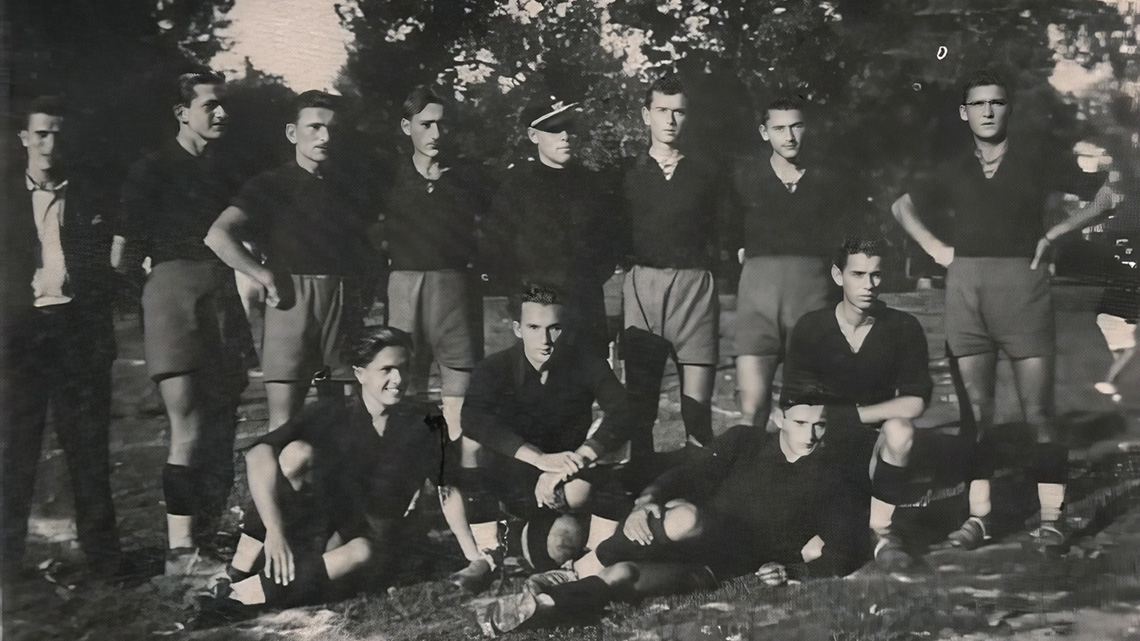
Thanks to the remarkable circumstance that one of our fellow citizens—Vladislav Kostović—was studying in London in the 1870s and brought back a football, football appeared in Novi Bečej as early as the 1880s.
There are no written records about this, nor about the year when it actually began to be played. However, based on statements from the oldest living residents of Novi Bečej during the period of data collection for this history (in 1980), documents from the Historical Archive in Zrenjanin, and information published in monographs about the emergence of football in neighboring towns, it can be asserted with considerable confidence that Novi Bečej was fortunate to be one of the first towns in Banat where football emerged.
Archival materials clearly show that in Vojvodina, the emergence and development of football were significantly influenced by both the size of the town and the national composition of the population. In the areas of Northern Banat, particularly Northern Bačka, football appeared earlier in places with Hungarian and Jewish populations than in those predominantly inhabited by Serbs and Germans. This is entirely understandable, considering that at the time, the intelligentsia, artisans, and merchants were predominantly from Hungarian and Jewish communities. All innovations of this kind were brought by students and pupils from larger cities to smaller ones, including villages.
In these regions, farming was mostly practiced by Serbs, Bunjevci, and Germans. Thus, in places where the population predominantly belonged to these nationalities, football appeared several years later.
This is further confirmed by the fact that, for example, the first football club in Senta was founded in 1905, while in Kikinda it was established in 1909. In Čantavir and Debeljača, where the population was of Hungarian nationality, football clubs were founded as early as 1911, which is a whole decade earlier than in the largest villages with Serbian populations. Perhaps Mošorin in Bačka represents an exception in this regard.
The national structure of Novi Bečej was such that football could appear there earlier than in towns with a different national structure, especially those surrounded by Serbian and German villages, where football was not yet played, making it difficult to find partners for inter-town matches. Without such encounters, football could not be an appealing game. Traveling by train was expensive at that time, and one could not rely on horse-drawn carts for long distances.
Novi Bečej had a particularly favorable position in this regard: the proximity of Stari Bečej was less than 4 km away, while Ljutovo and Bački Gradišt were about 10 km away, and Bačko Petrovo Selo, if approached via the summer route along the Banat side, was not far—approximately 15 km. In all these places, as well as in Novi Bečej, a significant portion of the Hungarian population was involved in trading and had to meet their and their families' needs in the market. This means they greatly contributed to the development of trade, which was an incentive for the settlement of Jews, who dominated commerce in Vojvodina at that time, especially in villages, leading to an early emergence of football in these areas.
All this is confirmed by an example from Novi Bečej itself, where as early as 1923, 7–8 Jewish football players from Bački Gradišt (two brothers Vig), Štrebl, Šimon, and Jakobović from Novi Sad, Pancer and Kraus from Novi Bečej, and Berger from Bačko Petrovo Selo were playing. They had already been playing football in their hometowns and, prior to arriving in Novi Bečej, also in Novi Sad at the then excellent club "Juda Makabi." The case of Berger and the Vig brothers confirms that they likely played as children in their villages before World War I when football was still unknown in Kumane or Melenci—entirely Serbian villages.
It is unfortunate that the writing of the memorial on the development of football in Novi Bečej comes with considerable delay, as most contemporaries of the emergence of football have already passed away. However, it is never too late, and tomorrow can always be later, so considerable effort was made to extract the maximum information from the remaining oldest residents of Novi Bečej who remember certain events. Perhaps we were able to collect precious data based on their memories at the last moment. These statements were verified through mutual comparisons and by comparing them with data later collected in the Historical Archive in Zrenjanin, and it was a great joy to find that these statements were largely objective and even completely accurate in many details.
We visited several eighty-year-olds multiple times, who have followed or actively played football since their early youth, to encourage them to reflect on the past and provide us with as much information as possible for making realistic assessments, and of course, to verify their earlier statements.
These elderly individuals made a great effort to recall as much as they could from the distant past, their memories now quite faded, and naturally only about what they were convinced truly happened, which was not at all easy. Thus, we obtained statements from three eighty-year-olds, all born in 1896 (what a coincidence), as well as around ten others who had long passed their seventieth year. Precisely because we value this effort, we feel obligated to include their statements, particularly that of Milorad Vlaškalin, who was born even earlier, in 1889.
According to the late Vladislav-Lacika Kostović, he brought the first football to Budapest while returning from his studies in England. At that time, perhaps a little earlier or later, he also brought the first football to his hometown, where his parents lived, in Novi Bečej.
Kostović was born in 1854 and studied in London around the 1880s, so it can be assumed that he brought the first ball to Novi Bečej during that period. Of course, initially, and for quite some time, it was a game played exclusively by a small, economically privileged group of students, only when they were on summer holidays in Novi Bečej. Perhaps football remained almost unknown to the wider youth of Novi Bečej until the end of the 19th century.
Milorad Motok, a retired teacher born in 1896 in Kanjiža, who came to Novi Bečej in 1905 as a nine-year-old, claims that even that year, football was played in Gradište (a grove by the Tisa River), using a ball similar to today’s. He does not recall whether matches were held, but he knows that there were wooden goals and a playing field where football was played with two goals. Thanks to the fact that Motok came to Novi Bečej during those years, to a then-rare family of Serbian intellectuals, which made Gradište accessible to him, his memories—gathered long after the fact—are invaluable.
If Motok had been born and raised in Novi Bečej, it would have been difficult for him to precisely determine the year when football started being played there. However, his recollections are infallible because that was the year he moved to Novi Bečej, and those first encounters—with everything that surrounded him in his new environment—remained indelible. His statement and data are all the more valuable because they were provided by a particularly serious man, mentally very sharp, who was otherwise not interested in football, and therefore had no reason to fabricate stories to highlight himself as a once sports-involved resident of Novi Bečej.
Ištvan Sič, a former clerk of the Water Cooperative in Novi Bečej, born in 1896, recalls that in 1906 or 1907, while going to Gradište, he saw young men playing football with two goals. He particularly remembers that a clerk in the county court, a certain Margitai, had such a strong kick that the ball would go high over the poplars that surrounded the playing field. Sič, like Motok, did not play football nor was he interested in it. His first visit to Gradište should be taken with some reservations. It must have been much earlier, as there was no child in Novi Bečej who, with their parents or friends, hadn’t already been in Gradište since the age of seven or eight. This was simply because Gradište was, so to speak, in the center of Novi Bečej, and was attractive to both the oldest and the youngest. Fortunately, since he was not interested in football, he had no reason to make up stories, and if he misremembered the year of his first visit to Gradište, it is easy to explain because it was just an ordinary experience in the environment where he grew up.
Assuming that Kostović brought the ball in the 1880s and that, according to Motok's statement, there was a playing field with goals in Gradište as early as 1905, it can further be inferred that it existed for several years prior. It should not be interpreted that Motok went to Gradište in 1905 precisely when the playing field was marked and the goals erected, but rather that he found them there that year.
There is no doubt that this playing field and the stable goals were preceded by play on a small meadow, and perhaps that meadow was precisely Gradište, where the goals were initially parts of discarded clothing or hats. That period of using clothing as goals before transitioning to wooden posts and crossbars was likely quite lengthy. Football must have attracted older players, or when those who first played it had already grown up, they would have been ready to invest financial resources to purchase lumber to transport and build the goals on the playing field.
Our aim is not to impose an earlier start date but to establish as accurately as possible the year when football began to be played. Of course, we do not want to go to the other extreme, accepting as the first year one that could have been several years after the appearance of the first football.
Considering the rapid spread of football across the globe, if we accept that Novi Bečej already had a marked playing field and wooden goals by 1905, it is very likely that the first ball appeared and football was played on a meadow with goals marked by pieces of clothing or bricks during the period when Kostović returned from his studies in London, somewhere in the 1880s. With his subsequent departure from Novi Bečej to Budapest, Belgrade, and other cities for work, football may have faded or receded, only to be brought back by someone else to Novi Bečej’s Gradište after a few years, where it has been played since the end of the last century, more precisely since 1899.
The first football was brought to Veliki Bečkerek (Zrenjanin) in 1889, which further supports the assumption that football also emerged in Novi Bečej around that time. This information was taken from the Historical Archive of Zrenjanin, although the issue of the "ToTontal" newspaper from May 19, 1889, speaks of a ball game, which was indeed a proper football, but the game was not real football; it was more like just kicking a ball around.
Later, the newspaper "Torontal," in issue no. 77 from 1903, on page 2, reported the following: "The management of the association calls on the youth to appear tomorrow afternoon in full numbers and on time, as regular football training will commence, which will be held every Sunday under the guidance of Ostija Bela, a state teacher."
If this news mentions regular training under the supervision of a state teacher, then it is likely that football was played in Veliki Bečkerek in the last years of the past century, albeit unorganized, on a meadow just like in Novi Bečej. The fact that students from Veliki Bečkerek played their first official match in Novi Bečej, and not in Velika Kikinda, Žombolj, or Pančevo—places that were larger than Novi Bečej—indicates that football was also being played in Novi Bečej at that time.
The first inter-town encounters were preceded by public performances in mutual games between two groups of young men from Novi Bečej, which likely followed immediately after the establishment of stable goals and marking of the playing field, as this was probably the motivation to mark the field and erect the goals. It is likely that encounters with youths from other towns did not happen so quickly. First, a group of young men who played football needed to be established, and then an older group would arrange matches and provide the necessary conditions for them.
In assessing and determining the year of the first matches played with youths from other towns, it was taken into account that football was played only in the summer, when students studying away from home were back at their homes in Novi Bečej, and then during the year, no more than one or two matches were played. The entire season, or even two, was prepared and lived for one such visit, or for hosting guests to play a match.
These visits were a special incentive for playing and preparation; it is logical to assume that they could not be delayed for long, as otherwise, football as a game would have become uninteresting, and its existence would have been jeopardized. As football was maintained and developed, it is certain that a group of boys from Stari Bečej visited Novi Bečej, which could have happened without any cost, as it was easy to walk the 4 kilometers that separate Novi from Stari Bečej via Ljutovo.
This could have happened in the very first years of this century, but it was all unofficial—an agreement among the boys—so consequently, it did not remain in the memory of any living resident of Novi Bečej. Indeed, Laslo Rigo's statement suggests that the visit of youths from Stari Bečej must have occurred before their official encounter in 1912 in Stari Bečej, but such a significant date cannot be based solely on assumptions; it must have some more secure foundation.
The first official football match in Novi Bečej was played on August 1, 1909, between the students of Turski Bečej and Veliki Bečkerek.
Regarding this match, the "Torontal" newspaper on August 3, 1909, wrote on page 3 under the title "Football Match Between the Students of Veliki Bečkerek and Turski Bečej," stating: "The Veliki Bečkerek student team visited Turski Bečej on Sunday afternoon, where they achieved victory over the local student team with a score of 2:0. After the match, a cabaret performance with a dance was held. The rematch will take place on the 14th of this month."
Here, the term "students" should not be understood as students from Novi Bečej schools, as Novi Bečej then only had an elementary school and the first and second grades of a newly established civic school; these would be young boys who were to compete against the Bečkerek students from higher grades of the gymnasium. These were students from Novi Bečej who studied outside of Novi Bečej and returned home for the summer holidays, which is also confirmed by the timing of the match (August).
Due to the entertainment and dance that was organized in honor of the visiting players from Veliki Bečkerek, we believe that this was indeed the first official encounter with a team from another town, as it was given such significance. The cabaret and dance were not organized solely by the Novi Bečej students; prominent older representatives of public life in Novi Bečej must have participated, and perhaps even representatives of the state authorities.
This was also the first official match for the players from Veliki Bečkerek, as mentioned in the following report published in "Torontal" on August 9, 1909:
"The rematch between the teams of Veliki Bečkerek and Turski Bečej will take place in Veliki Bečkerek on August 14 under the patronage of Dr. Vincehidi Erne—county chief clerk—at the student playing field. The match will start at 5 PM. Tickets purchased in advance are 50 fillers, while at the box office, they are 1 crown."
The significance of this first match in Veliki Bečkerek is underscored by the fact that the county clerk himself accepted the patronage, being the highest authority in the social and political life of Banat. It is true that Dr. Vincehidi, while still a student, brought the first football to Veliki Bečkerek in 1889, so he was likely interested in ensuring that the date of the first official match was specially commemorated and remembered by the citizens.
The rematch took place on August 14, 1909, about which "Torontal," in issue no. 185 on page 2, reported: "Yesterday, the rematch between the students of Veliki Bečkerek and Turski Bečej was held at the playing field near the barracks. The Veliki Bečkerek team won with a score of 4:0. Despite their nice play, the Bečej team could not manage to score. After the match, a very successful entertainment event was held."
These reports from "Torontal" are cited to preserve the record of one of the most significant dates for the development of football in Novi Bečej. This way, it will remain entirely accessible to everyone, so that later, if needed, the archival material in Zrenjanin does not have to be searched again. Furthermore, this information is all the more important as it also marks the first match for the Veliki Bečkerek (Zrenjanin) footballers, and it is an honor for Novi Bečej that the first match was played against representatives of the county center and the largest city in Banat, with Novobečejci being the first football team to visit Veliki Bečkerek.
Perhaps it may be criticized that we did not consider the matches against the youths from Stari Bečej as the first match in Novi Bečej, even though it is assumed that those encounters occurred earlier. It is not significant whether the match was played a year or two earlier or later, but in this case, it is important to use a reliable fact rather than an assumption. Since we have archival material available, I opted for the written record.
Therefore, the first football match in Novi Bečej took place on August 1, 1909, between the students of Turski Bečej and Veliki Bečkerek, and it was marked as an extraordinary event celebrated in a festive manner.
Comments