



It may sound a bit unusual, but it is true that no Novi Bečej resident, when describing the beauty and appearance of their town, fails to start by talking about the Tisa River and Gradište. Gradište was a small forest of towering poplars and oaks. Its name likely derives from the ruins of an old fortress (town), the walls of which lie in the Tisa River, with only a small portion emerging when the water level drops. It is believed that the town was built between 1300 and 1320, and in the early 15th century, it was held by despots Đurađ and Stevan Branković. According to the terms of the Treaty of Karlowitz, it was destroyed in 1701.
The forest was located next to the Tisa River—between the riverbed and the embankment, which protects Novi Bečej from floods. It stretched from the ferry landing, today’s exit to the Tisa River from Svetozar Miletić Street, to the ruins of the old town, over a distance of about 1 km, and in its broader part, it was 200 to 250 meters wide. The majority of the forest, closer to the center of Novi Bečej, was planted with poplars, while the area towards the ruins of the town was covered with oak trees.
In the central part, the forest was cleared and transformed into an open space where a football field was located. Near the embankment, a well-maintained tennis court was also found.
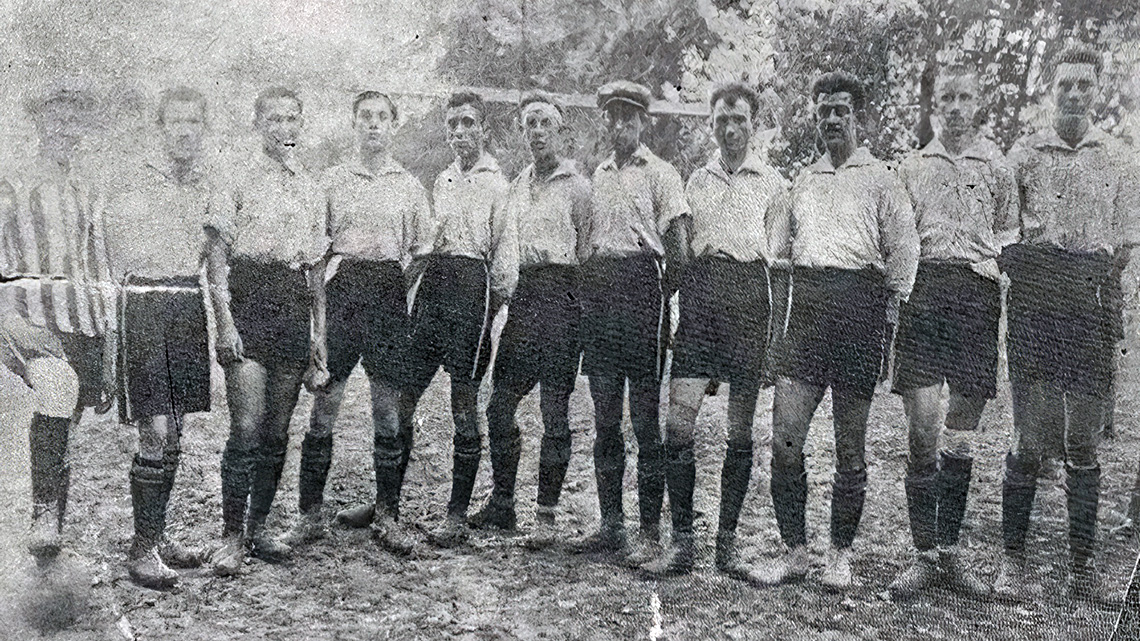
Immediately upon entering Gradište, there was another open space surrounded by poplar trees, where the Sokolski gathering for the Novi Bečej district was held once a year. This area also served as a training ground for the players of the two football clubs in Novi Bečej, Građanski and Soko.
Football emerged and developed in Gradište due to its excellent location. The close proximity of the Tisa River allowed players to cool off in the river during the summer heat or, conversely, enjoy football, tennis, and other sports in the cool shade of the poplar trees. Additionally, Gradište was conveniently located near the town center. If it had been situated elsewhere, the forest would have been far from certain parts of the town, making it less attractive for sport—especially considering the prevailing interest in sports at the time.
Gradište left an unforgettable impression on all who visited Novi Bečej, especially visiting football teams. During the hottest summer months of July and August, matches were held in Gradište starting at 4 p.m. so that the visiting teams could return home on evening trains. Without the shade provided by the poplars, matches could not have been played in such early afternoon hours, and it is safe to say no spectator would have wanted to spend two hours in the summer heat.
In the 1930s, a small house on concrete pillars was built by the Tisa River, next to Gradište. In the final years of Gradište’s existence (the Gradište forest was cut down in 1948), it served as a changing room for football players and swimmers. The building had two beautiful rooms and a spacious hallway running the length of the house. This modest house itself harmonized with all the unforgettable memories that Gradište provided—not only to Novi Bečej residents but to everyone who visited Gradište, especially during the summer months.
Sadly, it must be said—despite the deep affection for Gradište—that it was one of the reasons for the modest success of Novi Bečej football. Almost every year, the Tisa River would flood Gradište, and the water would remain there from April to May, sometimes even until June, leaving the Novi Bečej footballers with a rather short pre-season for their upcoming competitive matches.
The love for Gradište never allowed anyone to consider moving the playing field elsewhere. There was constant fear that, if relocated, the matches would attract fewer spectators.
Comments