



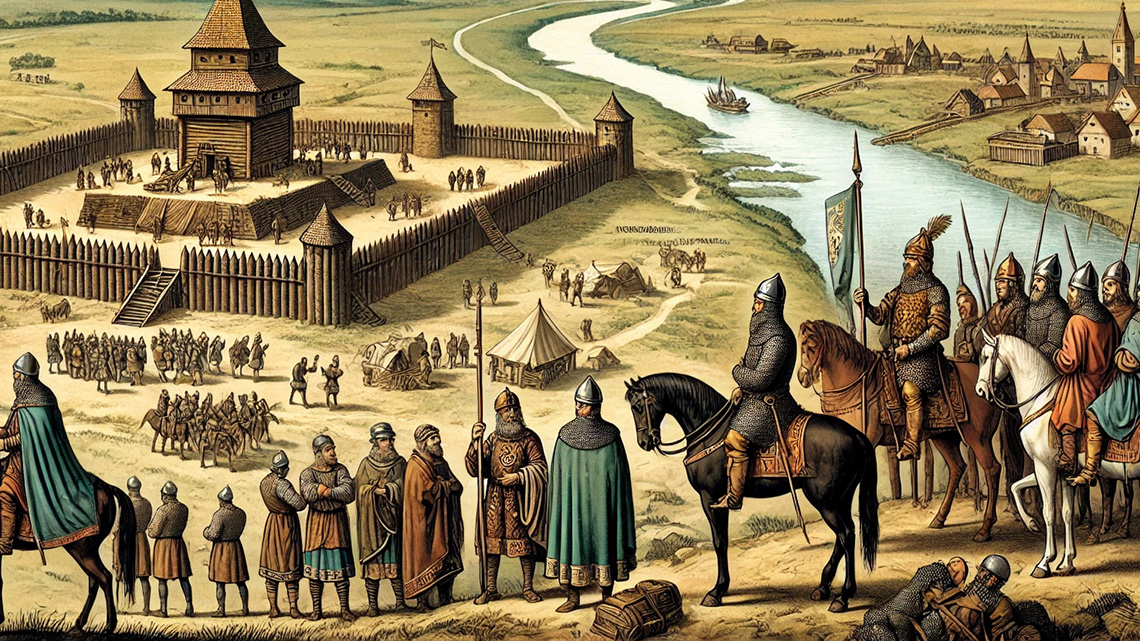
As I mentioned in the book "Novi Bečej and Vranjevo through History from the Earliest Times to 1941," it is not known when and how Novi Bečej got its name, or who founded it and when.
Dr. Sentklaraji, in his book *The History of Parishes of the Diocese of Csanád*, suggests that perhaps, after the fall of the Roman settlement, it was the Cumans who laid the foundations of present-day Bečej. He refers to the following:
"Our historians write that during the reign of Saint Ladislaus, the Cumans ravaged from Tokaj all the way to the village of Beche by the Tisza."
He further claims that during the period we call the era of Saint Stephen, Bečej may have been in its infancy, but that it already existed as a settlement, and that some of the Christian propagators, led by Saint Gellért, preached the Christian faith there.
At that time, or perhaps somewhat later, during the period of the introduction of Christianity among the Hungarians, two families from the French tribes of Beche and Gregor settled in this area. They played a significant role in the religious sphere in this part of Hungary and gave their names to the places they inhabited. The name Beče (Becse) is allegedly the result of a misreading by the Hungarians of the name Beche. Thus, the first owners and rulers of Bečej, after whom it likely got its name, were Beche and Gregor, and later their descendants.
In contrast, in the *Etymological Dictionary* by Petar Skok - Zagreb, 1971, it is stated that the word "Becs" is of Cuman origin, and it is likely that Avarian earthen fortifications were called by this name.
According to some data, the Slavs adopted this word as a term for fortifications made of earthen embankments. The Hungarians, upon arriving in the Pannonian Plain, adopted this term as a designation for fortifications that protected river crossings.
Since Sentklaraji, in his aforementioned book, emphasizes that the area where Novi Bečej is located has always been suitable for connecting the left and right banks of the Tisza, it can be assumed that this crossing was also secured by an earthen fortification called "BECSE," just as the Avars referred to such fortifications. This is supported by Sentklaraji's statement on page 302 of the same book that Bečkerek (Zrenjanin) was originally also known as Bečej, according to István Horváth, and that it was owned by the French family Becse. On page 303 of the same book, Sentklaraji states:
"In the early stages of its reestablishment, Bečej was annexed to the former Bečej County, about which little evidence remains. The Bečej County likely got its name from the present-day Veliki Bečkerek, which was also once called Becse."
Because of Sentklaraji's remark, "about which little evidence remains," these details were not highlighted in the book *Novi Bečej and Vranjevo through History from the Earliest Times to 1941*.
However, we emphasize them here, as it seems there is some basis for the belief that Bečkerek also got its name from an earthen fortification that protected the important route from Transylvania to the mouth of the Tisza into the Danube.
All this raises doubts about the sources that link the origin of the name Becse to the French family Beche. Especially considering that there is also a village called Siget Becse on Csepel Island, a region in Veszprém County, and Becsehelv in Zala County, in the far west of Hungary. These areas cannot be connected to one another as they are far apart, making it seem almost impossible that these two French families were the only ones spreading Christianity throughout Hungary. This is unacceptable, given the transportation conditions of the time and the hardships and slow pace of spreading Christianity among the pagan population.
In practice, the opposite often happened. Individual feudal lords and noble families would take a predicate or surname based on the name of the region where their estates were located, and this might be one reason why it seems that Bečej did not get its name from the Beche family, but rather that the family took their surname from Bečej.
I present all this because it seems more plausible to me, and so that future researchers of the origin of the name Bečej will take these insights into account.
Comments