



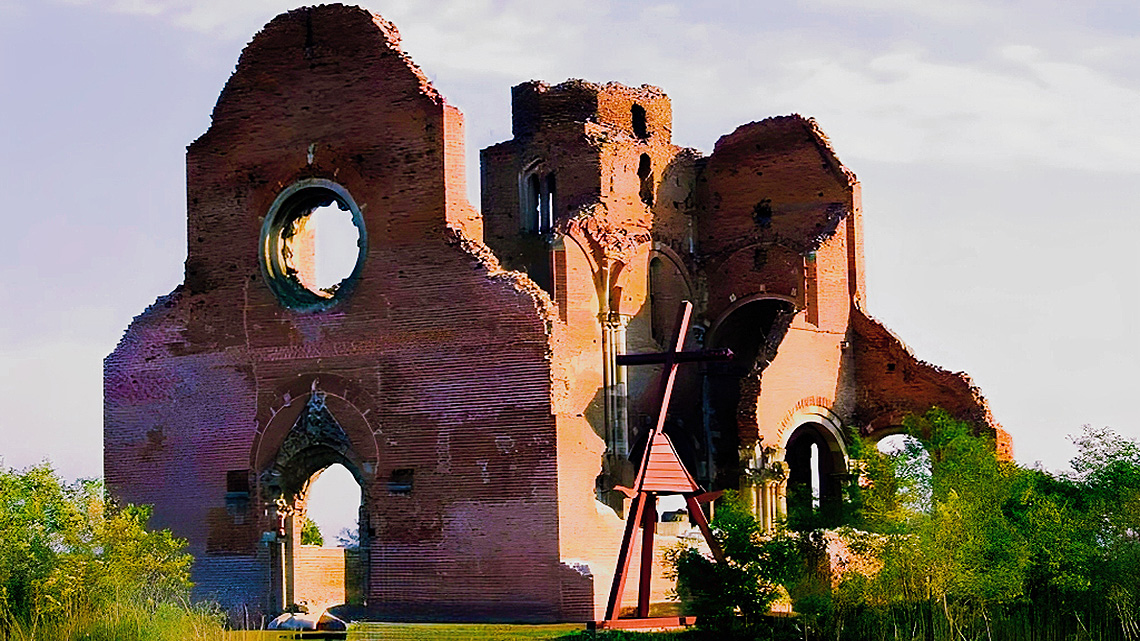
Arača: about 14 kilometers northeast of Novi Bečej - 4 kilometers right from the Novi Bečej - Novo Miloševo road, lies Arača, one of the significant monuments of medieval architecture in Vojvodina. From the former settlement, only the ruins of a Romanesque church - a basilica of the Dalmatian - Benedictine type - remain. This church was destroyed twice but has preserved some of its massive parts to this day, which can serve to study the cultural history of our people. Consequently, it was placed under state protection (by the decision of the Republican Institute for the Protection of Cultural Monuments No. 217 dated February 16, 1968).
Archaeological research reveals that the Arača complex and its immediate surroundings were inhabited as far back as prehistoric times (Neolithic and early medieval settlements). The original church seems to have been established in the 11th century and is presumed to have been a parish church or chapel.
The remains of the current Benedictine abbey from the first half of the 13th century (around 1228) were built in the Romanesque style. It was a representative three-nave basilica with three semicircular apses (the rear semicircular part of the church), divided by manual arcades with semi-columns. The building materials used were bricks, cut stone - sandstone, and marble. It was built by an unknown Hungarian feudal lord. This church suffered in wars and was restored by Hungarian Queen Elizabeth, the daughter of Stephen II Kotromanić, in 1370, when the Gothic bell tower was added, and probably more stone sculptures as well.
Arača had a tumultuous history. In the late Middle Ages, a defensive fortress was built in its complex, which has left no trace on the surface, and may only be discovered through further excavation. This fortress was in the possession of Despot Stefan Lazarević in 1417, and later held by Đurađ Branković. In 1551, the Turks under the command of Mehmed Pasha Sokolović conquered and burned Arača during their invasion of Banat. After this destruction, Arača gradually decayed until the end of the 19th century. In the 19th century, it belonged to the Karačonji estates from Beodra, when the Hungarian Commission for the Protection of Cultural Monuments undertook minor conservation measures, which were not very effective. Stone sculptures and other building materials were ruthlessly scattered in the surrounding areas, and some fragments can be found in various museums.
In recent years, some measures have been taken to protect Arača, but that will be discussed later.


Comments