



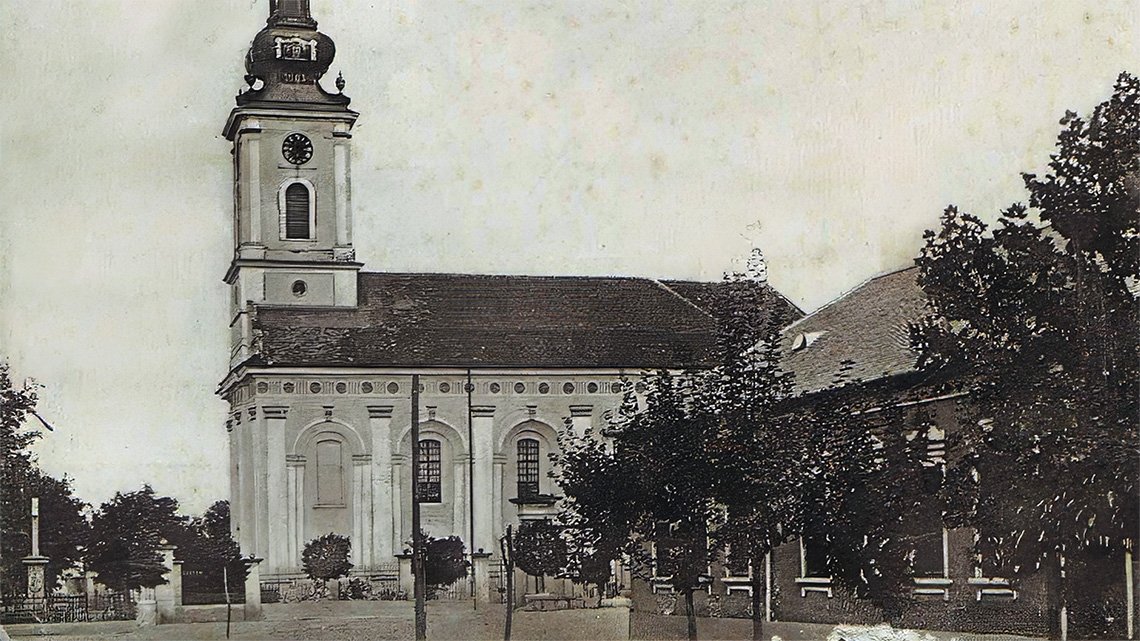
Here, we must address the claims made by Mr. Kasaš in the book *Greetings from Novi Bečej*, as they are completely unacceptable. On page 14 of the mentioned book, he writes:
"Vranjevo, which is mentioned for the first time in historical sources in 1717, will become part of it under the name Franijevo. However, its inhabitants will mostly use the Slavic variant Vranjevo until 1888, when the place changes its name to Arač..."
"There are several interpretations of the origin of the name Vranjevo, but two are particularly interesting. One is that the place got its name from the large number of crows, which can still be seen today in large flocks in the Vranjevo area. The second is that it was named after Serbs who migrated from the surroundings of Vranje during the 1690 migration."
The inaccuracy of this data is proven by several historical sources. Here are just a few:
Vranjevo is mentioned under the name Vranjevo as early as the 14th century. Dr. Jovan Radović, in his book *Banat*, Vol. 25, St. Sava, Bratstvo XV, Belgrade 1921, on page 124 under the title "Revival of the Serbian Element in Banat," writes:
"After the Battle of Kosovo in 1389, Serbs retreated from the Turks north into Banat towards the end of the 14th century under the leadership of Dimitrije, son of King Vukašin. However, Banat was systematically settled by Serbs only under Despots Stefan Lazarević and Đurađ Branković. As vassals of the Hungarian kings, they controlled most of the Torontal County with the fortresses of Bečej and Bečkerek... they also had the towns of Velika Kikinda, Vranjevo, and Bašaid."
Similarly, Dr. Dušan Popović, in his study *Serbs in Vojvodina*, Book One, from the earliest times to the Peace of Karlowitz in 1699, Novi Sad 1957, page 42, writes:
"The fact that the inhabitants were Serbs is evidenced by settlements recorded up to the 16th century in Torontal County, including Vranjevo and Jabuka."
Dr. Sentklaraji, in his book *History of the Parishes of the Csanád Diocese*, writes about Vranjevo:
"In the northeastern part of the municipality near the village of Akč, a branch of the Tisza river stands out... on the once navigable part along the left bank of this river extends the wasteland Vran... During the Turkish occupation, Serbian shepherds lived on this Vran wasteland, who called their settlement of a few houses Vranova."
"After the victory at Senta in 1697, this area was freed from Turkish rule. After the migration, Balkan Serbs under Patriarch Čarnojević settled in places along the left bank of the Tisza, where they found good prospects for living. Serbian families also settled in Vranovo."
This situation lasted until 1717. At that time, Mégse organized the province named Tamiš Banat. For the defense of the province, particularly to protect the Tisza and enable communication in the Bečkerek district, a military frontier of six companies was formed. One of them was Vranova. Since the place was far from the Tisza, the provincial government relocated the Serbian peasant militia in 1726 to a ridge between the ruins of the Bečej fortress and the lake Bak near the pier on the Tisza called Gustoš."
Therefore, what Dr. Radović, Dr. Popović, and Dr. Sentklaraji have recorded unequivocally shows that Vranjevo, under that name, existed long before the great migration under Arsenije Čarnojević in 1690. Hence, Mr. Kasaš's claim that it was first mentioned in 1717 is incorrect. The assumption that the name originated from refugees from Vranje, who came during the migration under Čarnojević, is also false.
As for the origin of the name, we find Branko Belić's explanation from his work *Contribution to the History of Beodra and Dragutinovo*, Novo Miloševo 1995, the most acceptable. He based it on the old pre-Christian religion of the Slavs, according to which the left side was always called "black," and the right "white." Thus, river flows were named accordingly. The left branch of the same river was called "black," and the right "white." This is the case with our rivers Timok and Drim. Similarly, in Bulgaria, with the rivers Lom and Vit. However, in Hungary and Romania, the river Kereš has the opposite names—White Kereš is the left branch, and Black Kereš is the right one.
Belić, starting from the Slavic approach to the left and right branches of a river, derived the names for Beodra and Vranjevo. The stream Galacka, coming from Romania, flowed below Kikinda and present-day Novo Miloševo, joining the Tisza. After entering the alluvial plain of the Tisza, it split into two branches. One flowed south, and the other north. "The southern, left branch was called Vran, Vranjaš, in the old Slavic meaning 'black,' and flowed into the Tisza near the present-day settlements of Vranjevo and Bečej. The northern, right branch was called Beo, from which the name of the village Beodra originated."
This explanation seems acceptable as it is based on terms explained in Petar Skok's *Etymological Dictionary*, where Volume III states:
"Vran, adjective, is a Pan-Slavic and Proto-Slavic term meaning dark, vran in Russian meaning crow, in Sanskrit 'varanas' (black color). The term also appears in Ugro-Finnic languages, 'Vran' in Samoyedic means 'crow.'"
It is not excluded that all this could be linked to crows, as they were named after the word "vran" meaning black. For us, it is crucial that the name Vranjevo originated from this root.
It is false that the original name of the village was Franjevo, as this name was introduced much later. According to Dr. Dušan Popović, it derives from the dynastic names of the Austrian court, in this case, after Francis of Lorraine, husband of Maria Theresa.
The Hungarians changed the name of Vranjevo to Arač (Aracs) in 1888 to erase the Slavic-Serbian name forever, removing the evidence from people's minds that this place, if not originally, had always been inhabited by Slavs—specifically Serbs—and that the name Vranjevo had a Slavic origin.
I will illustrate the Hungarian authorities' tendencies with a personal example. An excerpt from the birth registry issued on May 29, 1991, in Kumane shows my name as Lazar Mečkić, son of Tivadar (his real name is Boško) and Hajnalka (her real name is Zorka). To prove these facts, I will present excerpts from the Serbian Orthodox Church's birth and baptism records in Kumane from January 17, 1947, clearly showing my parents as Boško and Zorka, along with the birth certificate issued in Kumane on May 29, 1991. Why Mr. Kasaš falsified the data about Vranjevo, I leave for the readers to decide.
On page 15, Mr. Kasaš writes, among other things:
"After the demolition of the Bečej fortress, Turkish Bečej began to develop next to Vranjevo, where the majority of the population was Hungarian."
It is hard to accept this falsehood as ignorance or superficiality and remain indifferent to it. If left unchallenged, it could become a source of knowledge for future generations.
Here’s what Dr. Sentklaraji writes about it in his book *History of the Parishes of the Csanád Diocese*:
"After the expulsion of the Turks, documents from that time show that the name Turkish Bečej (Torok Becse), and sometimes Novi Bečej (Uj Becse), began to be used. Maria Theresa elevated it to the rank of a market town, granting it the right to hold fairs.
At that time, the settlers of Novi Bečej were exclusively Serbs, who had their parish there as early as 1685, and by 1731, they had built a church. In 1731, it had 13 priests and three deacons."
According to the Zrenjanin Diocese’s data, Prelate Dr. Tibor Geczy, in response to my question about when Hungarians settled in Novi Bečej, writes:
"It is difficult to provide precise data on the year when the first Hungarians settled in Novi Bečej after the expulsion of the Turks, but from the archive for the parish of Novi Bečej, it is clear that the first settlers came from Szeged and Belgrade. It is stated that the settlers from Belgrade were craftsmen from various parts of Hungary and that they settled in Veliki Bečkerek and Novi Bečej from Belgrade..."
This settlement of Hungarians from Belgrade took place after the defeat of the Austrian army by the Turks in 1737 near Grocka.
According to Dr. Sentklaraji in the aforementioned book:
"Until 1747, the Catholics of Novi Bečej, and
after that year of Vranjevo as well, were only a small colony."
Dr. Geczy further confirms that:
"By 1779, the Hungarians already had a sufficient number of parishioners to build their first Catholic church. However, at that time, the number of Catholic settlers was still very small."
It wasn’t until after 1837 that the Hungarian population began to grow.
So, the claim that the majority of the population in Vranjevo was Hungarian is not only false but also malicious.

Comments