



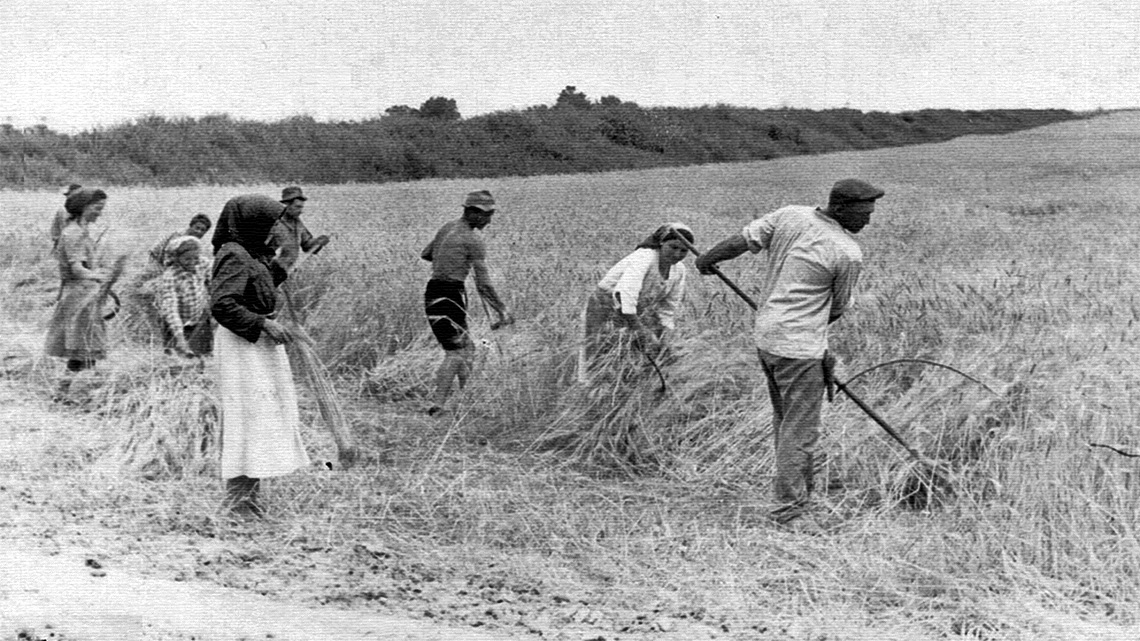
Whenever I think of Novi Bečej and Vranjevo, I simply see the beauty of the humble, yet so dear to me, houses and streets, and our blessed fields and meadows. These meadows and pastures inspire in me a desire to create. In my mind, I often see herds of horses or cattle, and in the distance, the outlines of farmhouses on Berek, just as they looked in the days of my youth. I enjoy this thinking and admire those beauties.
It should be known that Novi Bečej and Vranjevo, at that time (the time of my youth in the 1930s-40s), had 3-4,000 horses, just as many, if not more, cows and oxen, 7-8,000 sheep, thousands of pigs, and the number of birds and their diversity, then and now, I cannot even begin to estimate.
The plains fields are beautiful even without the herds of horses, cattle, flocks of sheep, and flocks of marsh birds, but with them, they gain something that can no longer be experienced or conjured up, something that can only be seen in films made on the vast expanses of America and Africa.
In the time when fieldwork stops - the second half of May until the end of June, there are over a thousand horses in the herds in Vranjevo, and somewhat fewer in the pastures of Novi Bečej. From May to October, there are a thousand cows on what is called night pasture (where they stay both day and night), and just as many on the nearby pastures where dairy cows are driven to graze in the morning and returned home in the evening for milking and night. Village cowherds blow their horns in the morning, a little before 6 o'clock, to signal the housewives to drive the cows out to the street so that the cowherds can take them to the nearby pastures for grazing. They do this always at a specific time, so the housewives can milk the cows and do other chores before driving them out to the street for the cowherd to take them to graze.
As a five-year-old child, I envied the cowherd for having a horn and for making such a strong and beautiful sound by blowing into it. In connection with this, I will tell a little episode from my early childhood, from that age. Since my earliest childhood, I have been an early riser. I woke up as soon as dawn broke and heard my mother getting up and starting her daily chores around the house. My mother was not thrilled with this trait of mine, as I often disturbed her in her many morning duties. In her frustration, she used to say, "Now you wake up early, but when it will be necessary, you will sleep in!" But I remained the same, as I was since my earliest childhood.
Regarding my early rising, I will describe the commotion I caused among the housewives - the owners of dairy cows in our area.
I mentioned that the cowherd blows the horn at exactly a specific time around 6 o'clock for the housewives to drive the cows to the street. One morning, as a five-year-old child, while my mother was doing her chores, I took a tube, went out to the street, and sat on the steps of the "big gate" of my uncle's house, which was on the corner, and started blowing into the tube. I must first explain what a tube is. A tube is an iron bearing in the wheels of horse-drawn carriages in the form of a steel pipe through which the axle of the carriage passes. This pipe is about 30 cm long. I don't know from whom I heard, or maybe I noticed myself, that blowing into the tube produces the same sound as when the cowherd blows into the horn.
I started blowing into the tube before 5 o'clock. I blew just like the cowherd, but more persistently. Hearing that sound, all the housewives, angry at the cowherd for starting so early, began to drive their cows to the street, unmilked, just to avoid them staying in the stable all day if the cowherd left without their cows. The women cursed the cowherd in the street, and the cows, unaccustomed to being let out with full udders, wandered confusedly because the cowherd did not appear to drive them to graze.
Ignoring the curses of the angry housewives for the cowherd being so early, I persistently blew into the tube until one of them looked to see where the horn sound was coming from and, in her surprise, saw me. There I was, a little boy, straining myself, blowing non-stop, while the cows wandered in the street without the cowherd. One of the enraged women approached me, cursing my mother and father, and seeing that I was about to get a beating, I ran home and hid in the yard behind some hay. They entered our yard and began yelling at my mother. - "Zorka, what kind of a father do you have, for letting him out to disturb us all in our work!"
My mother defended herself by saying she hadn't even seen me go out to the street, and certainly didn't know about the properties of the tube.
It was a real trouble because the cowherd would not come for at least an hour, and it was impossible to return the cows to the yards because they were not accustomed to it before coming back from grazing.

Comments