



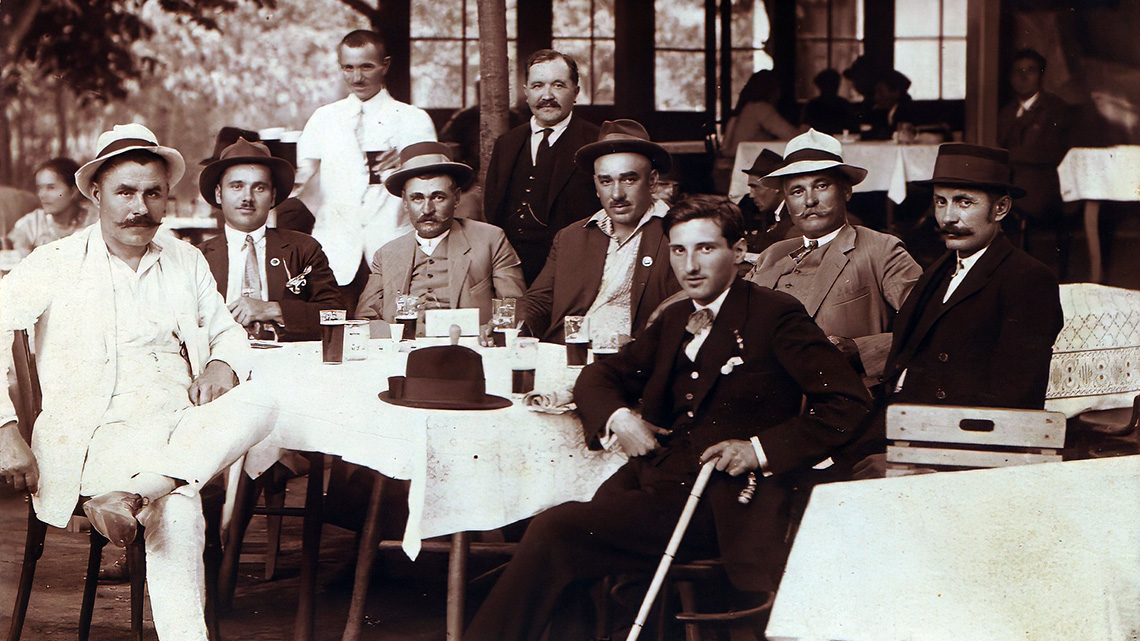
For the past 250 years, Serbian intellectuals have played a role similar to that of the nobility in other nations. They were familiar with European languages, as well as Latin and German, enabling them to follow all the cultural movements of Europe and guide Serbian life in accordance with the progressive ideas of the West. Although economically much weaker than the nobility of neighboring nations, Serbian intellectuals bore a significant burden of service to the people on their modest shoulders. The lack of material resources was compensated for by a strong spirit and deep love for their people.
Mileta Jakšić, a priest in Srpska Crnja and a poet, writes about our intellectuals: "The readiness and willingness of our intellectuals to serve the people was not always the same; like waves, sometimes higher, sometimes lower, stronger generations with new programs would periodically emerge, creating new movements, which in turn make up history, such as the Youth Movement in Vojvodina. While the stronger generation was consumed in service to the people, there would usually be a stagnation, disorder, or inability to serve among the youth, as a kind of resting before the emergence of a new wave."
The people of Vranjevo realized quite early that the time when it was said "Better six ravens in a cart than six schools in the head" had passed, and thus they began sending their children to school when very few villages considered serious educational endeavors. These children of Vranjevo peasants quickly became bearers of national thought and education in their new environment. They were close collaborators with prominent Serbs in cultural and political missions, alongside figures like Svetozar Miletić, Đura Daničić, Jovan Jovanović-Zmaj, and others.
Mija Vlaškalin was a first-year student at the Lyceum in Bratislava in the 1844/45 academic year, along with Svetozar Miletić. In the following academic year, they were in the same class. In that first year, the President of the Student Society was Lazar Jovanović from Novi Sad, a second-year philosophy student, with Svetozar Miletić as the secretary, Mladen Madarević as the librarian, son of Joca Mađarević, a teacher from Vranjevo, and Mija Vlaškalin as the recorder, son of the wealthy widow Sofija Vlaškalin from Vranjevo.
At the first meeting of the Student Society, held on September 21, 1845, Miletić was elected president, and Mija Vlaškalin was elected librarian. In the second semester, in the spring of 1846, the Rector of the Lyceum, Bolman, banned public meetings of the Serbian Student Society. At that time, the ten of them, including Miletić and Mija Vlaškalin, conspired to hold meetings in secret. That year, Mija donated 12 books to the Student Library, among which was Rusaljka - Russian folk songs.
In February 1847, Miletić issued a proclamation to Serbian youth to gather around Slavjanka, a literary almanac he initiated. For the printing of this book, the Youth collected 100 forints among themselves. Mija Vlaškalin personally contributed 50 forints (at that time he was studying in Prešov), thus enabling the book to be printed. The total printing costs amounted to 150 forints. Among the contributors were 28 youths from Pest, 21 from Požun, and 5 from Prešov. Thus, 53 youths contributed 100 forints, and Mija himself contributed 50 forints for the publication of Slavjanka.
The proclamation that Miletić sent to the youth to gather around Slavjanka was found by the police at Mija Vlaškalin's place in Prešov. Based on this proclamation, the Viennese War Council opened an investigation against Miletić. This indicates that Mija Vlaškalin, even in Prešov, stood out for his activism, as the police searched his apartment and found evidence for initiating an investigation against Miletić. Vlaškalin, like Miletić and many Serbian youths of that time, was enthusiastic about Ljudevit Štur's ideas on Pan-Slavism. In his home, as well as in the home of Vladimir Glavaš from Vranjevo, the portrait of this prominent Slovak was kept with special care.
Mladen Mađarević from Vranjevo was a schoolmate in the 1842/43 academic year, in the first year of studies, with Đura Daničić. He was one of the most prominent members of the Student Society in Požun. Like Daničić, he was among the first to adopt Vuk's orthography in 1843/44 and signed the minutes of the Student Society meetings using that orthography.
Mladen became a notary in Vranjevo, and his signature, as a municipal notary, can be found on the minutes of the Municipality meetings from 1860.
As previously noted, he was the son of the Vranjevo teacher Joca Mađarević. In the Chronicle of the Orthodox Church in Vranjevo, Prota Miloš Vlaškalin notes that in 1811 the first "great teacher" was Joca Madžarov, and later, upon his death in 1838, he was referred to as Joca Mađarević. He was called "the great teacher" because the "small school" referred to the "primer," while the "Great School" was the "Psalter," or the III and IV grades. As Joca was a teacher in the Great School, he was called "the Great Teacher" by the people of Vranjevo.
Not only were the intellectuals of Novi Bečej and Vranjevo carriers of the cultural and educational movement among Serbs, but merchants also played a significant role, which is discussed in a separate chapter of this book.


Comments