



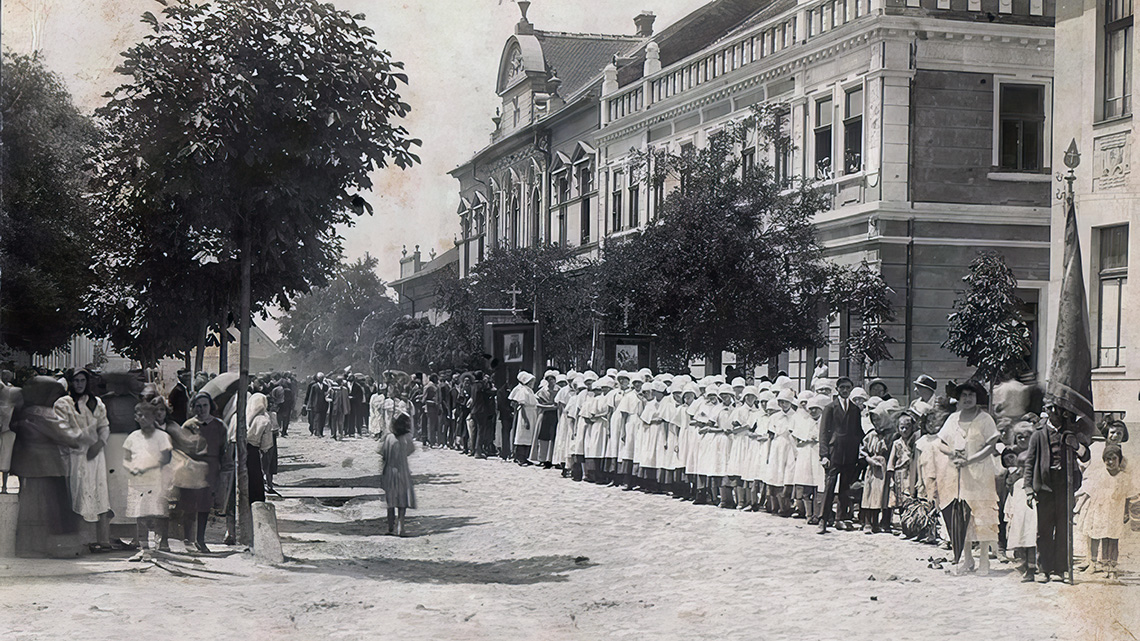
It is worth mentioning, perhaps not revolutionary, but undoubtedly a turbulent school history of Novi Bečej between the 1920s and 1930s.
Since 1908, Novi Bečej has had a four-year civic school where children were educated, primarily to meet the needs of local commerce and crafts. Those who wished to continue their education and whose parents had the necessary means would go to nearby cities like Veliki Bečkerek, Velika Kikinda, and even Novi Sad and Sremski Karlovci. Studying outside of one's place of residence meant limiting further education.
To enable more Novi Bečej-Vranjevo children to receive education, the residents of Novi Bečej and Vranjevo persuaded the relevant state authorities to open a private high school in Novi Bečej with public rights. More details on this can be found in the books "Novi Bečej and Vranjevo through History..." and "The Flame of the Homeland." Here, we will focus more on an unusual school where the children (girls) of all Russian emigrants, who settled in the Kingdom of Yugoslavia after the October Revolution, were educated. This was the KHARKIV INSTITUTE.
The history of this school begins in Kharkiv, Russia, in 1812. By 1841, it had been transformed into a full eight-year secondary school and was then named the "KHARKIV INSTITUTE OF EMPRESS MARIA FEODOROVNA."
After the victory of the October Revolution in Russia, the Institute was evacuated, and by the end of 1919, along with its students and teaching staff, it moved to Yugoslavia, where in March 1920, it was housed in Novi Bečej.
By the decision of the Ministry of Education of the Kingdom of Serbs, Croats, and Slovenes No. 11539 of August 10, 1922, the Institute was elevated to the status of an eight-year girls' (real) gymnasium with the right to grant diplomas according to the regulations that applied to secondary schools in the Kingdom.
In terms of teaching, the Institute was under the supreme supervision of the Ministry of Education, while the financial-economic support of the Institute was managed by the State Commission of the Kingdom for Russian refugees. The language of instruction at the Institute was Russian.
In 1929, the Institute came under the High Protection of HER MAJESTY QUEEN MARIE.
The Kharkiv Institute celebrated its 10th anniversary in the Kingdom of Yugoslavia in 1930 and its 120th anniversary in 1932.
The economic significance of the Institute for the economy of Novi Bečej is briefly depicted in the book "Novi Bečej and Vranjevo through History," while here, we would highlight some statistical data and photographs provided by Engineer Georgi-Zorka Slatvinsky, a retired professor from Novi Sad. Zorka also provided some additional valuable information about the history of the Kharkiv Institute.
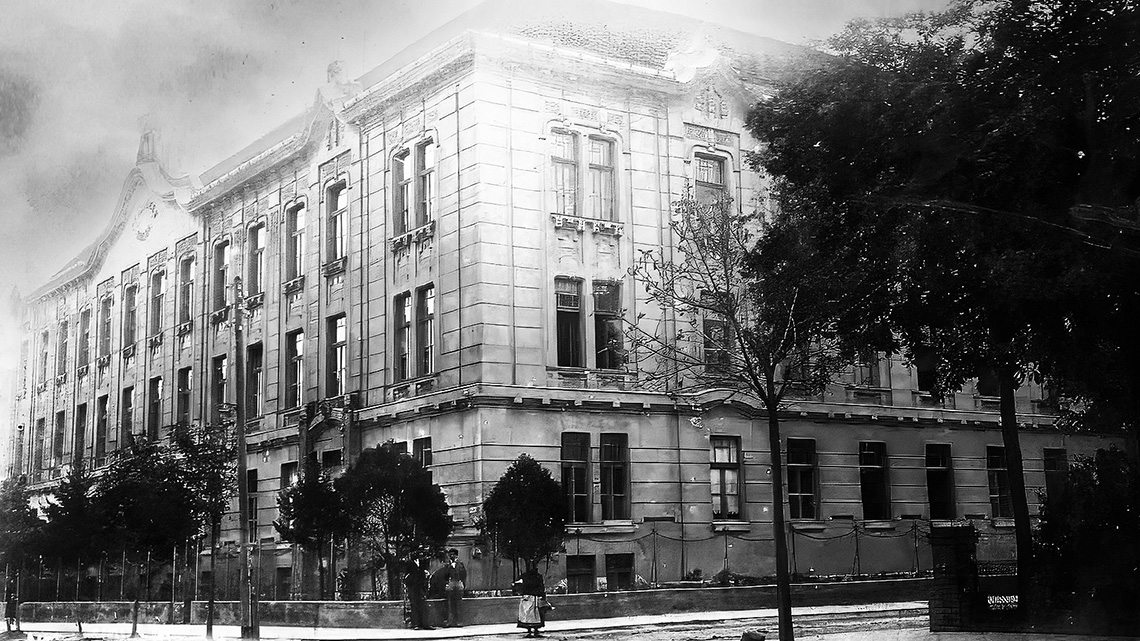
The Kharkiv Institute was a boarding-type school. All students, except those from Novi Bečej, lived and ate in the boarding house. The boarding house was located in the building of today's Gymnasium, and the cafeteria was in the building of today's practice hall of the "Miloje Čiplić" School.
The students wore uniforms, with each grade having its distinctive features in the color tone of their dresses and caps.
In Novi Bečej, in addition to the professors of the Kharkiv Institute and their families, there were about thirty Russian families who settled in Novi Bečej and created a special Russian atmosphere and their (Russian) cultural center. These were mostly not just the families of former Russian wealthy individuals but were mainly intellectuals.
Among other Russians in Novi Bečej, Vladimir Tolstoy, the grandson of the famous Russian and world writer Leo Tolstoy, settled and remained there until the end of World War II, serving as a district agronomist. There he started a family – two sons.
In the early days of the entry of the Red Army into Novi Bečej, on October 4, 1944, Vladimir offered his services as a translator, but the Red Army officers received him with suspicion, as they did with other White Guard members. In those early days, their NKVD service gathered information about the behavior of these Russians in Novi Bečej. When they received a written statement from the local authorities that Vladimir Tolstoy had been correct and patriotic towards the Soviet Union, they completely changed their attitude towards him and his family and accepted him as one of their own. Namely, we, the people of Novi Bečej and Vranjevo, were aware of one of his outbursts in the café of the "Vojvodina" Hotel. In a hall full of guests one Sunday morning in October 1941, he shouted at the top of his lungs in a drunken state: - "No one has ever conquered Russia, not even Napoleon, and the Germans will end up the same way..." All present were frightened and began to leave the café, but everything ended peacefully. His friends, who were sitting with him at the café table, immediately took him out of the café and led him home.
Learning of his patriotism, the Russians accepted him, as well as his brother Ilya, who came to Novi Bečej in the summer of 1944 from Vršac, where he had lived with his family until then. Soon, the entire family of Vladimir and Ilya Tolstoy was moved by truck with all their belongings to Moscow, where Vladimir and his wife passed away. Their older son Oleg graduated from the Academy of Fine Arts in Moscow, and forty years after leaving Novi Bečej, the Belgrade daily "Politika" published a short report which reads:
Tolstoy From Vojvodina
Great-grandson of Leo Tolstoy, Oleg, cannot forget "his" Bečej, where he lived with his father Vladimir, the grandson of the great writer, and from where he left as a volunteer in the Vojvodina Brigade.
(From a Tanjug correspondent), Moscow, August 1, 1985.
In the 87 paintings presented at his solo exhibition, Oleg Vladimirovich Tolstoy told his entire life story. But the best ones are those that depict the places of his first oaths. These are Novi Bečej, the banks and forests along the Tisa River, and a bit of Zrenjanin.
Under one of the paintings is the signature: "Soldiers - memories from the war." And since he is still under 60, journalists made Tolstoy recount where he fought.
In Yugoslavia, in Vojvodina, in Novi Bečej, in the forest and on the banks of the Tisa River, and in the Vojvodina Brigade, which I joined as a volunteer.
Thus, in one burst, the mystery of the life and past of the great-grandson of the great writer Leo Tolstoy and his father, Tolstoy's grandson, a pre-war agronomist from Novi Bečej, was revealed. In that town on the Tisa River, there are probably still people who knew Tolstoy and remember that Vladimir Ilich Tolstoy was a prisoner in Zrenjanin during the war.
His son Oleg visited him there and brought him pieces of bread, never sure if he would find him alive. He has not forgotten any of those hard days in Novi Bečej and Vojvodina, and some of those memories he immortalized on canvas. That is why Moscow art critics named his solo exhibition "Self-Portrait of the Artist, the Great-Grandson of the Great Writer." He can sometimes be seen at some event in the Yugoslav embassy in Moscow, but he doesn’t like to talk much. However, if someone touches upon the delicate aspects of his youth, he immediately feels rejuvenated by four decades.
He remembers his pre-war childhood and the whirlpool of war in which his family, along with the families of his friends, found themselves. When the image of his schoolmate Radojka crosses his mind, he remembers that her father was shot by the fascists in 1943 as a hostage for the murder of a German. This was a fate narrowly avoided by his father Vladimir.
Radojka was a brunette, tall, a beauty. The last time we met was by chance, on a march from Sremska Mitrovica to Zagreb. A handshake and never again. She carried a submachine gun on her back. Decades have passed since then, but when someone asks me about Yugoslav fighters, Radojka appears before my eyes.
He remembers his father's friend Branko Branič. "Calm, reserved, no one would have said that he was the one who planted explosives under the trains passing through Novi Bečej." "He has also preserved in the family archive a letter that friends from Novi Bečej sent to his father Vladimir. In it, they explained why they constantly advised him to be cautious during those war days. Oleg knows its contents by heart: 'Not only for you but for our people whom you always helped. You were ours, you were a man.'"
Oleg Tolstoy is very proud of those words and, in general, of his father. His paintings at this exhibition do not hide that. Last year, when he appeared in the pages of "Krasnaja Zvezda," he spoke about the liberation struggle in Yugoslavia, about the mining of Novi Bečej after the fascists retreated to Hungary. Oleg Tolstoy turns these memories into paintings. But he prefers to talk about his granddaughter rather than painting. When a Yugoslav jokingly calls him "our Tolstoy from Vojvodina," he just smiles.
Slavko Stanić

Comments