



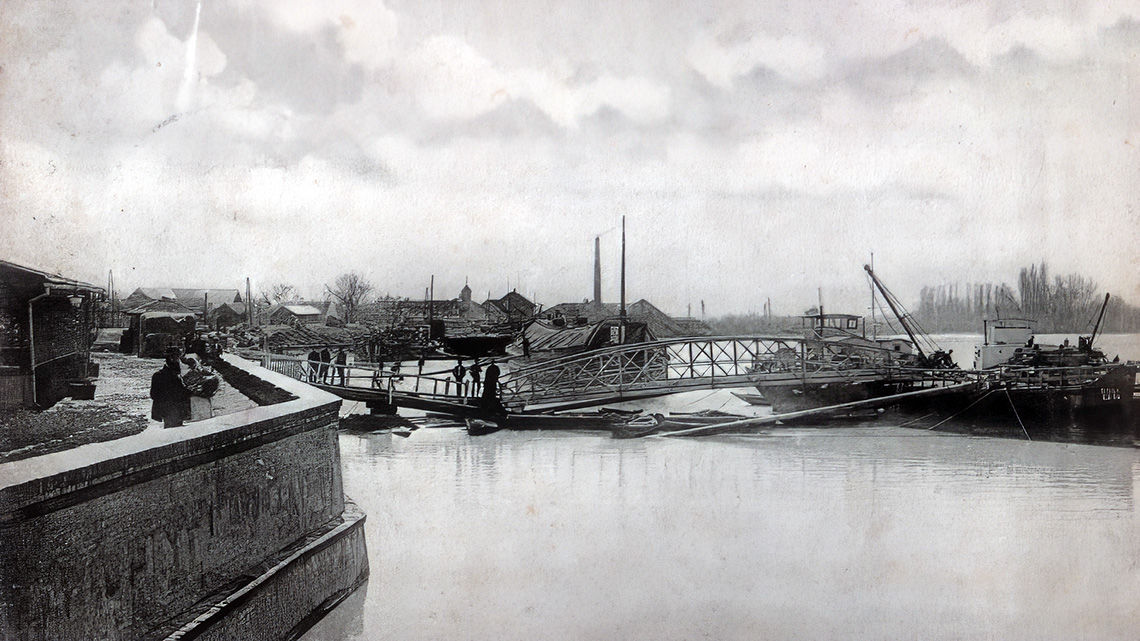
The well-developed grain trade in Novi Bečej was predominantly controlled by Serbs and a few Cincars. Unlike our noblemen, they were deeply devoted to their people and wholeheartedly supported initiatives that contributed to the development of Serbian culture and the general advancement of Serbdom.
Besides enhancing Novi Bečej's appearance with the construction of what were at the time the most beautiful houses, where they lived and had their shops, they also played a significant role in the development of culture and education. Their contributions were not limited to Novi Bečej, where they spearheaded progressive endeavors, but extended to supporting all institutions significant for the cultural and educational advancement of Serbs across the Sava and Danube rivers.
In Novi Bečej, during a period of flourishing trade, the economic foundation was laid for the development of superstructures where culture and education held a prominent place. In addition to schools and churches, a local amateur theater troupe was established as early as 1830, with the most distinguished citizens joining, among whom the prominent grain traders Dimitrije Papić and Šandor Dada Cincar held a special place.
Dada was not content merely to provide material support to the endeavors of Antonije Brežovski, the founder and director of this theater troupe, but also participated as an active amateur actor. After Brežovski's death in 1840, Dada took over the role of director and led the troupe until 1848.
In his memoirs, one of the most prominent amateur actors of the time, Lazar Mirosavljević-Lala, writes how the wife of grain trader Dimitrije Papić rewarded him when he performed the role of Emperor Lazar in the play "Miloš Obilić":
"A wealthy lady, Mrs. Papić, entered the dressing room, and in recognition of their patriotism, placed a golden chain around my neck and adorned my hands with diamond rings, making me look truly imperial. The audience, full of patriotism and enthusiasm, provided us with beautiful costumes."
Of particular significance to Serbian culture overall was the role of Jovan Knežević, the son of the Vranjevo merchant Mojsije, who in 1860 founded the first Serbian professional theater in Vranjevo (now part of Novi Bečej), from which the Serbian National Theater in Novi Sad emerged in 1861. Later, in 1868, with the division of this theater, the National Theater in Belgrade was established.
Novi Bečej native Dimitrije Papić, a grain trader, along with his wife, warmly embraced and materially supported the work of the Novi Bečej amateur troupe. With the same fervor, he supported the work of the newly founded Serbian National Theater in Novi Sad. For his contributions, the Serbian National Theater recognized and expressed gratitude by making him an honorary member at its Second Regular Assembly in 1865. This was a high honor, as by the outbreak of World War I, the Serbian National Theater had only 38 honorary members, among whom were the most prominent writers of that time.
Among the first benefactor members of Matica Srpska, headquartered in Budapest, from the ranks of merchants outside Budapest—specifically from the provinces—was Živko Nedeljković, a grain trader from Novi Bečej. He was registered under number 36, at a time when Matica Srpska was still unestablished as a cultural institution, with barely fifty members. Shortly before him, Matica Srpska members included the Semikluš nobleman Jovan Nako, registered under number 32, and Matica Srpska's greatest benefactor, Sava Tekelija, registered under number 34.
The merchants of Novi Bečej did not falter in their patriotism, even when the grain trade in Novi Bečej significantly diminished with the construction of the railway. Thus, in 1884, Đorde Vukov, a merchant from Novi Bečej, bequeathed a quarter of his house in Timișoara, valued at 10,000 forints, to Serbian national schools in Novi Sad and the Serbian National Theater in Novi Sad.
Considering that the merchants of Novi Bečej were deeply attached to their people and dedicated to their cultural and general progress, it is not surprising that a Serb born in Novi Bečej, Joca Savić, the son of the Novi Bečej grain trader Vasilije Savić, became one of the most renowned actors and directors in German theaters. He is considered one of the greatest Shakespearean scholars in Europe.


Comments