



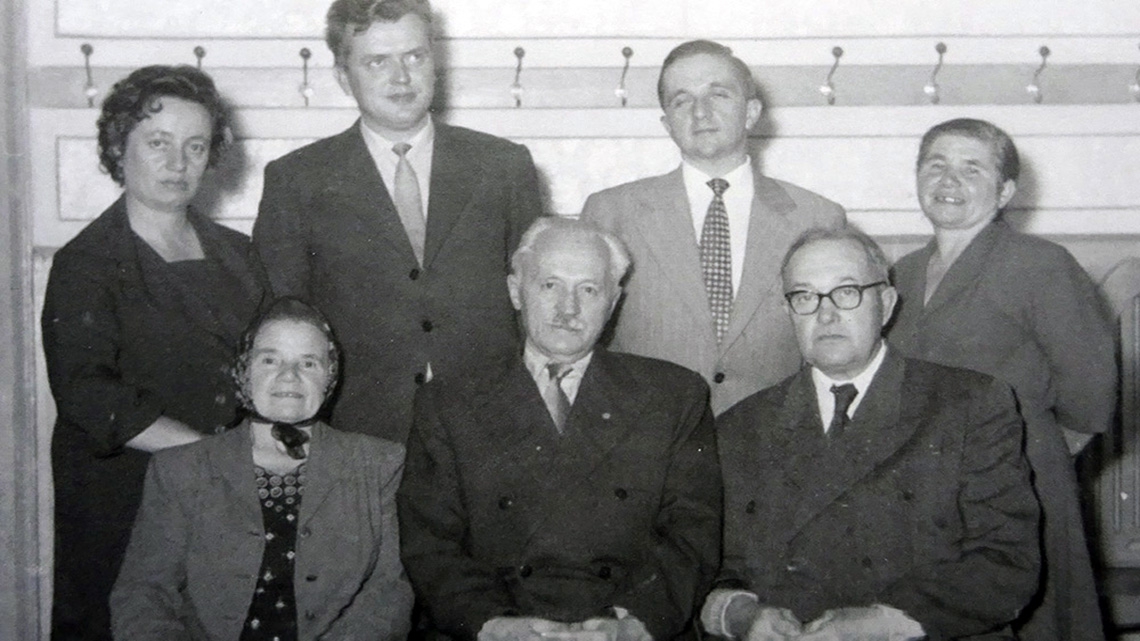
By the late 1980s, the first signs of the future crisis, which would culminate in the 1990s and whose consequences are still felt today, began to appear. In 1989, Branimir Lisičin took over the leadership of the institution. Reports from those years mention the deterioration of living and working conditions for both employees and beneficiaries, as well as "defense plans" in case of wartime danger...
Until September 12, 1990, the "Home for the Elderly and Pensioners" had the status of a working organization, and from then on it functioned as an institution for the social protection of adults and the elderly, when it also received a new statute. This created the conditions for the first time to provide open forms of social protection services, such as home care, home help, and the Day Care Club. Due to unfavorable material circumstances, the number of employees began to decrease. In 1991, construction of a new building and adaptation of the existing ones in the "obsolete" second department began. However, the current social situation did not allow for its completion within the planned time frame. For the same reason, other difficulties in the functioning of the institution arose. Shortages of medicines, hygiene supplies, spare parts, and other necessities, heating problems, and a decline in food quality became frequent... Clothing and other items were procured through humanitarian centers. In the early 1990s, refugees and displaced persons from other parts of Yugoslavia appeared in the Home. Since 1991, there have been three shifts within all three departments. The position of department nurse was introduced, with nurse Paulja Smiljka holding this role in psychiatry.29
Nevertheless, many difficulties were overcome thanks to the resourcefulness and inventiveness of the workers. Certain successes were also recorded in the work of the Home. In 1997, the Day Care Club, located at 60 M. Tito Street, near Department 3, was opened. Music therapy was introduced. As a substitute for medicines, the collection of medicinal herbs was initiated. The number of users, especially those with mental disorders, mostly women, increased. At the end of 1999, the "Geriatric Center Novi Bečej," as the Home was then called, had 360 users, fully utilizing its capacity. They came from the territory of Novi Bečej municipality, neighboring municipalities, and from all over the country. There were 89 employees.30
Entering the 21st century, the Home had 355 users, 284 members of the Day Care Club, and over 90 workers. Although the consequences of the 1990s were still visible, such as inadequate and dilapidated accommodation, dampness in buildings, a lack of skilled workers, and a shortage of basic food products, medicines, and sanitary materials, partly still procured through humanitarian organizations, from then on, continuous progress was noticeable in all segments of life and business. Branka Lisičina was replaced by Balogi-Miletić Gizela as director, and by the end of 2001, Dr. Bognic Ljiljana took over the leadership of the institution. According to Ljiljana Panić, daughter of the first manager, "the energy for a better tomorrow of the first collective and the great mothers has reawakened and continued to enrich the users and workers of the institution."
Let us mention some of the achievements of this decade:31
- The clinic and the space for nurses in psychiatry were adapted and equipped; psychiatry received a large number of new workers, some of whom became "permanent staff" for a long time;
- Necessary equipment for the clinic was acquired, new vehicles and new inventory were purchased, new information equipment and a complete telephone exchange were installed, cable television was introduced...
- Three garage spaces for the needs of the institution's vehicle fleet, storage space for food products, and a guardhouse for the needs of the security service were built within the first department, the laundry was renovated, and rooms for occupational therapy were established...
- The complete renovation and extension of the prefabricated pavilion of the first department were carried out. In this way, a completely new toilet space and a hairdressing salon were obtained. By renovating the old toilet space, a living room was created, which did not exist within the first pavilion until then, as well as an intensive care room and several dormitories. These changes expanded the capacity by about twenty beds. All rooms were equipped with appropriate furniture, considering the privacy of the users. In the ground floor part of the old pavilion of the first department, a living room was built, which did not exist until then.
- During the year, the hygiene maintenance service was separated from the user care service. For these reasons, about twenty new workers were employed in 2004 as cleaners, caregivers, and nurses.
- In 2005, the local government purchased a building for the institution, expanding and consolidating the space of the first department. The following year, due to the increasing number of requests for the accommodation of mentally ill persons, a complete project for the expansion of the capacity of this department was completed.
- In 2005, the institution's feast day (May 12) was established, and that year, users and employees stayed for three days in the lodgings of the Ostrog Monastery.
- In 2006, after two years of adaptation and extension, the rooms for the accommodation of mentally ill persons within the second department were completed. New furniture and equipment were purchased with the institution's own funds. Thus, 52 users moved into high-standard rooms. Also, these works resulted in two large rooms for occupational therapy and two for the living room. Within this department, a guardhouse was built, the street fence was reconstructed, and the construction of a chapel began, although the work was interrupted due to bad weather.
- In the third department, the work was reorganized to fill vacant places. Some rooms were occupied by mentally ill users in good remission. At the same time, since the rooms within the Club, intended for the accommodation of relatives of users during visits, were empty, the institution's professional team decided to change their purpose. They began to be used as accommodation for pensioners and elderly persons during the adaptation period before entering the institution, as well as for seasonal accommodation and protected housing...
- Since 2007, the project "Home Care and Help - So You Are Not Helpless" has been implemented, occasionally funded by the Provincial Secretariat for Health and Social Policy and the local government's budget. Simultaneously, the "Meals on Wheels" program was implemented, aiming to distribute food to Club members in their homes.
- The following year, a complete reconstruction and adaptation of the stationary part of the pavilion known as the "sick room" was carried out; in the next period, the kitchen block in this department was reconstructed, which was especially important because it had not been invested in for 40 years; the administrative service rooms were reconstructed and adapted into a residential pavilion for users, with a living room and a sanitary block.
- The home newspaper "Sparkle in the Eye" began to be published (2003); a music section started operating; an art colony was organized in the Home's premises...
- A chicken farm was built, but due to the avian flu epidemic, it was not put into operation; instead, the project "My Little Home" was implemented, aimed at training and preparing users for independent living and leaving the institution.
- Each department slowly gained its structure and scope of work, resulting in better service quality and a better working environment; scholarships for employees in deficit professions were introduced; new jobs were created due to increased workload; young people serving civilian military service in our institution appeared as work support (in 2009, there were 47 of them); programs for working with users' families were initiated, and phone booths installed in the departments improved users' communication with their families.
- All employees began living and working with the users, patiently trying to help them, experiencing every illness, sorrow, or joy with them. All this shows to what extent the lives of our beneficiaries were facilitated, beautified, and fulfilled during this period.
In the next decade, this trend continued even more intensively, especially in psychiatry, where the living conditions of users improved significantly in every respect. At the same time, working conditions for employees improved.32
29 Testimonies of employed workers; Dragan Dzigurski, referenced work, pp. 64, 67-69; Data from the Worker Register of the Home
30 Institution's Archive, Annual Report on the Work of the Geriatric Center Novi Bečej (hereinafter Work Report) for 1999; Dragan Dzigurski, referenced work, pp. 67, 70, 73,75, 77, 79
31 Institution's Archive, Work Reports from 2001 to 2010; Data provided by nurse Marija Barackov
32 All data from this section are taken from work reports for the period from 2011 to 2018


Comments