



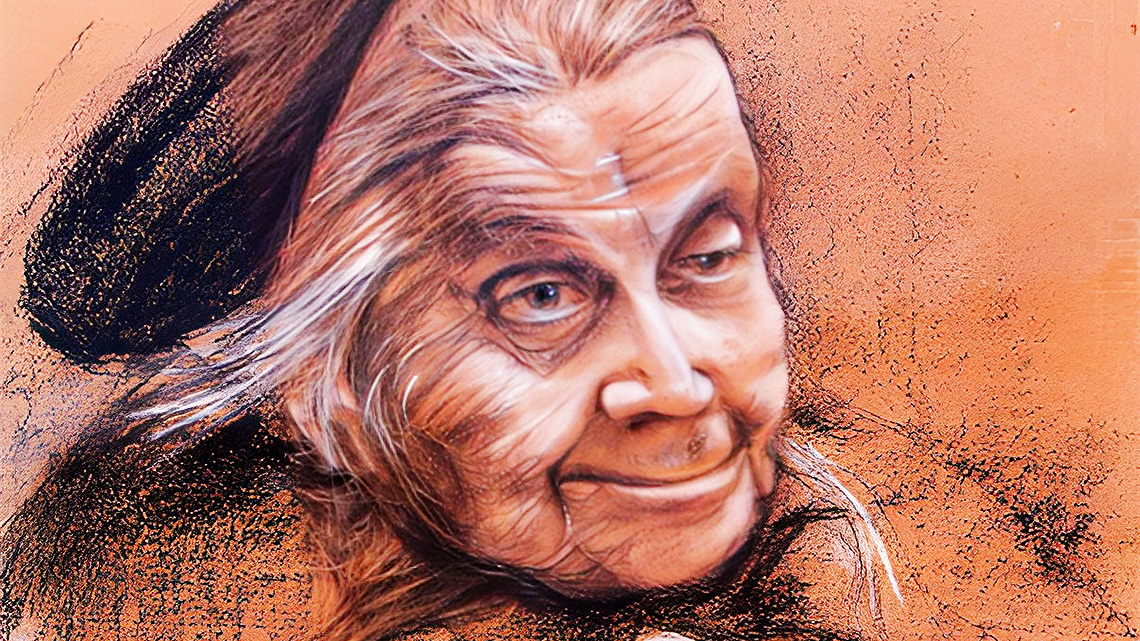
Aunt Eva - a little woman from Bačka whose family was liquidated by fascists and collaborators. Two nephews survived and were placed in a children's home somewhere in Bačka. They would visit their aunt during holidays and school breaks. Aunt Eva occasionally visited them at the children's home. They were always welcomed at our home as if they were her own children and could stay for several days.
I particularly loved Aunt Eva. She often took care of me at home when my mother attended seminars or had other obligations. She would sleep over at our apartment, and we considered her a family member.
Joka - an orphan from Lika. Jovanka and her brother survived the massacre in Lika by hiding in a marsh, breathing through reed stalks. An elder had hidden them there as the entire village was massacred by the Ustashe.
Katica was our orphan from Vojvodina.
These two young women stayed in the home even after the children were separated from the adults. They were young, beautiful, and hardworking, and they significantly helped the staff. They regarded and called the manager Mila 'mom' their entire lives. It was touching to see them sitting next to her on a bench in the park, snuggling like two kittens, one on each side, resting their heads on her shoulders. Although both were a head taller than Mila in heels, they cuddled like big babies.
Grsa - a bohemian painter who was transferred from the men's psychiatric ward to the Novi Bečej home. I believe he came from Belgrade. There is a story about him like a joke, involving filling a barrel with water without a bottom. Whoever fills the barrel gets to go home. While everyone else was filling the barrel, he stood aside and smiled. When asked, 'Grsa, don't you want to go home?' he replied, 'I do, doctor, but first, you fill it halfway.' After this supposedly true event, he was transferred to our town's home from the psychiatric ward. He settled down, didn't run away, and started painting intensely.
He painted landscapes of our Banat and the celestial lady - the Tisa River. His watercolors were beautiful.
In the winter period, there were more occasional guests.
'Madam' - an elderly lady whose parents fled Russia during the October Revolution. She was of count's descent (from the Zadonjskis) and a legend of Novi Bečej. She supported herself by giving lessons in Russian, English, German, and French to children and adults. She received modest social assistance. She was a petite lady in black, with a fragile body, a sharp mind, and a piercing gaze. When she looked at you, it felt like she was scanning you completely. She loved children and people. The people of Novi Bečej were proud of their Madam and adored her. As she aged and weakened, she stayed longer in the home, where she eventually passed away.
During the winter, the mother of Dr. Smilja Kikić, who worked and lived in Germany, also stayed there.
The same winter joys were enjoyed by the aunt of Dubravka Nešović, a singer of old town songs, romances, and folk songs. Her niece often visited and delighted the home's residents with her songs.
Regina the Romani - was a special guest in the winter period. She had many children, around ten, and always gave birth around New Year's. Naturally, she stayed in the home with her small children and newborn until spring. They gave her contraceptive pills, educated her, but alas, Regina being Regina, forgot to take them or threw them away. One winter, my mother lost her patience and called her husband to give him a lecture. She started explaining how he should take care of his wife and children and put them on the right path. She asked if he didn't feel sorry for the children suffering and being placed in children's institutions. Mila talked and talked, getting all flushed from explaining and kindness. When she paused, the big father asked her, 'Madam, do you have a radio? - Yes - And do you have a television? - Yes - And do you go to the cinema and theater for entertainment? - Sometimes. Well, you see, madam, you entertain yourself in a gentlemanly way, so you have one child. Our poor entertainment is making children!' After saying what he had to say, he left, swearing and slamming the door. Of course, he left his wife and children in the home, as he had done several times with the municipality president and the social work center. My mother sat in her chair to cool down, red as a boiled lobster with blood pressure around 200. They barely managed to lower her blood pressure. The lecture was delivered, but not to the big father, but to the manager madam.
Children from our municipality placed in children's homes were regularly visited at least once a year by social workers, especially before the New Year. They were brought gifts and packages regardless of the city or republic they were in. The social workers of the social work center and the old-age home strictly took care of this tradition. The children eagerly awaited it because they were used to being visited and loved by someone from their homeland. They slowly grew up, went to school, and became their own people.16
In the late 1950s, the home had rooms with 3 to 10 beds, a bathroom, separate male and female infirmary rooms, a tailoring workshop, a farm with 5 acres of land, and pig fattening... There were ten employees, including a house doctor. The first position of 'health worker' dates back to 1960 when Danica Kokotović was hired as a nurse.17
When the old-age home in Žitište was closed in 1964 as unprofitable, its residents moved to the Novi Bečej home. At that time, the first statute was adopted, and the following year the home became a municipal institution. The documents list the following as 'responsible' managers: Isakov Mila, home manager and 'commander,' Ana Vlaškalin, bookkeeper - accountant, Dragoljub Vrebalov, treasurer, and Milena Maljugić, storekeeper.18
Throughout the 1960s, efforts continued to improve the living and working conditions in the home. Numerous repairs and adaptations were carried out on the buildings, including the construction of offices, a dining room, a kitchen, a common room for residents, an apartment for the caretaker, and more. New laundry washing and drying devices, an electric stove and cooking pot, a television, a radio with a record player, and a bicycle were acquired. Renovated facilities were equipped with new furnishings, the quality of food improved, and efforts were made to educate and train the staff. A caretaker was appointed, providing supervision during evenings and nights, which had not been the case before. Until 1965, residents were alone at night without staff supervision. Considering today's user structure, this fact is surprising. After that, documentation mentions the presence of a female caretaker. The first caretaker was Nada Marjanov. She, along with her family, was provided with an apartment within the home, allowing her to care for the residents when the staff was not present. The caretaker's job was extensive and responsible. She spent evenings and nights with the residents, who were also 'her family.' During their shared time, the caretaker and her family watched television, listened to music, or performed necessary tasks within the home impeccably and on time. She helped residents, cared for them when needed, comforted them, visited the sick at night, and much more, all with great love, patience, and willingness. The driving force and quality of such work were good interpersonal relationships.19
16 Ljiljana Panić - Lika, manuscript
17 Institution Archive, Work Report ... for the period from 1955 to 1965; Dragan Džigurski, cited work, pp. 19, 22, and 26
18 Institution Archive, Business Report of the Home for the Elderly and Pensioners in Novi Bečej for 1964 and Work Report ... for the period from 1955 to 1965; Dragan Džigurski, cited work, p. 30
19 Institution Archive, Work Report ... for the period from 1955 to 1965; Information obtained from the family of Nada Marjanov (collected by Marija Baračkov)


Comments