



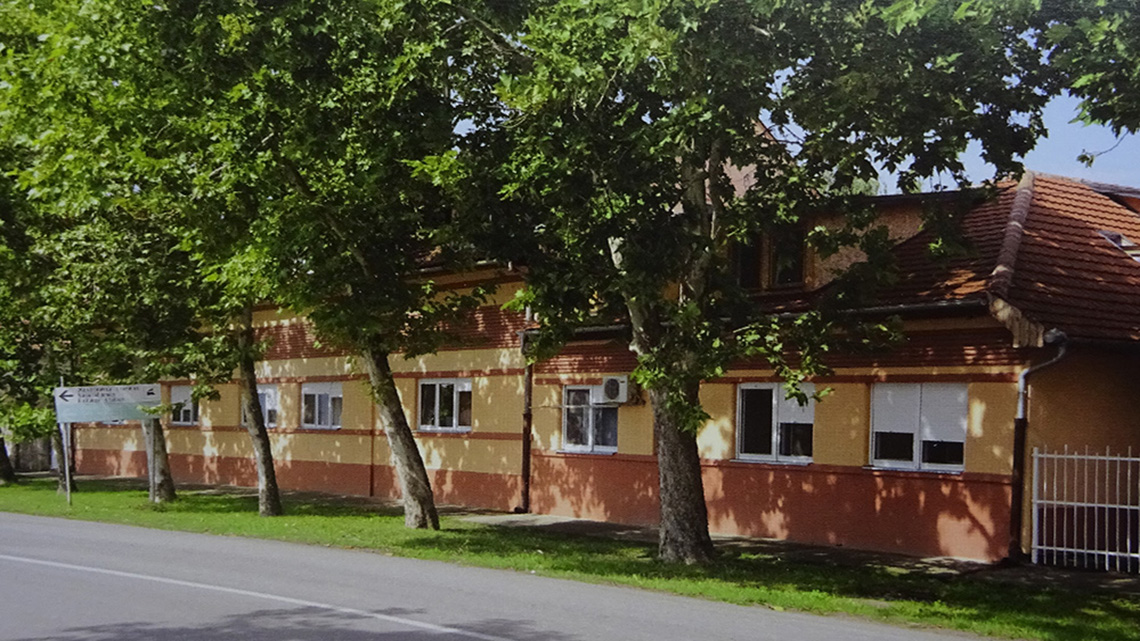
Although we will strive to use as little professional jargon as possible in presenting our Home, we must start officially by saying that it is an institution of "social protection in transformation" headquartered in the municipality of Novi Bečej, tasked with providing residential accommodation services, "Supported Housing" services, and non-institutional protection services through the Day Care Club and the "Home Help" service. It is intended for the elderly, as well as for adults with mental and intellectual difficulties, or in other words, all categories of adults and the elderly - independent, semi-dependent, and dependent. In accordance with the Social Protection Act, we provide our users with housing, health care, and the fulfillment of all other life needs.
The Rulebook on Organization and Systematization determines the organizational parts of the institution, job positions within them, job descriptions, required education for job positions, the number of employees, and other necessary working conditions for these jobs. Each service, as an organizational unit, has its manager, while the employees carry out the tasks within these organizational units according to the job descriptions from the systematization act. The systematization act is adopted by the director of the institution based on the Labor Law and the Decision on the Number of Workers from the Ministry of Labor, Employment, Veterans, and Social Affairs.
The Home is located in multiple locations and operates within three departments and a Day Care Club. All are located within the city's territory and possess all necessary infrastructure. The departmental organization enables all services within the Home to function autonomously.
We will briefly outline the basic information and specifics of each department.
The first department is located at 77 Marshal Tito Street. It covers an area of 7,020 m2, of which 2,401 m2 are buildings. This department can accommodate 145 users. On an adjacent plot at 75 Marshal Tito Street, sized 1,700 m2 and obtained in early 2006 from the local self-government, a new accommodation facility of about 1,300 m2 is to be completely adapted. Within this department, at 73a Marshal Tito Street, there is an administrative building of about 160 m2, as well as garages for vehicles.
The first department houses a modern central kitchen, reconstructed and adapted in 2010. All meals are prepared here and then transported in specialized vehicles in thermoses to the so-called distribution kitchens. Meals for the "meals on wheels" service for Club members are also prepared here.
In addition to several accommodation pavilions, the first department includes a central warehouse, physical therapy, a carpentry workshop, a pottery workshop, a tailoring workshop, and a home library with hundreds of titles available to users and staff at any time.
A physiotherapy room has been set up in the prefabricated pavilion of the first department. New equipment for this type of service has been acquired. This type of rehabilitation has not existed in the Home before. With the provision of physiotherapy services, the quality of health care has been raised to a higher level, and physiotherapy services have become available to users, employees, and Club members.
A Work-Occupational Center has also been established in the first department. This initiative began in mid-2015 when the garages were moved out of the courtyard of this department, as vehicle movement endangered the users. The works were completed in October 2016. The former garages were reconstructed, expanded, and repurposed. The space now houses the Work-Occupational Center, with pottery and carpentry workshops. The remaining space has been transformed into a canteen-café with a kitchen area, sanitary block, and terrace space. Here, users can make tea and coffee, socialize, and spend their free time. For various occupational therapy activities throughout the year, not just in the summer, there is a large covered terrace enclosed with modular-demountable walls made of Lexan.
The second department is located at 8 Milošev Put Street, with a capacity of 218 users and a total area of 7,310 m2, of which 3,050 m2 are buildings.
Within the courtyard of the second department, a home chapel has been built on the site of a demolished old and non-functional morgue. An agreement has been made with the local public utility company "Komunalac" for the transport of deceased persons to the morgue. A catechist has also been engaged, who holds services and religious education once a week.
The third department is located at 60 Marshal Tito Street, covering an area of 1,940 m2, of which 1,473 m2 are buildings, and has a capacity of 68 users. This is the newest department, opened in 1988. Initially, it was intended for mentally stable individuals. However, as requests for that category of users decreased, it also housed users with mental and intellectual difficulties.
In the courtyard of this department, there is an open sports-recreational hall, i.e., a multifunctional hall for special purposes. It is primarily intended for accommodated users to improve their health and mobility, but it is also available to Day Care Club members, Home employees, and all other citizens.
The Day Care Club, within the third department, is located at 60 Marshal Tito Street, with a total area of about 550 m2 in buildings.
It is a space where social protection services are provided in the local community - the so-called non-institutional protection, such as home help, service activities, meals on wheels, etc.
Each department is equipped with a distribution kitchen, dining room, hair salon, work therapy workshops, laundry room, warehouses, and a porter’s lodge. There are also well-maintained and enclosed courtyard spaces with greenery and flowers. They are regularly maintained and beautified with ornamental trees and flowers, gazebos, and garden furniture. As soon as the weather permits, users and employees spend a good part of the day outdoors, conducting work-recreational-fun therapies.
Through continuous adaptations and reconstructions, work-occupational therapy and day care spaces have been formed in each department. In earlier years, dining rooms were used for these purposes, which did not meet the high sanitary and health standards of the Home. Users are engaged by work therapists and work instructors based on their interests and abilities. In these spaces, users spend most of their free time together, watching TV, listening to music, enjoying coffee, and chatting.
Each department also has workrooms for social workers, work therapists, ward nurses, healthcare staff, caregivers, and cleaners. They also have health blocks with a doctor's office and rooms for examinations and interventions. In recent years, laundries in each department have been reconstructed and expanded, equipped with modern machines for maintaining linen hygiene.
One of the most important functions of the Home "St. Basil of Ostrog the Miracle Worker" is user accommodation. There are only a few accommodation units within the so-called high-standard accommodation facilities, while most exceed the prescribed standards, especially regarding accommodation for mentally ill persons. Overall, although the quality of accommodation has visibly increased in recent years, there is room for further improvement. This will be achieved in the coming period through their renovation, adaptation, and humanization.
For accommodation purposes, the three departments have a total of seven accommodation pavilions that can house 432 users, meeting the standards required for licensing. The rooms are mostly double and quadruple, with some single rooms. They are equipped with all necessary furniture for a comfortable stay. In addition to beds, each room contains a table, chairs, wardrobes, and other inventory. Users can personalize this living space according to their preferences and add items from their private property. In the third department, a third of the rooms have private toilets, while the remaining ones have shared toilets, divided into male and female.
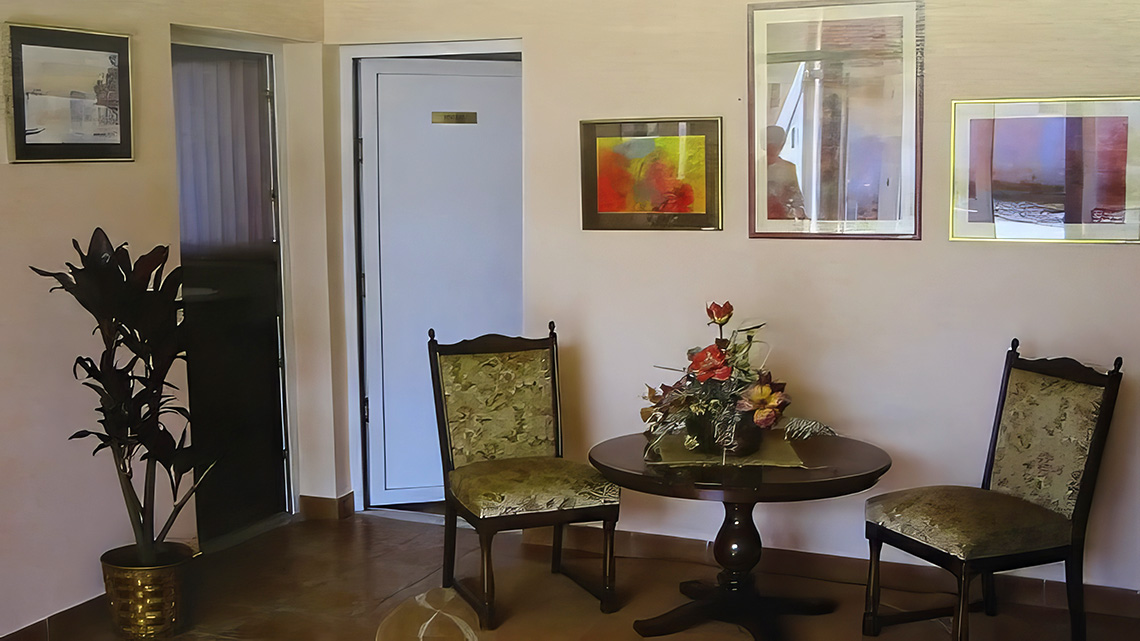
All spaces are beautified and adorned with works by painters from the "Art Colony," who traditionally donate their works to the Home every year as a gesture of solidarity.
Ramps are installed at the entrances of all ground-floor pavilions, making them accessible to people with disabilities. Also, there are no barriers inside the pavilions for their unobstructed movement, with handrails mounted along the walls. Since the third department is a two-story building, it has an elevator, and since 2015, the first department has one due to the attics.
It has already been mentioned that the institution for adults and the elderly "St. Basil of Ostrog the Miracle Worker" is an institution of "social protection in transformation." What does this actually mean?
The answer to this question shows how much the institution's activity is embedded in broader social trends. Namely, in the process of joining the European Union, social policy is dealt with in Chapter 19. In solving this issue, European funds were available to our country. However, a problem arose because funds could not be obtained for expanding accommodation capacities but only for those investment activities and activities aimed at gradually releasing users from social protection institutions and their placement in special accommodation capacities within their local community.
According to the current situation in the Home "St. Basil of Ostrog the Miracle Worker," it is estimated that a third of the users could leave the institution. This would create conditions for raising standards, i.e., the quality of accommodation and life, and make more space for those residents who stay here indefinitely and with 24-hour supervision. The requirement for "increased norms," i.e., more employees taking care of fewer users, would also be met. In this case, it would be possible to respond positively to numerous justified requests for accommodation.
Among the users who could leave the institution, some would return to their own families, a few more would continue living in the open community with support, and most would be housed in small communities in special housing units on the institution's premises.
The institution for adults and the elderly "St. Basil of Ostrog the Miracle Worker" operates within the broader system of social protection and represents a significant factor in
the effort to overcome, or at least minimize, the life problems of people in social need, to enable them for independent living, meet their basic needs, and show them how to exercise their rights. To this end, all employees perform their work tasks through the following services:
- Service for providing professional-social work services
- Service for providing healthcare services
- Service for general and legal affairs
- Service for financial-accounting affairs
- Service for maintaining buildings and equipment, transport, and physical security of the premises
- Procurement service and kitchen block
- Non-institutional protection service


Comments