



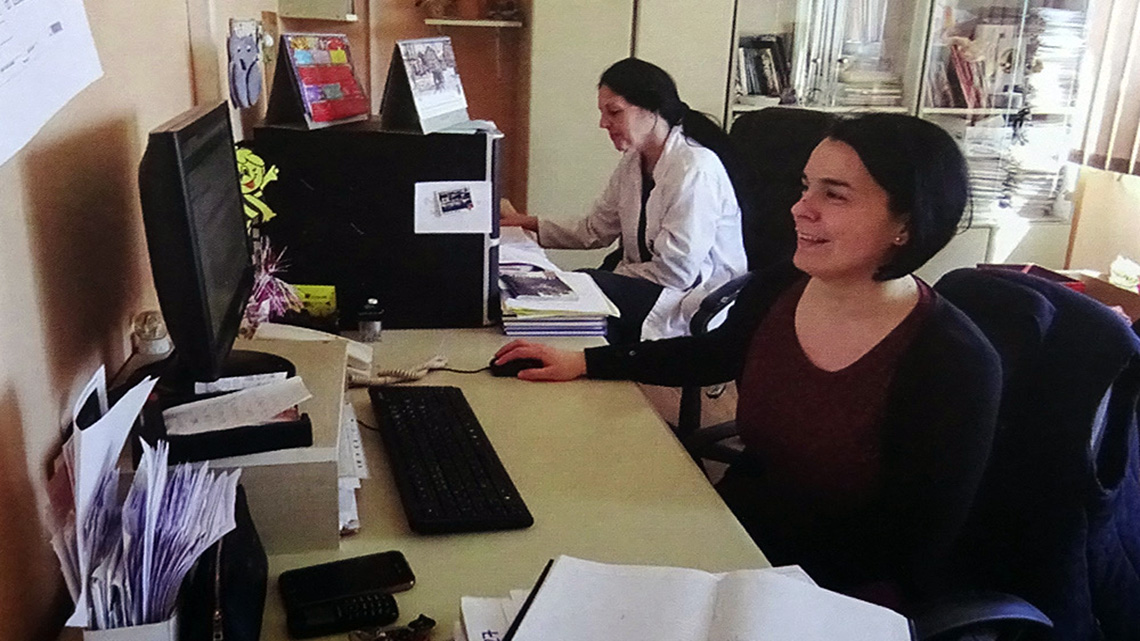
The Home "St. Basil of Ostrog - Miracle Worker" as a social protection institution addresses the social and life problems of users, bringing the activities of social work to the forefront.
Advisory work, psychosocial support, empowerment, assistance in realizing certain rights, contacts with relatives and referral centers for social work are just some of the activities within the framework of social protection that are applied daily in working with users. The main bearers of these tasks in our institution are social workers.
The social service developed together with the Institution. It went through all the crises and advances, adapting to social changes, new value systems, and contemporary trends in the field of social activities.
The service for providing professional and social work services in the institution began to form only in the 1970s. Until then, tasks that fell under the scope of social work were performed by all employees, each in their own way and according to their abilities. This was possible due to the number and structure of users, the lack of professional staff, a different value system, as well as the criteria that were valid in the field of social protection at the time.
By the late 1960s, there was a felt need to elevate this segment of work to a higher, significantly higher-quality level. The then-chief accountant, Ana Vlaškalin, after completing the Higher School for Social Workers, began to comprehensively engage in this field in 1973. That year marks the beginning of modern social work in the institution. The apparent lack of professional personnel in the field of social work led the then-management to invest more in the education of employees, sponsoring their undergraduate and specialist studies in social work. Alongside this, their professional development was encouraged through various seminars and other forms of education.
Ana Vlaškalin performed the job of a social worker until her retirement in 1994. Alongside her, Dušanka Pajić should be mentioned, who, after working as a nurse and occupational therapist, became the second social worker in the institution in 1978, performing these duties in all departments until her retirement in 2006. The third in this service was Slavica Cica Arsenov. She was the first graduate social worker in the Home. She worked as a social worker from 1980 to 2002, previously performing various administrative tasks. She served in the first and third departments, in the Day Club, and briefly as the deputy director of the institution.
In the 1990s, Jadranka Lazić, who had previously worked as a nurse, and Veselin Sudarski were employed as social workers. Sudarski, who worked in all departments, retired in 2012. According to user Tanja Lopičić: "He had an incredible talent for assessing people. He knew the home like the back of his hand and it was like a second home to him. Veselin will forever be running around the home." Since 2015, Jadranka Lazić, as a graduate social worker, has been employed, mainly performing her duties in the second department.
From 2006 until her retirement in 2015, Nada Ninić worked as a social worker in the first department, and from 2008 to the present, Zoran Mandić has been working. In addition to serving in the first and third departments, Mandić also managed home care and assistance services.
After about forty years, there was a need for the employment of new social workers. This led the management to invest in the education of employees from 2005, sponsoring Jadranka Lazić and Zorislava for their undergraduate studies and Zoran for his specialist studies in social work.
Recently, Slavica Bogdanović (from 2013 to 2017), Marija Cucin (from 2014 to the present), and Zorislava Vojnov (from 2017 to the present) have been employed as social workers. Slavica Bogdanović worked on establishing the "Supported Housing" service, Marija Cucin is engaged in the "Open Embrace - Supported Housing" project, and Zorislava Vojnov, before her role as a social worker in the third department, was an occupational therapist.
From 2004 to 2015, Nada Džigurski provided logistical support to social workers, performing administrative tasks in this service.
In performing their duties, social workers start with diagnostics. Upon admission to the institution, preliminary interviews (interviews) are conducted with users, and based on this, an assessment of their condition and potentials is made. This assessment is the basis for further work with them.
After that, work begins on rehabilitation, adaptation, empowerment, and utilization of their capabilities. Based on individual plans, goals to be achieved in a certain period, measures and activities to achieve those goals, individuals who will participate in the implementation of the plan, and the resources needed are defined.
Social rehabilitation activities are aimed at solving a range of social security problems, solving family problems, ensuring contact with the family, cooperation with the referral center for social work. It is of great importance to include users in cultural, entertainment, recreational, sports, and other occupational activities. Also important is the work on structuring their time, discovering and encouraging the optimal life potentials of each user, and providing assistance in overcoming life difficulties.
The psychological protection of the Home's users also operates within this service.
The psychological service in the Institution started working only at the end of 2003, with the approval of the job position by the relevant ministry and the arrival of Dragica Višnjevac - Fink, a graduate psychologist and gestalt-oriented psychotherapist. Her education in the Gestalt psychotherapy program was financed by the Institution. She conducted extensive research in the field of psychiatry on the topic "Evaluation of Group Treatment with Gestalt Orientation in Working with Hospitalized Psychotic Female Patients". Enriched with experience gained at the Home, she went to the United States, where she worked in the field of non-institutional protection. Her arrival initiated project work. The first project, "Psycho-Social Rehabilitation and Reintegration of Users with Psychiatric Disorders," was accepted by FSI and funded by the Kingdom of Norway. It was implemented during 2003 and 2004. In 2008, Ivana Ružička, a graduate psychologist and also a gestalt psychotherapist, took the position of psychologist. She was employed at the institution until 2018, simultaneously running a private practice in the field of psychotherapy. Another psychologist, Tatjana Kovač, who was previously a nurse and also sponsored by the management, started working in 2015. She completed her master's degree in psychology with the support of the Institution. Two years later, as part of the "Aromatherapy" project, and later the "Open Embrace" project, Dunja Iličić, a master's psychologist and supportive psychoanalytic psychotherapist, was employed.
Each of these workers, within the activities of the psychological service, dealt with, and continue to deal with, individual work with users, as well as psychotherapy according to their orientation, but mainly with techniques from the fields of behavioral, relaxation, transactional, and gestalt therapy. This is a job to which the psychologist devotes most of their time. It involves daily advisory conversations, and, if necessary, psychotherapy of states, emotions, and behaviors, resolving conflicts between users, providing support to new and old users, and so on. Conversations with users are conducted at their initiative, as well as based on the assessment of the professional worker themselves, and take place in the psychologist's office or in their rooms.
The psychologist's activity includes psychodiagnostics as part of the preparation of an individual service plan, at the request of various services, starting from the psychiatrist, guardian, center for social work, etc. Support groups are organized for new users to help them adapt to the institution's conditions and integrate into the home's community.
Psychologists work on increasing group cohesion through appropriate education and informal meetings. The psychological service has also directed its work towards promoting mental health, preventing mental disorders, and trying to cooperate with health, educational, social, and regional mental health centers (Karika - Network for Better Mental Health, organized by the Institute of Public Health of Vojvodina).
Within the psychological service, educational workshops for the institution's wards and users of the "Supported Housing" service are prepared and conducted. Psychologists attend therapeutic communities in all three departments, where they contribute to a harmonious atmosphere in the group, as well as resolving any problems or conflicts. Their task is the destigmatization of users by bringing them closer to the social community, most often through excursions, visits to theaters, book promotions, sporting events, and the like.
In some cases, if deemed appropriate, psychologists also work with relatives (with parents or children of users) to establish a harmonious relationship among them.
The psychologist's work is also directed towards employees, in terms of resolving conflicts among workers, educating workers on various topics such as burnout at work, familiarization with psychiatric diseases... Psychologists are also members of the institution's expert team, and as such participate in all events within its framework and in the work of the commission for the admission of new users. They have participated in conducting evaluations of user satisfaction with the institution's living conditions and similar, and have also conducted educational activities for pensioners in the city.


Comments