



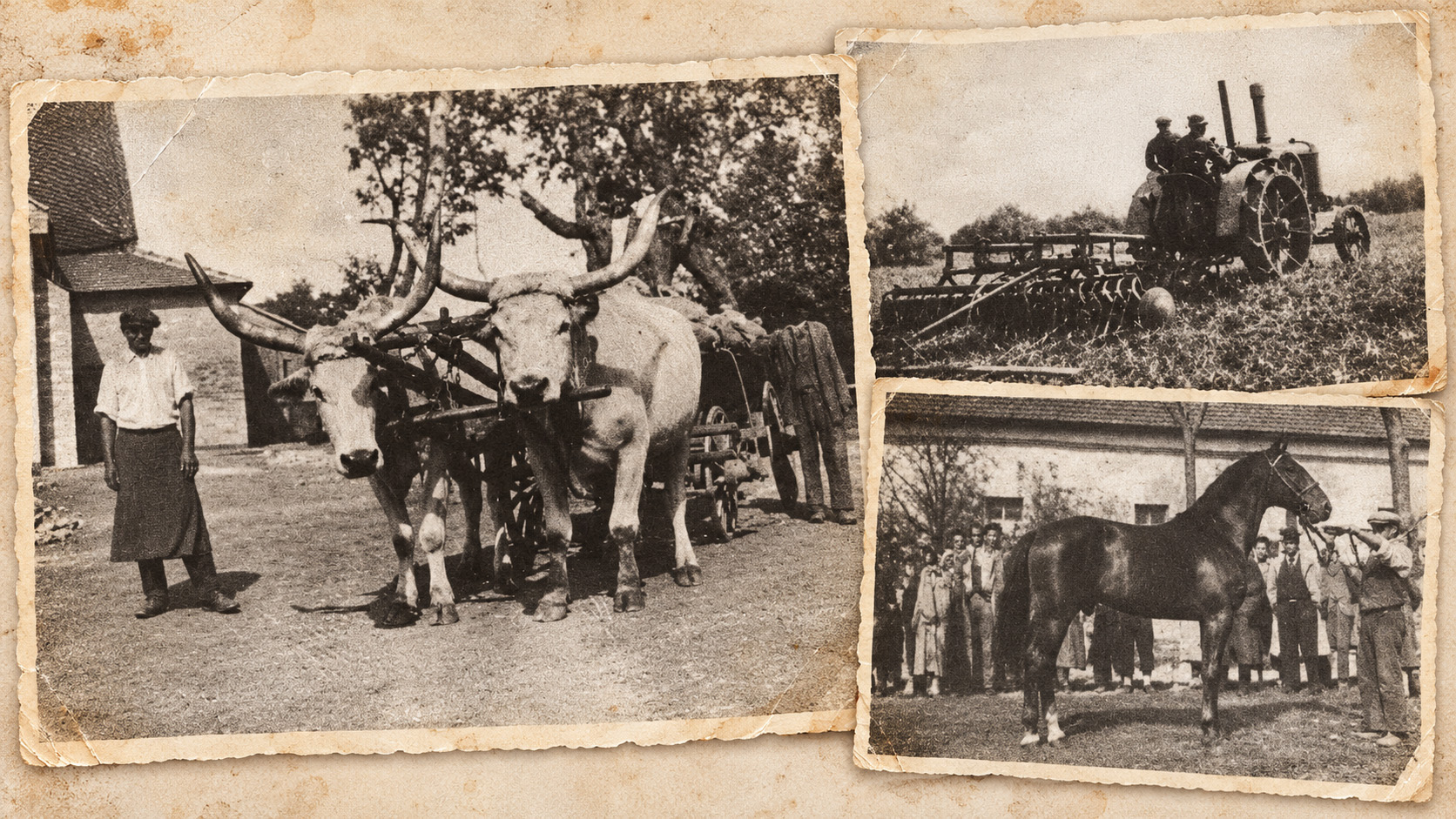
By the end of 1945, according to the figures provided, Kamendin had a total of 1,906 cadastral jutra of arable land.
To manage the estate and organise agricultural production, the administrative and operational management authority and higher state bodies appointed and dismissed managerial and professional staff.
On 13 October 1945, the Serbian Ministry of Agriculture assigned administrative clerk Ljubomir Živanović to Kamendin. However, he was dismissed on 27 November of the same year. A complaint against him, written by Lazar Kolarski, contained serious allegations concerning his work and conduct:
“He is unsuitable for the administrative duties and correspondence register assigned to him, because he does not understand even the simplest tasks relating to administration and the register and performs them incorrectly. Moreover, he is disorganised and disobedient. He constantly requests advances on his salary, which he immediately spends on drink. On the 19th of this month, he went to Novi Sad to look for belongings lost during his move and stayed for another day, during which he spent all his money on drink. He then borrowed 50 dinars from Ivan Marinkov, an employee of Đoka Dunđerski, and spent that on drink as well. Afterwards, he met me, Lazar Kolarski, in the street and asked to borrow 200 dinars, which I refused. When I refused, he began threatening me over what he considered irregularities on the estate. It is impossible to work with such a man, and I therefore request his removal from the estate as soon as possible, since I need his accommodation for another clerk.”
In early January 1946, Ivan Brand was also transferred from the estate. He became manager of the Provincial Agricultural Station for Hemp and Maize Breeding in Kulpin. Lazar Jošanov was appointed in his place, with a gross salary of 5,200 dinars.
In September of the same year, Jošanov left to perform his military service. Engineer Marko Paunović from Novi Sad, previously the estate’s operations manager, was then appointed manager of Kamendin.
Alongside Paunović, the following staff worked on the estate:
| Name | Position | Recorded salary |
|---|---|---|
| Branislav Petrović | Estate supervisor | 4,000 dinars |
| Lazar Kolarski | Estate supervisor | 3,000 dinars |
| Teodor Sekulski | Part-time veterinary assistant | 3,800 dinars |
| Vladimir Pop-Jovanov | Accountant and cashier | 4,000 dinars |
| Milan Vukelić | Accountant and cashier | 4,000 dinars |
| Stevan Lukić | Administrative clerk | 3,000 dinars |
Petar Jovanović also worked at Kamendin as an estate operations manager from December 1945 to February 1946, before transferring to Kulpin.
Livestock Selection and Cooperation with the Veterinary Serum Institute
The first livestock selection at Kamendin took place in the summer of 1946. Foundation breeding animals were selected and entered in the herd books.
Purchases of pedigree livestock from abroad began the following year. For example, five bulls and 46 heifers were bought from Czechoslovakia. Pigs were generally bred from the estate’s own stock.
In addition to breeding selection and fattening, Kamendin supplied pigs during the early postwar years to the Kamendin State Veterinary Serum Institute in Novi Sad. From the first days after liberation, that institute had been designated an enterprise of special federal importance.
Because of the considerable demand for serum production, B. Kostić, head of the Department of Agriculture and Forestry, ordered in late February 1946 that all pigs being fattened at Kamendin weighing approximately 130 kilograms should be supplied to the Veterinary Serum Institute. They were intended for the production of serum against swine fever, at a price of 25 dinars per kilogram of live weight.
By 1 December 1946, 350 pigs had been placed in fattening at Kamendin. By 1 January of the following year, five had died, 20 had been removed from fattening, two had been slaughtered to feed the workers, and 100 had been delivered to a livestock purchasing enterprise. At the end of the year, 223 pigs remained in fattening.
Inspection of the English Thoroughbred Stud
A commission from the Department of Agriculture and Forestry of the Main Executive Committee of the People’s Assembly of the Autonomous Province of Vojvodina visited Kamendin on 21 January 1947. Its task was to assess the condition of the English Thoroughbred breeding stock, on which it prepared a detailed report.
The commission consisted of:
- engineer Kamenko Ćirić, head of the Main Executive Committee’s Livestock Section;
- engineer Milan Maksimović, an officer in the same section;
- Franja Marušić, veterinarian;
- engineer Borivoje Rajković;
- engineer Branko Čolanović, manager of the stud farm in Stara Moravica.
The report stated that Kamendin had 37 English Thoroughbred mares. The reproduced list recorded the following names and years of foaling:
| Mare’s name | Year foaled |
|---|---|
| Crnogorka | 1923 |
| Retunde II | 1928 |
| Hentalan | 1941 |
| Honej | 1929 |
| Kosovka | 1931 |
| Minek | 1931 |
| Rumba | 1931 |
| Manon | 1932 |
| Morana | 1932 |
| Pepina | 1932 |
| Ljupka II | 1933 |
| Ružica | 1933 |
| Dont veri | 1934 |
| Simplonida | 1941 |
| Medina Kazbaš | 1934 |
| Para | 1937 |
| Ekserdoboz | 1936 |
| Olimpijada | 1939 |
| Dubravka II | 1937 |
| Hitra | 1938 |
| Ljubomorna | 1938 |
| Fog meg | 1939 |
| Stamina | 1940 |
| Verše | 1940 |
| Misterija | 1940 |
| Rabah | 1940 |
| Helvecija II | 1940 |
| Klari | 1940 |
| Dona | 1941 |
| Rajtuto | 1941 |
| Duši | 1942 |
| Parica | 1943 |
| Hanuma II | 1943 |
| Bedevija | 1937 |
| Punom | 1941 |
The estate also had three English Thoroughbred stallions: Konzul, foaled in 1929; Komodo, foaled in 1939; and Moran, foaled in 1931.
The commission proposed transferring Honej, Kosovka, Rumba, Morana, Simplonida, Helvecija II, Dona, Hanuma and Bedevija to the half-bred stud farm in Stara Moravica to expand its foundation breeding stock. The stated reason was that they did not meet the requirements for English Thoroughbred breeding, having produced offspring with little racing value.
Interestingly, Honej, Rumba, Morana and Ružica were descendants of Idomeneus, Đoka Dunđerski’s favourite horse.
Hentalan and Rajtuto were allocated to the Provincial Stud Farm in Hajdučica to expand the breeding stock for purebred and half-bred Anglo-Arabian horses.
The commission recommended selling Pepina because she was barren and had not foaled since 1942, and Parica because of a deformity of the fetlock joints in her right foreleg.
The remaining mares stayed at Kamendin until the 1950s. The commission recommended using Komodo and Konzul for breeding, although neither fully met the requirements for a breeding stallion. It therefore emphasised the need to consider importing Thoroughbreds from England.
During the 1946 breeding season, 29 mares were covered: 22 by Konzul, four by Komodo and three by Moran. The other mares were not covered because they were racing or were already in foal.
At the end of its report, the commission concluded that conditions at Kamendin were no longer satisfactory for breeding English Thoroughbreds. In addition to the deteriorating stables, grazing opportunities were limited. It recommended investigating the possibility of moving the stud to Čib or Stara Moravica.
Crop Production and Yields in 1946
According to the overview associated with the 1,906 cadastral jutra of arable land recorded at the end of 1945, the distribution of cultivated areas was as follows:
| Crop | Area in cadastral jutra |
|---|---|
| Winter wheat | 370 |
| Winter barley | 107 |
| Spring barley | 64 |
| Spring oats | 109 |
| Spring vetch | 111 |
| Peas for human consumption | 77 |
| Maize | 613 |
| Millet | 10 |
| Foxtail millet | 56 |
| Hemp for seed | 20 |
| Hemp for stalks | 114 |
| Sunflower | 98 |
| Fodder beet | 10 |
| Beans | 29 |
| Established lucerne | 62 |
| Maize for green fodder | 51 |
| Garden | 5 |
These figures show that maize and fodder-crop production increased after liberation to support more intensive livestock farming. Substantial pea production also continued, supplying raw material to the “Kulpin” factory in Novi Sad.
Kamendin’s total maize output in 1946 amounted to 5,244 metric quintals. Of this, 50 quintals were given to workers as ris, a payment in kind for harvesting, while the remainder was retained for the estate’s needs. An average yield of 15 metric quintals of maize on the cob was also recorded.
Winter wheat production totalled 3,441 metric quintals, with a stated yield of eight quintals per jutro. Winter barley output amounted to 1,223 metric quintals, with a stated yield of 14 quintals per jutro. Spring barley yielded six quintals per jutro, while spring oats yielded 7.75.
The drought that year contributed significantly to the low yields, alongside the other difficulties facing postwar agriculture in Vojvodina.
In these production records, a metric quintal equals 100 kilograms. A cadastral jutro is a historical unit of land area.
Production in 1947
The following year, maize was grown on 674 cadastral jutra. Total production reached 10,890 metric quintals, comprising 9,399 of first-grade and 1,491 of second-grade maize. A total of 149,260 bundles of maize stalks were also cut.
On 127 cadastral jutra planted with the Flajšman wheat variety, output amounted to 2,050 metric quintals, with an average yield of 16.14 quintals per jutro. On 67 jutra planted with the Crveni kralj variety, the yield was ten quintals per jutro.
The 1947 overview also recorded 620 cadastral jutra under winter wheat, with an average yield of 8.03 metric quintals per jutro.
Winter barley occupied 150 jutra and yielded 8.77 metric quintals per jutro. Spring barley was grown on 30 jutra, with a yield of 9.66 quintals.
On 132 jutra under spring oats, output totalled 1,153 metric quintals, averaging 8.73 quintals per cadastral jutro.
Hemp held an important place among industrial crops. On 267 jutra planted with the Flajš variety, production amounted to 9,209 metric quintals, with an average yield of 34.5 quintals per jutro. Hemp for seed was grown on 70 jutra, averaging 3.17 quintals per jutro.
Fodder Crops and Vegetables for the Workers
Since livestock production was the institute’s primary purpose, considerable attention was devoted to fodder crops.
The production overview recorded the following areas and yields:
| Crop and purpose | Area in cadastral jutra | Average yield in metric quintals per jutro |
|---|---|---|
| Lucerne for hay | 132 | 7.20 |
| Vetch | 82 | 3.64 |
| Winter field peas | 64 | 5.30 |
| Spring vetch | 30 | 2.73 |
| Lucerne for seed | 10 | 10 |
| Foxtail millet for seed | 10 | 3.80 |
| Fodder beet for roots | 23 | 15 |
The 64 jutra planted with winter field peas produced a total of 339 metric quintals.
Vegetables were also grown to supply the estate’s workers during the early postwar years and later. Potatoes occupied 20 cadastral jutra, with an average yield of 31 metric quintals per jutro. Beans were grown on 24 jutra, yielding 3.97 quintals per jutro, while peas for human consumption occupied 50 jutra and yielded seven quintals per jutro.
The Arrival of Electricity
Despite the difficult postwar conditions, efforts were made to improve living conditions at Kamendin for both permanent and seasonal workers.
The year 1946 was particularly significant because electricity was brought to the estate for the first time. According to the recollections of older workers, the newly lit bulb was intended to symbolise a new stage in Kamendin’s history.
The Transition to a Planned Economy
The country’s reconstruction was carried out primarily through its own resources, with assistance from UNRRA, considerable effort and widespread public participation. The determination to overcome the consequences of war, together with support for the new authorities and their measures, contributed to preparations for the transition to a planned economy during 1946.
Changes in social and property relations at the end of the war and immediately after liberation were implemented through various measures: confiscation, sequestration, the seizure of wartime profits, agrarian reform and colonisation, the cancellation of peasant debts, and other procedures. The state, acting through the Communist Party and mass organisations, played an increasingly powerful role in implementing these changes.
That role extended beyond changing ownership of the means of production. The state was expected to organise production and centralise distribution, which was considered particularly important in a still underdeveloped country with limited capacity to accumulate investment funds.
Expropriation and other measures strengthened the state sector of the economy. The Basic Law on State Economic Enterprises, adopted in August 1946, was especially important. It gave the state a central economic role in the early development of socialist relations and established the organisational foundations for implementing the Five-Year Plan.
Drawing on Soviet experience in economic planning, primarily based on rapid industrialisation and electrification, the Communist Party of Yugoslavia believed that the country’s inherited economic and cultural backwardness could be overcome through its first Five-Year Plan.
The First Five-Year Plan and Vojvodina’s Role
In April 1947, the People’s Assembly adopted the proposed law on the First Five-Year Plan for the period 1947–1951. According to the original text, the general objectives for the country as a whole were given legal form on 28 August of that year.
The plan envisaged overcoming economic backwardness, achieving economic independence, strengthening defence capabilities, improving the population’s general welfare, and consolidating and developing the socialist sector. It also emphasised the need to reduce differences in economic development between regions.
The foundations for accelerated growth were sought in the development of basic industry, which was expected to support progress in other industrial sectors, transport and agriculture.
The federal plan was followed by republican and provincial plans. The Five-Year Plan of the People’s Republic of Serbia was adopted in June 1947.
Based on the federal and republican plans, which defined Vojvodina’s place and role in the planned economy, the provincial Five-Year Plan was adopted at the Eighth Session of the People’s Assembly of the Autonomous Province of Vojvodina on 7 September 1947.
Agriculture played an important role in the country’s industrialisation under all these plans. The main emphasis was on improving production, expanding cultivated areas and diversifying crops.
The principal task of agriculture and the “working peasantry” was to produce more food for workers and the rest of the urban population. Agriculture was also expected to supply industry with raw materials and provide products for export.
Planned Growth in Crop and Livestock Production
Vojvodina’s First Five-Year Plan envisaged agricultural production exceeding its 1939 level in every sector. Particular emphasis was placed on bread grains, industrial and fodder crops, vegetables, animal fat, milk and other products.
The cultivated area was expected to increase from 1,668,000 hectares in 1939 to approximately 1,700,000 hectares in 1951.
At the same time, the area under cereals was to be reduced by five per cent compared with 1939, in favour of industrial crops, particularly sunflower, sugar beet and hemp.
To increase yields, the plan called for land improvement, greater use of chemical inputs and an expanded machinery fleet. By 1951, wheat yields were expected to reach 16 metric quintals per hectare, maize 30 and oats 14.
The plan also envisaged increasing livestock numbers and improving their quality. Compared with 1939, cattle numbers were to rise by 24 per cent, pigs by 136 per cent, sheep by 63 per cent and poultry by 33 per cent.
Particular attention was paid to livestock nutrition, the expansion of fodder-crop areas and veterinary measures to protect animal health. Veterinary services were expected to focus primarily on prevention:
“To implement various preventive measures in advance, rather than take part in putting out a fire only once it has flared up.”
According to figures in the proposed provisions of Vojvodina’s Five-Year Plan, infectious diseases caused livestock losses of 38 million dinars during 1946 and the first half of 1947. The same account separately recorded losses from dourine during 1946, estimated at approximately 250 million dinars.
Total planned investment in the development of Vojvodina’s state agricultural estates amounted to 776 million dinars. The funds were intended for the construction of storehouses, dairies, stables and housing for horses, sheep, cattle and pigs, silos and poultry houses. Workers’ housing was also planned to improve living standards for permanent estate employees.
Agricultural estates of provincial importance were expected to play a major role in achieving these objectives.
A New Administration and Changes in Kamendin’s Area
By a decision of the Main Executive Committee of the Autonomous Province of Vojvodina dated 18 October 1947, the Main Directorate of Provincial Agricultural Estates of Vojvodina was established. It took over all the assets, rights and obligations of the previous Provincial Administration of Agricultural Estates.
By that time, Kamendin already held more than 3,000 cadastral jutra of land, considerably more than the 723 jutra taken over in 1945. The estate’s area changed frequently during this period and in later years.
According to a statement of total land areas submitted to the Main Directorate by Milan Vukelić, identified in that document as the institute’s director, 1,795 cadastral jutra of arable land were received in late 1947. By early 1948, the estate held 3,568 cadastral jutra.
These changes were connected with the creation of larger state farms nearby and the allocation of land for other purposes.
In the autumn of 1947, part of the land was transferred to the Novi Sad City People’s Committee and industrial enterprises, including “Novkabel”. Through their trade union organisations, these enterprises used the land as workers’ farms and gardens.
Transfer of the “Savez” Estate in Sirig
On 30 January 1948, the “Savez” estate in the cadastral area of Sirig was handed over to the Sirig Municipal Farm, following instructions from the Agricultural Department of the Main Executive Committee of the Autonomous Province of Vojvodina.
The Kamendin Provincial Livestock Institute was represented by:
- Milan Vukelić, assistant director;
- Jakov Živanović, crop-production officer;
- Živa Đuragić, brigade leader.
The Novi Sad municipal authorities were represented by Lazar Bašić, committee chairman; Radivoj Radanov, commissioner of the Municipal and Technical Section; and Vjekoslav Vjelman, land surveyor. The Sirig Municipal Farm was represented by its director, Veljko Kovačević.
The handover was based on the condition found on site and the inventory dated 31 October 1947, with the book values of the transferred buildings, immovable property and movable assets recorded.
The surviving report provides a detailed picture of the land area, the condition of buildings, equipment and supplies, and the position of the workers. Its contents are reproduced below with language and presentation edited for clarity.
Land and Cultivated Areas of the Transferred Estate
The total land area amounted to 1,222 cadastral jutra, distributed as follows:
| Land category | Area in cadastral jutra |
|---|---|
| Class I arable land | 1,056 |
| Class II arable land | 33 |
| Pasture | 34 |
| Marshland | 57 |
| Reed beds | 25 |
| Land under the entry concerning “buildings and yards” | 2 |
| Field tracks | 15 |
| Total | 1,222 |
At the time of the handover, 250 cadastral jutra were recorded under wheat, 12 under winter barley and 54 under established lucerne.
The remaining Class I and Class II land had been ploughed to a depth of eight inches, except for 13 cadastral jutra that had not been ploughed.
The Residential Building and Living Conditions
The transferred estate had one residential building containing 14 workers’ flats. Each consisted of one room, a kitchen and a pantry.
The same building contained the manager’s flat, with a kitchen, pantry, entrance hall and three rooms, and the estate supervisor’s flat, with a kitchen, pantry, entrance hall, two rooms and a toilet. One room served as an office.
The building was constructed of masonry and roofed with tiles. The 14 workers’ flats had earth floors, while the office and the manager’s and supervisor’s flats had wooden floors.
A total of 25 small upper window sashes, 24 lower sashes and glass in 95 panes were missing. The commission concluded that the doors and windows were so deteriorated that they could no longer properly fulfil their purpose and could remain in use only for a short time.
Agricultural Buildings Listed in the Report
The handover included the following buildings and facilities:
- Cattle barn, 60 × 10 metres. It was built of brick, roofed with tiles and had an attic floor made of boards. It was in poor condition and could be used only for storing sunflower and oats. A wide brick-paved passage through its centre allowed wagons to pass. The livestock resting areas were made of compacted earth, and the troughs were concrete. The barn had a capacity of 100 cattle. It included a feed-preparation room measuring 6 × 10 metres that was at risk of collapse. The entire barn and its doors were deteriorated.
- Horse stable, 50 × 7 metres. It contained three sections and a harness room under the same roof, with space for 30 horses. It was built of brick and roofed with tiles. The wooden troughs were in poor condition, and the floor was compacted earth. The boarded attic could be used for storing hay. A total of 80 window panes were missing from this stable and the cattle barn described above. The building was assessed as being in poor condition.
- Shed adjoining the horse stable, 38 × 8 metres. It was built of masonry and boards, roofed with tiles, had no attic, and contained an earth floor and two sets of doors. It was in poor condition.
- Blacksmith’s and wheelwright’s workshop, 8.5 × 6 metres. It was built of brick, roofed with tiles, and had an earth floor and a plaster ceiling. The doors were neglected, and two windows had no glass.
- Small storehouse, 10 × 7 metres. It was built of brick, roofed with tiles and had a plaster ceiling. Its wooden floor was deteriorated. The doors were neglected, and the windows were worn, with two sashes missing.
- Farrowing house with a feed-preparation kitchen, 35 × 7 metres. It contained one usable and 18 unusable pens. It was built of brick, roofed with tiles, and had a brick floor and a boarded ceiling suitable for storing hay above. The kitchen had no oven but contained two concrete tanks.
- Feed storehouse, 28 × 10 metres. It was built of masonry, roofed with tiles, and had a boarded ceiling and floor, with steps providing access to the attic.
- Low pig house with paved pens, 22 × 6 metres. It was built of brick and thatched with reeds. The pens were paved with brick.
- Pig-feeding shed, 21 × 6 metres. Its eastern side was built of brick, while the other three sides were open. It had a reed-thatched roof and a brick floor. The shed was deteriorated and unusable.
- Kitchen for preparing pig feed, 5 × 7 metres. It was assessed as completely unusable.
- Pig house with pens, 22 × 6 metres. It had no roof and was completely unusable.
- Large pig-fattening enclosure, 29 × 13 metres. It had two sections and three pens. It was built of masonry and covered with worn reed thatch. All the boards and doors were missing from the pens. Two concrete water tanks stood inside.
- Poultry house, 14 × 2 metres. It had two sections, was at risk of collapse and was unusable.
- Small icehouse. It had been covered with reed thatch but was completely ruined and unusable.
- Small cellar, 4 × 2 metres. It was built of masonry, roofed with tiles and had an earth floor.
- Two bread ovens. They were built of masonry and were in working order.
- Two toilet structures with three compartments.
- Pig house with a shed. It was worn out and at risk of collapse.
- Pig house for the workers’ pigs, 17 × 3 metres. It contained eight sections, was built of brick, had a reed-thatched roof and an earth floor.
- Pig house for the workers’ pigs, with two sections. The reproduced report gives two different sets of dimensions for this entry: 5 × 3 and 28 × 7 metres. It was described as a brick building with a reed-thatched roof.
- Pig house for the workers’ pigs, 28 × 7 metres. It had 12 sections, was built of brick and was covered with reed thatch.
- Wooden drying shed. The report stated that it no longer existed.
- Cattle shelter with an enclosure, 15 × 6 metres. Three sides were built of brick. The reed-thatched roof was in poor condition.
- Maize crib, 100 × 2 metres. It ran from north to south, had a tiled roof and was in usable condition.
- Four wells. They were lined with brick and sealed with cement.
Equipment and Blacksmith’s Tools
The following non-living inventory was transferred:
- one usable wagon scale with a capacity of 3,000 kilograms;
- one horse-drawn “Unicum” grain drill with 16 seed tubes, serial number 183,609.
The blacksmith’s workshop handover included:
- one machine;
- one anvil;
- four hammers;
- three hand hammers;
- six tools recorded as ručne steklje;
- 15 small tools;
- two tools recorded as najglazne;
- one šrafstug;
- one pair of snajcangle;
- two vendajzla;
- four spanners;
- four files;
- one drilling machine;
- six drill bits recorded as drvene burgije;
- six pairs of fire tongs;
- farriery tools.
Oxen and Fodder Supplies
Twenty-two oxen were assigned to the new farm on condition that they be returned to Kamendin by 1 August 1948 in the same condition in which they had been handed over.
The transferred fodder supplies consisted of:
- one stack of barley straw, approximately 15,000 kilograms;
- one stack of pea straw, approximately 15,000 kilograms;
- one stack of pea chaff;
- two stacks of barley chaff;
- 22 piles of maize stalks, comprising 10,000 bundles.
Special Handover Conditions and the Workers’ Position
The commission also agreed on special conditions governing the transfer.
Kamendin undertook to provide bread during February for the permanent workers on the Sirig estate, with the costs to be settled subsequently with the Sirig Municipal Farm.
The Kamendin Provincial Livestock Institute remained responsible for all obligations relating to the Sirig estate up to 31 January 1948.
As of 31 January, the permanent workers on the Sirig estate ceased to be Kamendin employees and transferred to the Sirig Municipal Farm under the same contractual conditions as before. They informed the commission that they agreed to continue working for the new employer.
Seed, artificial fertiliser and other goods allocated to Sirig that Kamendin had already received were to be handed over to the Sirig Municipal Farm. Kamendin was entitled to recover the value of the goods and their transport costs.
All premises on the Sirig estate were to be cleared by 5 February 1948, except for the attic above the cattle barn and the maize crib. Kamendin undertook to clear those spaces as soon as possible.
All manure found on the estate was transferred to the Sirig Municipal Farm.
The fixed assets listed in the report were to be transferred in accordance with the relevant regulation, at the book values recorded by the Kamendin Provincial Livestock Institute.
The report was prepared in four identical copies. One copy each was delivered to Kamendin, the Sirig Municipal Farm, the Agricultural Department of the Main Executive Committee of the Autonomous Province of Vojvodina, and the Novi Sad City People’s Committee.
Comments