



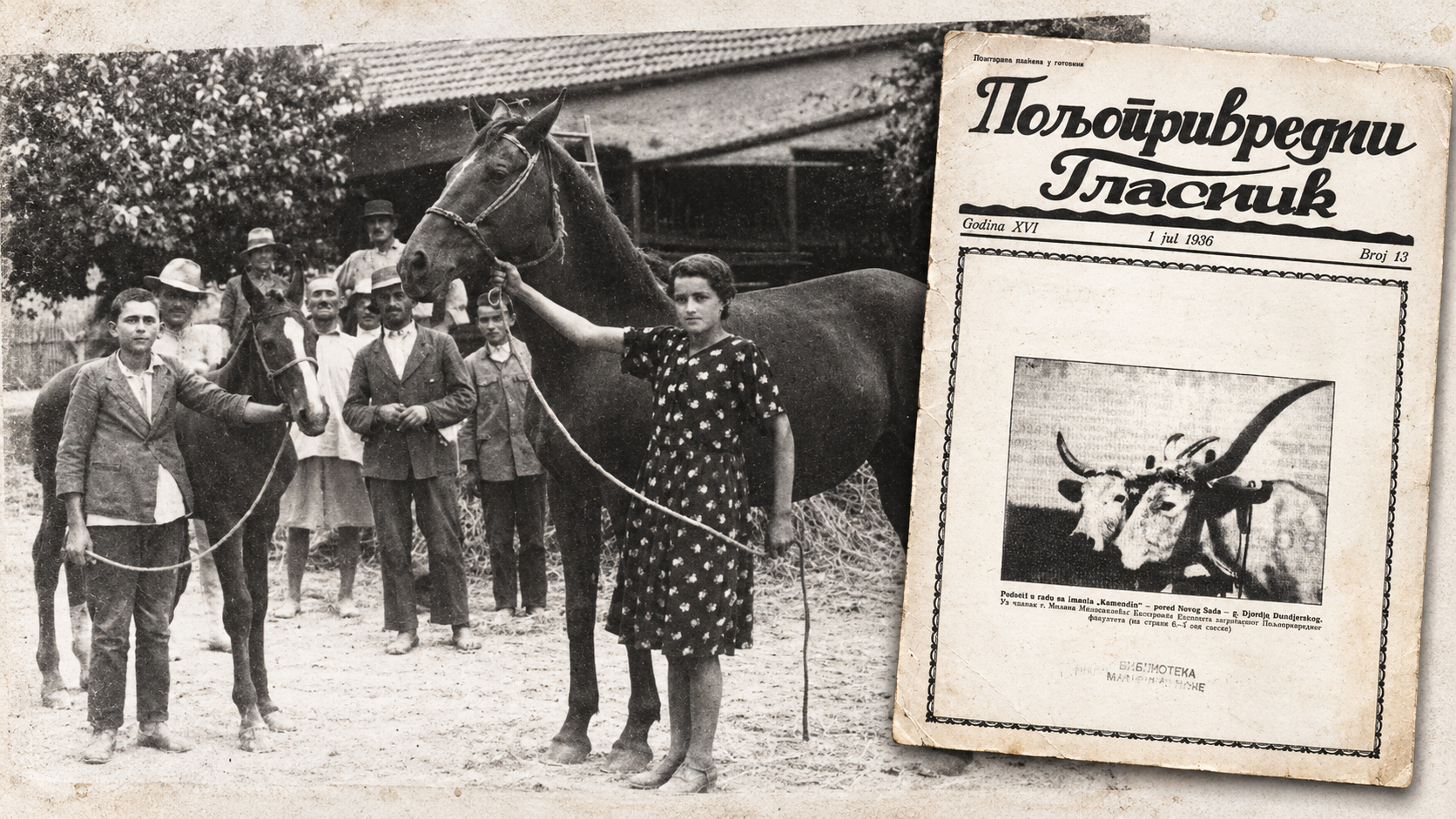
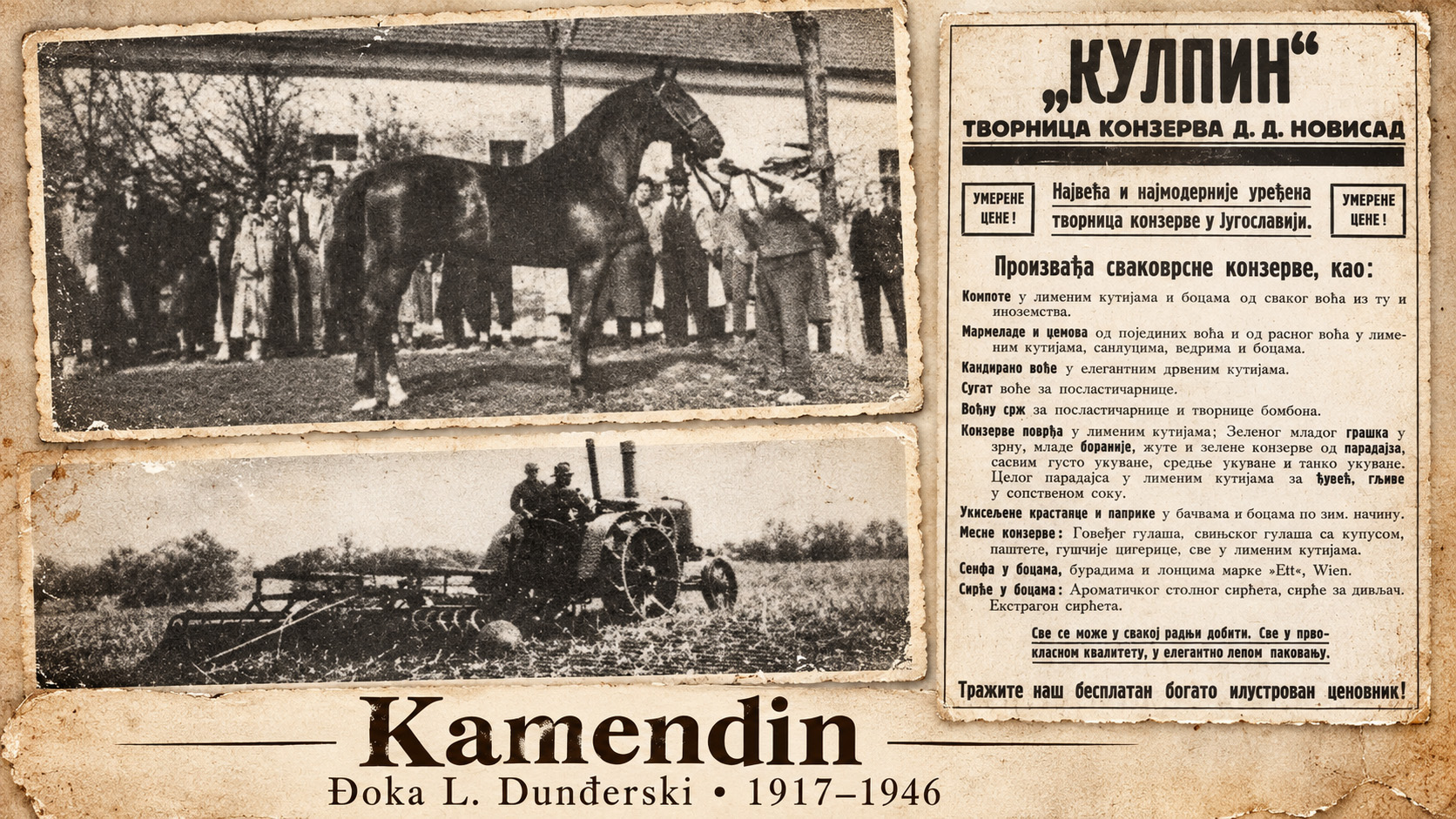
The liberation of Vojvodina in the autumn of 1944 brought new social and economic circumstances. During wartime reconstruction, Kamendin also directed its production towards supporting efforts to bring the war to an end. Products from the estate, processed in the Dunđerski family’s factories, particularly “Kulpin” in Novi Sad, were needed by Soviet troops and Partisan fighters at the front.
After the Second World War, the new authorities sought to deprive the prewar bourgeoisie of its political and economic power. Its property became a particular target, especially when classified as enemy property. Property belonging to members of the German minority was affected by decisions concerning the seizure of enemy assets. In November 1944, the Presidency of AVNOJ adopted a special decision transferring enemy property to state ownership.
The Law on Agrarian Reform and Colonisation, adopted on 23 August 1945, was particularly important in establishing a state land fund. Its basic principle was that land should belong to those who cultivated it. However, the reasons for implementing the reform were broader: alongside dispossessing large landowners and those regarded as enemies by the new authorities, it aimed to provide land for landless agricultural workers from impoverished, economically disadvantaged regions.
The preparation and implementation of agrarian reform took place amid complex changes in social and property relations. Establishing larger state farms played an important role in this process. Kamendin’s size and previously exemplary management made it suitable for this purpose. Đoka Dunđerski’s cooperation with the occupying authorities, as assessed by the new government, further supported the intention to transfer the estate from private to state ownership.
State farms established through expropriation and confiscation were placed under the administration of federal and republican ministries, municipal and local authorities, and the military. Their role was to support livestock and plant breeding, scientific research aimed at agricultural development, and the advancement of agricultural education.
The Condition of the Estate and Efforts to Preserve It as a Whole
Đoka Dunđerski’s large estate at Kamendin was in a difficult condition, although production had continued throughout the war. As various armies passed through, agricultural equipment was dispersed, some land remained uncultivated because of labour shortages, and the stables and livestock pens deteriorated because sufficient investment had been impossible under wartime conditions.
Following liberation, horses from Kamendin were requisitioned. According to a recorded statement by the new authorities, they were expected to work and “haul manure, rather than race for capitalists and earn them money”. This treatment of the racehorses resulted in the deaths of two valuable animals soon afterwards.
Đoka Dunđerski faced the certainty that his land would be taken away because he was classified as a non-farming landowner and regarded by the new authorities as a collaborator with the occupiers. Unlike during the prewar agrarian reform, this time he could not preserve his father’s estate. The owner’s advanced age and demoralisation further contributed to its neglect.
Nevertheless, records show that on 22 February 1945 he sent a letter to the Main People’s Liberation Committee of Vojvodina. He requested that a special commission of agricultural experts inspect his farm at Kamendin so that it could continue to serve livestock development. He submitted a similar request in September of the same year, after the adoption of the Law on Agrarian Reform, emphasising that Kamendin should be preserved as a complete experimental agricultural estate.
Establishment of the Kamendin State Livestock Institute
As early as late October 1944, the estate was placed under the supervision and administration of the Main People’s Liberation Committee of Vojvodina. Milan Dobrenov, the municipal agronomist from Novi Sad, supervised it on the Committee’s behalf.
Dobrenov’s illness, other circumstances, and particularly the decision to turn Kamendin into a livestock institute led to a change of supervisor. On 19 September 1945, the Presidency of the Main People’s Liberation Committee of Vojvodina appointed Jovan Popović, an officer in its Livestock Section, to this position.
By a decision of the Executive Committee of the People’s Assembly of the Autonomous Province of Vojvodina dated 1 October 1945, Kamendin was excluded from redistribution under agrarian reform. Its entire landholding was designated for the establishment of a provincial agricultural estate. This marked the beginning of a new period under the name Kamendin State Livestock Institute.
Decision No. III–14.418/945, issued by the Presidency of the People’s Assembly of the Autonomous Province of Vojvodina on 7 October under Articles 3 and 4 of the Law on Agrarian Reform, appointed a commission to take over the estate. On 13 October 1945, the commission took possession of Kamendin, including all its land, buildings, livestock, equipment and other assets.
The commission consisted of:
- Jovan Popović, the delegate of the Main People’s Liberation Committee of Vojvodina on the estate;
- Ivan Brand, the newly appointed first manager of the Kamendin State Livestock Institute;
- engineer Đorđe Isaković, the district agricultural officer from Novi Sad.
Lazar Kolarski attended the handover on behalf of the estate’s owner, Đoka Dunđerski.
At the time of the takeover, Kamendin’s total area was recorded as 723 cadastral jutra, a historical unit of land area. According to the inventory, arable land occupied 647 jutra, meadows 52, gardens two, and buildings, yards and roads 21 cadastral jutra.
Livestock Recorded in the Handover Inventory
The detailed handover inventory shows which assets were taken from Đoka Dunđerski and, consequently, what resources the Livestock Institute had when it began operating.
The following Simmental cattle were recorded:
- 16 cows;
- five pregnant heifers;
- six heifers under one year old;
- one weaned calf;
- two male and two female suckling calves.
The estate also had 44 Podolian oxen, four Simmental oxen and two buffalo.
Among the Montafon cattle and their crosses, the inventory listed one animal described in the source as a “buffalo for breeding”, three cows, three pregnant heifers, four crossbred cows, four purebred heifers under one year old, one young bull, five crossbred heifers under one year old, two weaned crossbred calves, two purebred suckling calves and three crossbred calves.
The pig population was particularly substantial. The Yorkshire stock included eight older and four younger boars, 83 sows, 179 young males and 180 young females, as well as 56 suckling piglets.
The Berkshire stock comprised 15 older boars, 87 breeding sows, 279 young pigs and 39 suckling piglets. In addition, the estate had 232 fattening pigs and 54 Mangalitsa pigs.
There were also 26 working horses. The 33 English Thoroughbreds were particularly valuable. Kamendin also had three donkeys.
Agricultural Machinery and Equipment
The handover inventory covered both movable and immovable assets. The estate had a 17-row seed drill, a hemp mower, an H. S. C. S. No. 10 threshing machine with belts, an elevator, three lifting devices, a tractor and an electrically powered maize sheller.
The inventory also included an inoperative tractor–binder recorded as “Kormik”, six inoperative flax threshers and two sorghum threshers. It listed 33 single-furrow ploughs, 15 harrows, ten small railway wagons, one inoperative rail trolley and a livestock scale.
The grinding mill contained, among other items, a “Volf A. G.” diesel engine and an inoperative stone mill.
Office furnishings included three desks, two cupboards, an AEG typewriter, a wall clock, a grain test-weight scale, an iron stove, a washstand with a basin and jug, and a night watchman’s clock.
A bathtub, a stove, a flush toilet and an iron stove were found in the manager’s residence. Stud-farm equipment included 11 leather halters, two oat chests, water buckets and other items.
The dairy had an “Alfa” separator, a butter churn, a butter-working roller with a table, an ice chest and two butter dispatch boxes.
Workshops, Stables and Transport Equipment
Kamendin also had a blacksmith’s workshop. Its detailed inventory listed two blower units with a fan, a humaka, an anvil, four hammers, one riveting tool, 11 assorted hammers, 18 rundstekle, two špicstekle, two anvil cutting tools, 11 naglajzen tools, 16 pairs of fire tongs, seven thread-cutting tools, six threading bits, four vendajzen tools, ten thread-cutting jaws, 11 spanners, one stos file, one pair of nail tongs and one pair of farriery tongs, two hoof knives, two huflinge tools and one farriery cutting tool.
The inventory also included a farriery stand, two farriery leather items, two haiser tools, two hoof files, two wall-mounted tool racks, three covers recorded as navlake za đine, a metal saw, a drilling table, eight twist drills, two forged drills, two horse twitches, a workbench, 11 round punches, five horseshoe punches, three iron dividers, two fire shovels, two sirhakne, sheet-metal shears and a vice.
The equipment recorded in individual stables and pig houses provides further evidence of the estate’s facilities.
The cow barn contained two tethering ropes, three straw-cutting knives, one milk can each of 30, 15 and five litres, a water bucket and four wooden handbarrows.
The farrowing houses for Yorkshire pigs contained eight wooden troughs two metres long, 61 wooden troughs one metre long, 12 water buckets, a wooden barrel, donkey harness and a large-capacity wheelbarrow.
The farrowing houses for Berkshire pigs had 14 medium-sized wooden troughs, 15 wooden partitions, ten water buckets, eight wooden boar troughs two metres long, two feed chests, four troughs one metre long, seven hay ladders, an iron water cauldron and a manure cart.
The houses for fattening pigs contained three iron troughs two metres long, two wooden troughs four metres long and ten wooden troughs two metres long. Also recorded were 25 sacks, ten water buckets, four iron shovels, two wells with pumps, two handbarrows, and one each of the following: a feed chest, a built-in iron cauldron, a lantern and a large-capacity wheelbarrow.
The wheelwright’s workshop had a workbench, a grindstone with a stand, a diamond glass cutter and a cabbage knife.
The horse stable contained 17 sets of horse harness, one set of harness for a two-wheeled carriage, four hemp blankets, five tethering ropes, seven curry combs, eight feed containers and three racks. It also had a lantern, a feed chest, a scythe with a handle, a well with a hand pump and a bed.
The ox stable had two wooden forks and iron forks with five tines, 14 containers recorded as porcije, four tethering ropes, four wooden handbarrows and ten curry combs. It also contained two each of wooden troughs, lanterns, water barrels and scythes, together with a straw-cutting knife, a feed chest, an iron shovel and a water pump.
The transport equipment on Đoka Dunđerski’s estate included:
- seven horse-drawn wagons;
- two flatbed wagons;
- one two-wheeled carriage;
- ten horse-drawn sledges;
- 11 three-horse, 15 two-horse and 12 single-horse draught bars;
- one small single-horse sledge;
- 15 ox-drawn wagons;
- one vehicle recorded as a drombor;
- four liquid-transport containers recorded as lajta;
- three watering troughs;
- two horse-drawn carriages;
- one dairy wagon.
The machine workshop contained, among other items, six files, two hand hammers, 21 spanners for nuts and 22 drill bits.
Warehouse Stocks
Warehouse stocks included various types of sacks, hand tools, grain and seed.
The inventory recorded 20 sacks for hemp seed, 60 sacks marked “Kulpin d. d.”, another 150 striped sacks of the same type, and 70 old, wide “Mautner” sacks.
Tools and other equipment included ten spades for lifting sugar beet, 20 beet-lifting forks, seven beet-loading forks, 16 hoes for working beet fields, 104 beet-thinning hoes, eight sets of draught traces, four cattle traces, 64 large hoes and one 20-litre enamelled pot.
Grain and seed stocks amounted to:
- 1,095 quintals of old wheat and 610 quintals of new wheat;
- 250 quintals of oats;
- 250 quintals of barley;
- 12 quintals of poppy seed;
- 20 quintals of white beans;
- 34 quintals of vetch mixed with oats;
- 28 quintals of flax seed.
Buildings on the Estate
The detailed building inventory also illustrates the scale of postwar Kamendin. The estate contained the following structures:
| Building | Materials and roofing as recorded | Dimensions |
|---|---|---|
| Manager’s residence | Brick, rammed earth, roof tiles | 22 × 10 m |
| Office and residential building | Brick, rammed earth, roof tiles | 28 × 17 m |
| Workers’ accommodation | Brick, rammed earth, roof tiles | 57 × 10 m |
| Workers’ accommodation | — | 61 × 8 m |
| Workers’ accommodation | Thatch | 28 × 8 m |
| Workers’ accommodation | Roof tiles | 38 × 8 m |
| Workers’ accommodation | — | 22 × 8 m |
| Workshop | Brick, roof tiles | 20 × 14 m |
| Locomotive shed | Brick, roof tiles | 15 × 6 m |
| Maize crib with living quarters | Brick, roof tiles | 47 × 5.5 m |
| Maize crib with a materials shed | Brick, roof tiles | 65 × 5.5 m |
| Small stud-farm storehouse | Brick, roof tiles | 4 × 5 m |
| Cow barn | Brick, roof tiles | 80 × 13 m |
| Stud stable | Brick, roof tiles | 57 × 10 m |
| Working-horse stable | Brick, roof tiles | 26 × 10 m |
| Working-horse stable | — | 38 × 8 m |
| Horse-wagon shed | — | 35 × 8 m |
| Ox-wagon shed | — | 20 × 8 m |
| Machinery shed | — | 38 × 8 m |
| Machinery shed | — | 37 × 6 m |
| Concrete silo | Concrete | Recorded in the source as “50 metres” |
| Icehouse | Brick, thatch | 12 × 5 m |
| House for weaned piglets | Brick, roof tiles | 17 × 11 m |
| Boar house | — | 17 × 10 m |
| Farrowing house | — | 77 × 7 m |
| House for young pigs | — | 40 × 13 m |
| House for pigs in the intermediate fattening stage | — | 28 × 9 m |
| Feed-preparation building | — | 7 × 6 m |
| Piglet-weaning house | Brick, roof tiles | 28 × 10 m |
| House for non-pregnant sows | — | 35 × 10 m |
| Farrowing house | — | 103 × 10 m |
| Livestock-feed building | — | 10 × 10 m |
| Fattening-pig house | Brick, thatch | 38 × 7 m |
| Livestock-feed building | Brick, roof tiles | 6 × 3 m |
| Weighbridge building | Brick, roof tiles | 5 × 4 m |
| Woodshed | Brick, roof tiles | 5 × 2 m |
| Beekeeping building | — | 4 × 3 m |
| Pig house | Brick, roof tiles | 16 × 3 m |
| Poultry house | Brick, roof tiles | 5 × 2 m |
| Workers’ pig house | Brick, roof tiles | 84 × 3 m |
| Workers’ pig house | — | 106 × 3 m |
A wall 153 metres long and two metres high surrounded the farmstead, while the manager’s garden was enclosed by another wall, 225 metres long and also two metres high. Three traditional sweep wells, located in front of the office, workshop and workers’ accommodation, gave the estate a distinctive Vojvodina character.
The estate also held substantial supplies of livestock fodder: two stacks of new and six stacks of old grain straw, two stacks of new and five stacks of old grain chaff, three and a half stacks of oat straw, five stacks of barley straw, five stacks of pea straw and 12 stacks of mixed straw containing flax.
At the end of the handover inventory, a note stated that the agricultural equipment was “in a rather dilapidated condition” and required repairs and the purchase of certain new items.
It was also noted that no land had been ploughed or sown for the autumn sowing season. The labour situation at Kamendin was considered somewhat better than at Kulpin, but the available workforce was sufficient only for agricultural work on the farm.
Expropriation and the Trial of Đoka Dunđerski
According to Nikola L. Gaćeša’s book Agrarna reforma i kolonizacija u Jugoslaviji 1945–1948 (Agrarian Reform and Colonisation in Yugoslavia, 1945–1948), page 191, the entire landholding, then amounting to 2,793 cadastral jutra, was expropriated following a decision by the District People’s Committee in March 1946.
On 29 September 1946, the newspaper Slobodna Vojvodina reported that Đoka Dunđerski had appeared before the “people’s court” in Novi Sad on charges of “economic cooperation” with the occupying authorities during the war.
The trial took place on 26 September 1946. Vojvodina’s public prosecutor accused Dunđerski of strengthening the occupiers’ war economy throughout the occupation, as the owner of Kulpin and Kamendin, by supplying a large share of their products to the Hungarian and German armies and various fascist institutions.
According to the indictment, the Hungarian army received 46 wagonloads of marmalade, 11 wagonloads of canned meat and four wagonloads of other canned goods, with a total value of 2,575,000 pengő.
Deliveries to the German army were listed as 16 wagonloads of marmalade, ten wagonloads of fruit compote and 35 wagonloads of cooked aubergine, valued at 1,635,000 pengő. Further quantities included 22,500 kilograms of fruit compote, 54,000 of canned green beans and 65,000 of canned peas, although the reproduced text did not specify a unit of measurement for the last two figures.
The indictment stated that the “Kamendin” factory supplied the Hungarian army with meat, bacon and various cured meat products worth 2,121,750 pengő, and supplied goods worth 1,975,784 pengő to various fascist institutions.
The prosecution further alleged that Dunđerski, motivated by personal gain, had sought to keep “Kulpin” and “Kamendin” operating at full capacity throughout the war. According to the same allegations, he used influential friends—Hungarian landowners, barons and counts whom he had brought onto the companies’ board—to obtain orders from the German and Hungarian armies.
Dunđerski was defended by the well-known Novi Sad lawyers Dr Kosta Hadži and Dr Aleksandar Moč. The defence argued that, despite his economic cooperation with the occupying authorities, he had made substantial donations to help children in the Sárvár camp and had demonstrated Serbian patriotic convictions.
Đoka Dunđerski was sentenced to 18 months of forced labour and the confiscation of all his property. He appealed on 23 December, and a decision dated 6 January 1947 reduced his sentence to seven months of forced labour without imprisonment, suspended for one year.
It was also recorded that he donated his expensive car to the city Party committee in Novi Sad. The car was driven by a man known as Rudika. It is not known whether this gift influenced the reduction of his sentence. During the same period, it was recorded that the committee gave his “Kulpin” factory a truck for the needs of the military and the population.
Đoka Dunđerski died on 24 October 1950, in his 77th year. He was buried in the family tomb in the cemetery in Srbobran.
Restoring Agricultural Production
Agricultural production in Vojvodina faced severe difficulties after the war. Labour was scarce, and livestock numbers had fallen considerably. For months, production had been directed towards supplying the front and feeding large numbers of Yugoslav and Red Army personnel.
The new authorities made major efforts to revive agriculture and integrate it into the country’s reconstruction. As a predominantly agricultural region, Vojvodina had an important role in feeding people in the areas most affected by the war, as well as the growing urban and industrial population associated with the rebuilding and construction of economic facilities.
Quality seed, workers and machinery were all in short supply. Vojvodina had barely a thousand working tractors in those years, one of which was at Kamendin. Livestock numbers had fallen by more than half. Recovery therefore required considerable effort and commitment.
Despite enthusiasm and the desire to build a new society, numerous difficulties prevented production at Kamendin from reaching its prewar level of 1939, when Đoka Dunđerski owned the estate.
The greatest challenges for livestock farming in Vojvodina were rebuilding herds and acquiring high-quality pedigree animals. Livestock feed was also scarce. The remaining quality stock was scattered across Vojvodina and mostly held by private owners, including members of the German community.
With the establishment of a state agricultural sector, measures were introduced to restore livestock production. In late 1945 and early 1946, intensive work began on organising provincial agricultural estates as centres for producing high-quality breeding animals. Kamendin was assigned an important role within this system.
In the first year after liberation, agriculture in Vojvodina was directed by the Department of Agriculture and Forestry of the Main Executive Committee of the People’s Assembly of the Autonomous Province of Vojvodina.
Workers and Youth Brigades
Through the efforts of long-serving Kamendin workers, supported by mass anti-fascist organisations, particularly the People’s Front from nearby settlements and Novi Sad, crop and livestock production resumed in the first days after liberation.
Many employees found it difficult to accept that their employer was no longer Đoka Dunđerski, but the state.
Labour shortages and the need to complete autumn work quickly led to the involvement of People’s Front and youth work brigades. In October 1945, two secondary-school youth brigades, comprising a total of 350 pupils, took part in a two-week campaign to lift sugar beet and cut maize stalks at Kamendin and in the fields of Pašićevo, now Zmajevo.
In the early postwar years, Kamendin also used the labour of interned Vojvodina Germans. According to the original text, around a hundred people, mostly women and children from the camp in Bački Jarak, worked on the estate until 1949. At that time, almost all of them left for Germany with permission from the Yugoslav authorities.
Kamendin within the Provincial Agricultural Estate System
The Administration of Provincial Agricultural Estates of Vojvodina was established on 2 January 1946 to manage state agricultural properties of provincial importance.
Acting on behalf of the Presidency of the People’s Assembly of the Autonomous Province of Vojvodina, which owned these estates, the Administration was responsible for preparing production plans and programmes, organising scientific and experimental research, drawing up the institution’s general budget and final accounts, and monitoring the fulfilment of obligations and tasks set by provincial and higher authorities.
On 11 October 1946, the Presidency of the Main Executive Committee of the People’s Assembly of the Autonomous Province of Vojvodina designated the Kamendin Livestock Institute as an enterprise of provincial importance.
From 31 December that year, it was known as the Kamendin Provincial Livestock Institute, with its headquarters in Novi Sad.
In addition to Kamendin, another 28 properties were managed by the provincial agricultural estate administration:
- provincial stud farms in Srbobran, Stara Moravica, Maradik and Hajdučica;
- the “Sokolac” Provincial Stallion Station in Novi Bečej;
- cattle-breeding estates in Temerin and Mramorak;
- a maize-breeding estate in Stari Bečej;
- a sheep-breeding estate in Sombor;
- the “Irmovo” poultry-breeding estate in Stepanovićevo;
- an estate for lucerne breeding and production in Bajša;
- a cattle- and pig-breeding estate in Crnja;
- an estate in Novi Sad for the production and breeding of field-crop seed;
- agricultural estates in Čib and Kulpin;
- a pepper-breeding estate in Horgoš;
- an agricultural estate in Banatski Karlovac, primarily responsible for cereal breeding;
- estates in Mihajlovo, Inđija, Futog and Veliki Tork;
- the Provincial Fruit-Tree and Vine Nursery in Bela Crkva;
- fruit-tree nurseries in Subotica, Zrenjanin, Beška and Sremski Karlovci;
- the Provincial Fruit-Growing and Beekeeping Station in Vrbas;
- the Provincial Floriculture Station in Novi Sad.
The total area of these estates was recorded as 53,933 cadastral jutra. According to the breakdown provided, arable land occupied 44,856 jutra, meadows 759, pastures 4,386, vineyards 455, orchards 218, woodland 347, marshes and reed beds 979, and unproductive land 1,951 cadastral jutra.
Professional Staff and Livestock on the Provincial Estates
Vojvodina experienced a serious shortage of trained agricultural personnel. In 1946, the provincial agricultural estates employed 28 agronomists with higher-level qualifications, 50 with secondary-level qualifications and 30 with lower-level qualifications.
There were only nine veterinarians with higher-level qualifications, two veterinary assistants and 144 other support staff.
In the same year, these estates employed 1,422 permanent year-round agricultural workers, 119 skilled workers and 52 tractor drivers.
The livestock overview listed 2,830 horses, 5,024 cattle, 11,560 pigs, a separately recorded category of 3,714 fattening pigs, and 4,578 sheep.
Registration of the Enterprise and Expansion of the Estate
By a decision of the Main Executive Committee of the People’s Assembly of the Autonomous Province of Vojvodina dated 31 December 1946, the Provincial Administration of Agricultural Estates of Vojvodina was established within the Department of Agriculture and Forestry. It served as the administrative and operational management body for the provincial agricultural estates. This represented an attempt to introduce more direct state supervision of agricultural production.
Under Articles 14, 15 and 17 of the Basic Law on State Enterprises, the Kamendin Provincial Livestock Institute was entered in the register of state economic enterprises on 19 January 1947.
Its principal activity was defined as:
“The breeding of all types of livestock, except sheep, and particularly the breeding of Large Yorkshire, Berkshire and Mangalitsa pigs and red-and-white cattle.”
Its secondary activities were the production of seed and the cultivation of industrial crops.
Under Clause 13 of the founding decision, the enterprise’s fixed assets comprised land and buildings, agricultural factories, industries of an agricultural nature, machinery, mechanical installations, dispatch and transport equipment, tools, models and inventory under its management. Their value amounted to 28,450,096 dinars.
Working assets included crops in the fields, stocks of raw materials, operating and auxiliary supplies, semi-finished goods and finished products on the estate, valued at 4,581,565 dinars.
The following individuals were authorised to sign on behalf of the enterprise:
- engineer Mirko Paunović, director;
- Milan Vukelić, accountant;
- Branislav Petrović, estate operations manager and deputy director.
It was specifically stipulated that the director could take out loans only with the approval of the administrative and operational management authority.
Following the seizure of Đoka Dunđerski’s estate, Kamendin held 723 cadastral jutra. To create a larger agricultural enterprise, the Provincial Livestock Institute also incorporated the 1,081 cadastral jutra that Dunđerski had sold to the Royal Ban’s Administration of the Danube Banovina in 1941.
A further 105 jutra belonging to the Sura family from Bački Jarak were added to the Institute. From liberation until July 1945, this land had been administered by the People’s Defence Corps of Yugoslavia.
Comments