



Non-institutional, or open care, refers to the provision of local community services, which is a form of social and health care for people who have entered a state of social need, whether due to old age or illness. These individuals require professional and general social assistance to overcome life's difficulties and continue living in their natural environment. The open care system consists of a range of measures and activities, as well as organizations and services, with the aim of prolonging the independence and good psychophysical health of the users. The activities of non-institutional care are funded by the resources of local government and the institution organizing this type of care, through projects, and in recent years also through earmarked transfers from the budget of the Republic of Serbia. Part of the costs is borne by the users themselves through co-payment.
This type of care has existed in the municipality of Novi Bečej for several years. The first considerations about the need to provide local services date back to the 1970s, when a house was purchased at 60 Marshal Tito Street, where 24 users were accommodated. They were visited daily by nurses. Meals were delivered on carts from a central kitchen, but they could also prepare food for themselves. Everyone had some responsibilities, and it was clear who washed the dishes, who maintained room hygiene, changed bedding, hung laundry, tended the garden, planted vegetables, etc. Users were allowed to go outside the facility. Today, this type of accommodation is called Supported Living, and we can freely say it was a precursor to non-institutional care. At the same time, based on the expressed needs for assistance to elderly households—care, cleaning, food preparation—social worker Ana Vlaškalin came up with the idea of providing local services.
Previous experiences with non-institutional care justify its existence and the need for it to be organized as a municipal service. In 2008, a Sustainable Development Strategy for the Municipality of Novi Bečej was developed, which planned the development of local services. At the end of 2017, a new Decision on Social Protection in the Municipality of Novi Bečej was adopted (introductory provisions, social protection services, improvement of social protection, etc.) and the Decision of the Assembly of the Municipality of Novi Bečej on the implementation of the local government budget in the part of planned expenditures for social protection services. Starting from 2017, the local government allocates funds from the budget for the material costs and functioning of the Day Care Center and Home Care services. In this way, non-institutional care, after about ten years of operation, ceased to be a project-based activity.
Within the Adult and Elderly Institution "Saint Basil of Ostrog the Miracle Worker," there are several forms of non-institutional care, including the Day Care Club, Home Care and Nursing, and Supported Living.
Day Care Club
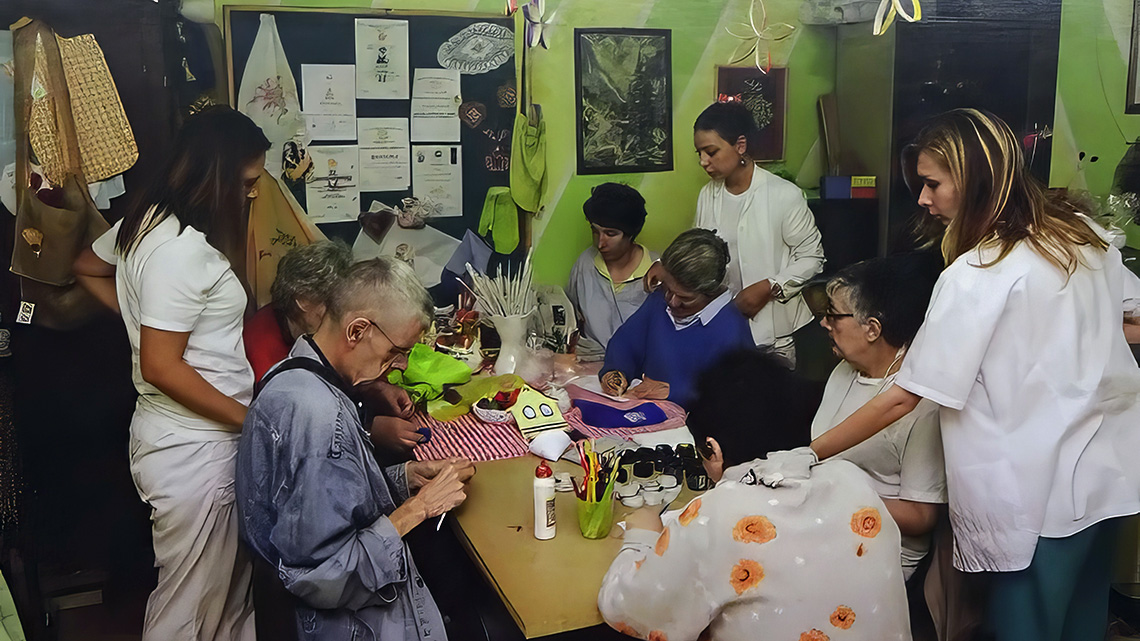
The Day Care Club is a form of open social protection that provides its users with the satisfaction of everyday needs through various daily services. It is intended for older citizens to promote their social integration, maintain psychophysical health after the productive period of their lives, overcome feelings of loneliness, prevent depression, and similar. Users of the Club establish various contacts with other people, acquire new knowledge and skills through cultural, entertainment, and artistic activities, realize their interests, engage in recreational and rehabilitative activities, and otherwise gain the opportunity to break out of their daily routine. The right to use the Club's services is granted to all individuals over the age of 55 from the municipality of Novi Bečej, as well as all retirees, regardless of age, and other adults who are unable to work. The Club has around 850 members.
The Club was founded on October 1, 1997, within the third department, with the primary vision of keeping the elderly residents of Novi Bečej socially active even after retirement. The Club's headquarters are located at 60 Marshal Tito Street. The first employees of the Club were Slavica Arsenov, a social worker, Ilona Luko, a nurse, and Biljana Nađ, a geriatric home care worker. A little later, Snežana Maksimović, who still works there today, joined as a geriatric home care worker. She is assisted in her work by: non-institutional care officer Lidija Bojović, social worker coordinator Marija Cucin, and the head of Home Care, Vesna Banjac.
The Club's work organization is based on the interests, desires, and needs of its members. They can express their creativity and talent through various sections or workshops, including choir, drama, literary, pottery, creative handicrafts, decoupage, recreational exercises, and a darts section. Each Club member fills out a survey questionnaire upon joining, through which they choose one of the sections. These are organized daily throughout the year. The work of the sections and workshops is occasionally showcased at various exhibitions, events, and competitions.
Through health-educational workshops, Club members can easily monitor and improve their mental health, measure blood pressure, and check their blood sugar levels. In the Club's facilities, where a pleasant and warm atmosphere prevails, hot and cold drinks are served daily, meals are organized, and laundry services, as well as hairdresser services, are provided. Members have access to daily newspapers, television, and socializing with other Club members.
Shortly after opening, a recreation section was established within the Club. This was a novelty in the system of non-institutional protection in Serbia. Exercises were held twice a week in two smaller groups - one for men and one for women. The exercises were led by Margita Lisičin, with assistance from retiree Ana Vlaškalin. The equipment for exercise was modest, but the enthusiasm was immense. Today, a modern sports-recreational hall exists within the Home for that purpose.
In addition to these services, the Club also offers members the use of other services, including laundry washing and ironing, hairdresser services, and meal services - 'meals on wheels.' In recent years, the option to receive cooked meals has proven to be the most needed service, alongside in-home assistance. This points to the increasing number of elderly and sick people, as well as the large number of single-person households.
Recently, the Day Care Club formed an editorial team for the Club's internal magazine, 'Golden Age.' The first issue was published in 2018. This magazine represents a display of enthusiasm, with the intention of drawing attention to other colleagues. The magazine's content includes topics close to retirees, as well as informative ones related to their daily lives.
Home Care and In-Home Nursing The 'Saint Basil of Ostrog - Miracle Worker' Institution for Adults and the Elderly offers another form of open social protection for the elderly population - Home Care and Assistance. These services are available to individuals from the Novi Bečej municipality who are in social need, including chronically ill individuals, people with disabilities, and generally those who cannot adequately care for themselves.
It all began in 2006 when the Home introduced in-home assistance and care as a pilot service. Recognized by the Provincial Secretariat for Social Policy and local governments as significant, the 'Home Care and Assistance - Don't Be Helpless' project was funded from the beginning of the following year. Thanks to the relevant Ministry, Provincial Secretariat, and the municipality of Novi Bečej, this service has been continuously provided to this day. Two years ago, the service began being funded from the municipal budget and designated transfers from the Republic of Serbia. The service coordinators are the Home's social workers. The first coordinator was Zoran Mandić, followed by Slavica Bogdanović, and in recent years, Marija Cucin, together with service manager Vesna Banjac. The services are provided by geriatric housekeepers, caregivers, and nurses. Every day, from 7 AM to 8 PM, they care for the elderly citizens, working according to a schedule based on the identified needs of the users. Vesna Banjac, the service manager, is responsible for ensuring high-quality fieldwork. Numerous services are provided by the 'Home Care and Assistance' service, including helping with meal preparation (from grocery shopping to assistance with feeding), maintaining personal hygiene, keeping the home clean, assisting with social, cultural, recreational, and other needs, and monitoring health. This includes overseeing medication intake, following medical professionals' advice, accompanying individuals to medical appointments, treating minor injuries, and monitoring vital signs.
Supported Living Supported Living is a relatively new form of non-institutional protection based on basic human rights, such as the right to live in the community and the right to choice. This program provides a normal life in an open community for individuals with intellectual and developmental disabilities. Due to the lack of basic local services and institutions that would guarantee these rights, such individuals were primarily housed in institutional care, thus excluded from the broader social community. This program removes them from institutional systems and offers them a chance to start a new and different life. The goal is to enable people with mental disabilities to live equally, with dignity, and as independently as possible in a natural environment, according to their capabilities. They are no longer objects of pity and care, but become our colleagues, neighbors, and consumers in shops, taking care of their needs and organizing their time. Their health condition is no longer the only thing that defines them. This gradually changes society's attitude toward these individuals.
With the aim of deinstitutionalization and improving the quality of life for users, in 2014, the 'Independent Living in the Community for People with Intellectual and Mental Disabilities in the Municipality of Novi Bečej' project was launched. It was one of the projects under the 'Open Embrace' program, supported by the Government of the Republic of Serbia and funded by the EU Delegation through IPA funds. A project logo was created, symbolizing the outstretched arms of citizens welcoming users leaving the institution. The pioneers of this new service were project manager Cecilija Šajber, social worker Slavica Bogdanović, service coordinator Marija Cucin, assistants Maja Kormoš and Milica Mitić, with great help from the Home staff.
This created the conditions for the Home to develop a new service - Supported Living. The users were individuals already residing in the Home who expressed interest in this service. They first had to undergo a training program designed by the Home's professional team. The training lasted three months, during which they learned necessary life skills through workshops and became familiar with the local community, institutions, and organizations in Novi Bečej. A personal support plan was developed for each user according to their needs, desires, and capabilities. The project lasted two years, during which two prefab houses were built, two houses were rented, and 26 users were taken out of the institution.
In this kind of community, users lead a somewhat independent life. They take care of their hygiene and the cleanliness of the rooms, prepare food, organize their living space according to their needs, and use their free time in line with their interests.
However, in all their activities, they receive daily support from employees (psychologist, social worker, psychiatrist, medical services, occupational therapists, instructors).
After signing a new contract with the EU Delegation in 2017, the Home began implementing a second project supported by the same IPA funds, under the name 'Improving the Capacity of Local Supported Living Services in the Municipality of Novi Bečej.' This project will last two years and is part of the 'Development of Effective Community-Based Services in Education and Social Protection at the Local Level' program, continuing the earlier project from 2014. The project plans to expand the 'Supported Living' service by building another prefab house and setting up a mushroom farm and a mini bakery. This project is being carried out by the same team, strengthened by psychologist Dunja Iličić, psychiatrist Dr. Nebojša Babo, and independent living counselor Bojana Stanisavljev, again with great support from the Home staff.
This was read at the final conference of the 'Open Embrace' project in December 2015: Once, I was led by the words of W. Shakespeare: 'Only a fool calls destiny chance,' 'A man can be free even in prison.' Then, ten years ago, I arrived at the Home and over time realized that my soul and everything that had been my world, the world of a poet, had turned into something else, a fleeting moment, a spleen... Last year, a glimmer of hope appeared again, that I would once again live life to the fullest, of course, not just me but my friends as well... Within the EU 'Open Embrace' campaign, my friends and I were chosen, based on many assessments, to reintegrate into normal living conditions, to return to the real world and a real life. The expert team, to whom we are all grateful, recognized this, having the trust to include us in this project.
In August last year, the training began: there was cleaning, washing, cooking, gardening, planting vegetables, laughter, coffee drinking, etc.
The first group, our friends: Dušica, Mirela, Đole, and Dušan, were the pioneers and the first to move into the house. I often visited them and once again experienced the emotions I had missed all these years.
Now, our group - Sneža Jež, Ištvan, Vlatko, and I - eagerly await moving into our house. Mixed emotions arise: uncertainty, fear, but above all, hope, that after so many years, we will once again find our 'place under the sun.'
With us goes our dear dog Meda, who has brought much joy into our lives. He is currently with our friends from the first house, who have accepted him well and are taking good care of him.
Of course, none of this would have been possible without the good people from the Home: the director, project coordinators, social workers, psychologists, doctors, occupational therapists, craftsmen, and everyone else who helped with this idea. I don't want to mention anyone by name to avoid unintentionally leaving someone out. But our gratitude for the trust they placed in us will follow them throughout their lives!
That's why I sincerely hope that we won't disappoint anyone and that we will gain even greater trust, not only from the Home staff but from all the citizens of Novi Bečej.
At this moment, I can think of the great Viktor Frankl's thought: 'Freedom is but the negative aspect of the whole phenomenon whose positive aspect is responsibility.'


Comments