



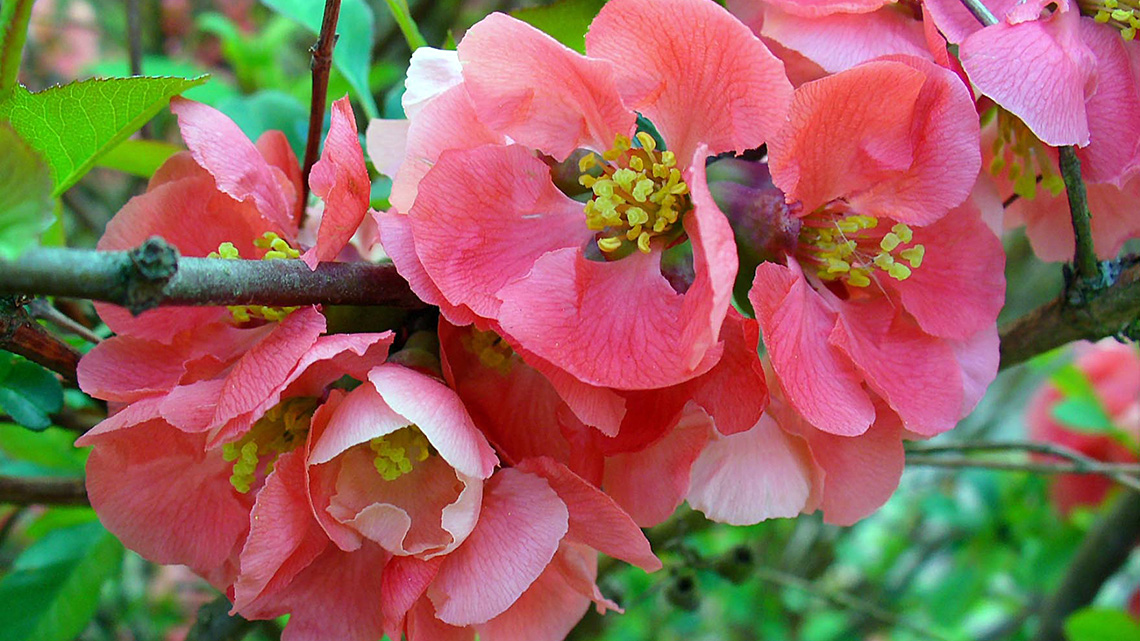
Japanese quince (Chaenomeles japonica) is a deciduous shrub native to Japan, widely cultivated worldwide for its decorative appeal and useful fruit. This plant belongs to the rose family (Rosaceae) and is commonly used in gardening, as well as in culinary and traditional medicine.
Plant Characteristics
Japanese quince grows to a height of 1 to 2 meters and is characterized by dense, thorny branches. Its leaves are dark green, glossy, and oval-shaped. In early spring, before the leaves appear, the plant blooms with stunning red, orange, or pink flowers, making it highly attractive in gardens and parks.
The fruit of the Japanese quince is small, round, and hard, with a diameter of about 4-5 cm. When ripe in autumn, it turns yellow and has a strong fragrance, but it is extremely sour and astringent when eaten raw.
Uses of the Fruit
Although raw fruits are almost inedible, Japanese quince is used in making jams, marmalades, compotes, and juices. The fruit is rich in vitamin C, pectin, and other beneficial compounds, making it excellent for producing healthy preserves. The pectin in Japanese quince naturally thickens jams and marmalades, often eliminating the need for artificial thickeners.
Medicinal Properties
Japanese quince has a long history in traditional medicine. It is believed to boost immunity, improve digestion, and have anti-inflammatory effects. Tea made from dried quince fruit is used to soothe coughs and respiratory issues. Additionally, due to its high antioxidant content, Japanese quince may help protect cells from oxidative stress.
Cultivation and Maintenance
Japanese quince is an exceptionally hardy plant that thrives in various soil types and climatic conditions. It grows well in sunny and partially shaded locations and requires minimal care. It is drought- and frost-resistant, making it ideal for regions with cold winters.
The plant can be propagated by seeds, cuttings, or by dividing the root clumps. Pruning is recommended to shape the plant and encourage better flowering.
Conclusion
Japanese quince is not only an ornamental plant but also valuable for its fruit and medicinal properties. It is easy to grow and blends well into landscaped gardens, where its vibrant flowers enhance the beauty of the surroundings. Additionally, its fruit can be used to prepare delicious and healthy products, making it a worthy addition to any garden or orchard.


Comments