


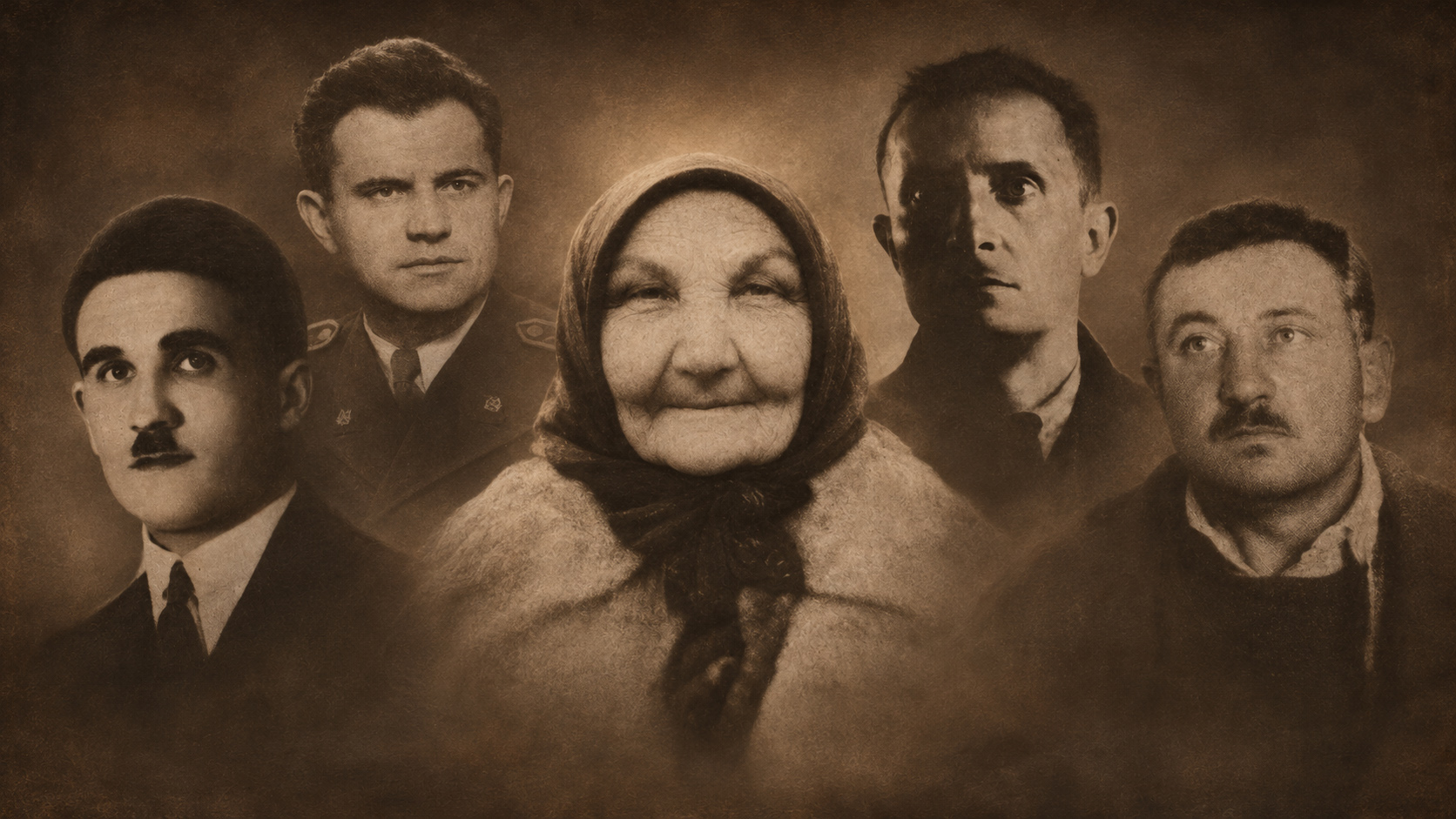
In early 1942, the occupation authorities launched a series of arrests in Kumane and the surrounding villages to uncover Partisan hideouts and dismantle the People’s Liberation Movement (NOP). After the January arrests, occupation forces sealed off Kumane on 5 February and carried out a major raid from 13 to 25 February. According to the account, around 210 people were arrested between 5 and 25 February, and 32 hideouts were uncovered. The Partisans and their supporters called these hideouts “bases.”
The January Arrests and Rada Odadžić’s Escape
On 6 January 1942, five Partisans and supporters of the People’s Liberation Movement from Melenci voluntarily reported to the German police. They were Živa V. Lončarski, Velimir S. Mavrenski, Milan D. Mikin, Radovan M. Kuručev, and Stanko Cvetić. They had believed Mihajlo Olćan, the minister of the economy in Milan Nedić’s government. At a public meeting in Melenci, with Rajt present, Olćan had promised that Partisans who turned themselves in would be pardoned.
 All five were arrested and tortured. Under beatings, they said that the Partisans were still in their home villages and that two residents of Kumane, Racko Brusin and Živa Kumrić-Batrga, had helped the detachment. Racko in particular had provided assistance.
On 16 January, Špiler arrived in Kumane with several agents and a small German army detachment on the pretext of hunting hares. The hunt lasted three days, and each day the municipal authorities selected villagers to drive the hares toward the hunters. On the final day, one of those selected was the Partisan Rada Odadžić. Špiler carried photographs of Partisans, and local policemen also took part in the hunt.
After the hunt ended, Rada went home, where he had not spent the night for some time. He took off his sweater and traditional shoes and lay down beside the stove. That night the police arrested Racko Brusin, Živa Kumrić-Batrga, and Sredoje Nemešev, then went after Rada.
Špiler entered the Odadžić home with an agent and two soldiers. The family woke only when the men lit the kerosene lamp. Špiler ordered Rada to get dressed and come with him. As he pulled on his sweater, Rada struck the agent, forced his way past the soldiers, and climbed over the fence into his neighbor Ivica Baračkov’s yard. Still in his socks, he made it through knee-deep snow to the street. His pursuers fired as they ran after him, but after about an hour he managed to lose them.
That night he took shelter briefly with Joca Maksić, Emil Petrović, and Zora Petrović. He could not stay with Emil because Miloš Nemešev, a former member of the leadership of the League of Communist Youth of Yugoslavia (SKOJ), worked there and might himself become a police target. Rada spent the rest of the night and the following day at Mirko Doroslovac’s home, then moved to Laza Brančić’s house. Between a room and the stable was a hollow double wall with an entrance from the attic. Borivoj Brančić, known as Laza Dadin, and Veselin Nemešev-Glišin were already hiding there.
A Warning Before the Blockade
After the first arrests, Arsa, Nikica, and Crni Rada left Kumane for Melenci. They gathered information about the hideouts and reorganized the local SKOJ leadership. Arsa then went to the area around Elemir, Aradac, and Perlez. Crni Rada was to go to Velike Livade, while Nikica was to stay in Melenci and try to establish contact with the People’s Liberation Movement in Taraš. They agreed to meet again in Melenci after 25 days.
Racko Brusin and Živa Kumrić-Batrga were released after only a few days. Sredoje Nemešev was also freed soon afterward. According to the account, he had been arrested by mistake in connection with a case in Elemir. The quick release of Racko and Batrga raised suspicions in the local organization. At a meeting in Ljubomir Čolić’s house, one person suggested killing them. The secretary opposed the proposal and urged the group to speak to them so they could warn the people whose names had reached the police.
Maksa Kovačev spoke with Racko, and Boža Titin spoke with Batrga. According to the account, both men named the people they had informed on and said they had agreed to continue working for Špiler. They also said that Špiler intended to wait three weeks before making further arrests so that their release would appear unrelated to the police operation. Party and SKOJ members were told who was on the list and warned to go into hiding.
The Blockade of Kumane on 5 February
On Thursday, 5 February 1942, occupation forces surrounded Kumane. A document titled “Operational Plan for Action Against Communists in Kumane” had been drawn up in advance. Three groups took part. The first comprised 64 members of the Criminal Police from Petrovgrad, now Zrenjanin. The second consisted of 140 State Police personnel, and the third of 70 State Police personnel from Novi Bečej. Each group had a list of people to arrest and their addresses.
The first group, accompanied by Rajt and Špiler, arrived at 11:30 a.m. on sixteen sleighs. The policemen wore civilian clothes and sheepskin coats. They forced their way into houses, bound those they arrested, and led them to the sleighs while holding the rest of the household at gunpoint.
At the same time, the second group arrived on a special train that stopped near the crossing of the railway and the Melenci–Kumane road. The third group approached by sleigh from Novi Bečej. The two groups formed a cordon around the village. At 12:30 p.m., they began closing in on the houses and set up ambushes at the village exits. Rajt and Špiler set up headquarters in the municipal building, where interrogations and beatings began immediately.
That morning, Boža Titin had crossed the street to Laza Brančić’s house to read A Short Course in the History of the Communist Party of the Soviet Union (Bolsheviks) with Rada Odadžić and the other Partisans. They had scarcely begun when they heard the town crier’s drum. Laza’s wife went outside to see what was happening and soon hurried back, visibly shaken.
“Our street is full of Germans!”
The Partisans withdrew into their hideout, and Boža went out into the street. He found Zoran Čobanov tied against a wall. The policemen were demanding that he show them where Toma Tatić lived. Čobanov kept saying he did not know and was eventually released. Rada Matić came by shortly afterward and showed them the house, but Tatić had already gone into hiding.
Twenty-four people were arrested during the blockade, including Ljuba Čolić. Most had been on the list supplied by Racko Brusin and Živa Kumrić-Batrga. During the interrogations, Špiler obtained confirmation that the Partisans were still in the village. A wider search followed in the days ahead.
The Major Raid, 13–25 February
Members of the State Guard for Banat, Deutsche Mannschaft units, and a German army detachment took part in the raid, bringing the total to around a thousand armed men. The operation was led by Dr. Juraj Špiler, a State Guard colonel and commander of Public Security. Others involved included secret police inspector Josif Vilhelm, deputy inspector Krsta Kozlovački, and agents Sava Brusić, Dobrosav Ćirović, Franc Veber, Rudolf Lajthajm, Petar Luc, Matijas Hinfel, and Viktor Šisler.
Špiler said that Kumane stood “body and soul with the Partisans” and called it a “stronghold of communism.” The occupation authorities described the aim of the raid as identifying Partisans, members of the local branches of the Communist Party of Yugoslavia (KPJ) and SKOJ, and those who helped them.
The forces arrived by rail and posted guards at the busiest points on the outskirts. On the first day, adult villagers were ordered under threat to assemble in the main hall of the Youth Centre. Špiler spoke about the might of the Third Reich and called on them to inform on the Partisans, promising pardons to those who did. The villagers remained silent. After the meeting, searches began in the village and the surrounding countryside. Fine snow fell incessantly, driven by a strong wind.
On the second day of the raid, Rada and Sava Aćimov-Kalić left the hideout in their house and headed for an unoccupied farmstead in the direction of Novi Bečej. Police from Novi Bečej found them by following their fresh tracks in the snow. They were taken to the municipal building, where they revealed the location of their hideout under beatings. Rada also disclosed Veselin Nemešev’s hiding place, and Nemešev was arrested that same day.
Fearing that their own hideout would be discovered, Boža Stojanov-Punga and Dušan-Dušica Stojanov-Punga left it and tried to reach Taraš. They were caught in the fields on 15 February. Under beatings, they disclosed the location of their hideout. Dušica also named the hiding places of Miroslava Eremić, Svetozar Zokić-Čivut, Žarko Tatić, Zoran Tatić, Rada Titin, and Milan Čobanov. Further arrests followed.
That same day, acting on information from Svetozar Tešić, the police arrested Milanko Bogdanov-Gvožđar and Milan Brusin. Both were found in hideouts in their own homes. During interrogation, they revealed the names of people who had previously sheltered them: Svetozar A. Brusin, Svetolik O. Đuričin, Dušan T. Lupurov, Boško I. Lupurov, Lazar C. Marinkov, Pera V. Stajić, Ivan Stančić, Slavko V. Stančić, Uroš P. Stančić, Lazar Ž. Trifunjagić, and Šandor Tubić. All were arrested. The police covered prisoners with blankets as they brought them to the municipal building by sleigh, so the villagers could not see who had been taken.
The Arrests of the Stančić Brothers and Svetozar Ješić
On the afternoon of 15 February, a patrol from Melenci was ordered to arrest Milan Stančić, known as Uča, and his younger brother Sava at the Stančić brickworks, about a kilometre and a half from Melenci on the road to Kumane. The patrol consisted of Đuri Bolokan, Jani Verfenbah, Andres Poljak, Pera Sasur, and its commander, Johan, a member of the Mannschaft.
The patrol found the brothers in the kitchen. While Johan held them at gunpoint, Poljak, who was working undercover for the People’s Liberation Movement within the occupation police, pushed the barrel of Johan’s rifle down. The rifle went off, and the bullet ricocheted off a brick and struck Poljak in the eye. In the confusion, Uča managed to escape despite a bayonet wound to the arm. Sava remained in police custody.
Wounded and freezing, Uča reached Taraš. A farmer he did not know let him shelter in a stable and gave him a blanket, then reported him to the municipal authorities. The police arrived after dark. Uča tried to escape but became stuck in deep snow. The police bound him and took him to the municipal building, beating him with rifle butts along the way. There he attempted to take his own life and survived.
At dawn, on Špiler’s orders, the Taraš police set out by sleigh to take Uča to Kumane. Near the village, they encountered Svetozar Ješić-Marko, who had lost his way in the blizzard while trying to reach Melenci. Marko had been hiding at Nata Žarin’s house with Proka Sredojev, Ljubica Odadžić, Milica Ružić, and Ljubomir Odadžić-Čiča.
When Marko saw Uča bound on the sleigh, he tried to free him. His pistol failed to fire, and the policemen disarmed and bound him. Hoping to buy time, Marko told them that Partisans were waiting in ambush on the road to Kumane. The policemen turned back toward Taraš. Only after reinforcements arrived were Uča and Marko taken to Kumane.
Seeking Shelter in Vranjevo and Elemir
Boža Titin and his son Živa initially hid in their own home. When their neighbor Zoran Čobanov was arrested on 15 February, they moved to the Čobanov house, believing the police would have no reason to return. With Zoran’s son Čeda, they dug a shelter beneath the straw. They left it after word came from Zrenjanin that the police had equipment capable of detecting people underground.
Boža tried to find another hiding place in the village, but fear of searches and arrests had spread among the residents. His wife suggested that he go to her relatives in Vranjevo. His uncle Milan Titin took him by sleigh, making it look as though they were going to fetch maize stalks. As they approached Novi Bečej, they heard a sleigh bell and suspected that the police were coming. Boža got down and continued on foot to the home of his mother-in-law, Ljubica Stanković. With the help of his brother-in-law Kosta, he was reunited with Živa, who had meanwhile taken refuge with Ivan Garčev.
Kosta went to Kumane to find out what was happening to the family. Through their neighbor Jovanka Zokić, he spoke to Milčika, who told him that the police came to the house every day asking about Boža and Živa. They had even questioned young Milenko at school about his relatives in Vranjevo. When Boža and Živa heard this, they filled in the shelter they had dug and set out for a farmstead in the Krivaja area. They lost their way in the fog and came upon a large stack of straw, where they sheltered for several days until the raid was over.
Meanwhile, Rada Odadžić had left the hideout at Laza Brančić’s house. With Ljubomir Odadžić-Čiča, he first dug a shelter at Ivica Baračkov’s home, then another in the shed of his father, Aleksa-Leksa. When the major raid began, his family feared the police would find that hiding place as well. At his father’s suggestion, Rada briefly hid beneath the snow in the yard, wrapped in a sheepskin coat. The cold was so severe that he lasted only a day.
On the night of 15 February, Rada, Čiča, Ivica Baračkov, and Rada Blažić-Socijalista set out for Elemir. They spent the night in a stable at a farmstead in the Vanj area. As they approached Elemir, Rada and Ivica spotted patrols and stayed outside the village. Police stopped Čiča and Socijalista and took them toward the municipal building, but both escaped. They took refuge with Čiča’s relative Paulina Mihajlov, who lived with her sister-in-law Slavka while their husbands were prisoners of war. Paulina then found Rada and Ivica at the Topalov home and invited them to stay with her. The four men from Kumane were together again.
The Final Days of the Manhunt
The police had yet to find Maksa Kovačev, Žarko Milankov, and Ljubica Odadžić. Through the town crier, Špiler announced a reward of fifty gold Reichsmarks for each resistance leader captured or killed. He threatened to have anyone shot who sheltered them or withheld information about their whereabouts.
On 20 February, the police discovered Ljubica Odadžić and Ivan Knežić-Cota in a hideout at Ljubinka Lj. Petrović’s home. Žarko Turinski-Arsa, Barbara-Boriška Seleši, Marija Kevrešan, and Stevan Petrović had also stayed there from time to time. According to the account, Ljubica’s friend Seka Santovac-Bogić, who had helped dig the hideout, disclosed its location under threat. As the police approached, a shot rang out from inside. Cota was found dead. Ljubica stood beside him holding a pistol that had failed to fire. She was arrested and taken to the municipal building.
Žarko Milankov and Velja Ubavić had left Lazar Brusin’s house and taken refuge in Pera Stojić’s hut in the Mali rit marshes. According to the account, Milivoje Korbić showed the police their tracks. The pursuit party caught up with them on 21 February. When Velja tried to run, Žarko shot and seriously wounded him. Žarko then shot himself, and at the same moment he was struck by two bullets fired by the pursuing force. The police took his body and the gravely wounded Velja back to the village by sleigh.
The following day, Žarko’s family came to the municipal courtyard, where his body was still lying. Dragić Češljarev told Žarko’s wife Smilja and their children to go to the cemetery, saying that the body would be brought there. After they left, the body was dumped in the snow outside the village. When the snow melted, Žarko Berić, the owner of the vineyard where it lay, found the body and buried it on the spot.
Milutin Stojanov-Bača remained in the hideout at Ljuba Eremić’s home until 23 February. He then went to Boško Odadžić’s house, where Boško alerted the neighbors. Milutin ran to Slavinka Miokov’s house and took his own life in the attic. That same day, Žarko Sekulić found Veselin Lupurov in his own attic, overpowered him, and handed him over to the police.
Maksa Kovačev and Svetozar Čolić remained in hiding at Ljuba Eremić’s home until 25 February. Svetozar went to Đura Aćimov-Kalić’s house, while Maksa went to Ljuba Čolić’s home, believing the police would not return because Ljuba had already been arrested. According to the account, Ljuba’s wife, Danica Čolić, reported him to the police. When Maksa saw the police in the yard, he attempted to take his own life. He died later that day at the railway station.
The Arrest of Dobra Gladić and the Detention of Teachers and Students
The police came looking for Dobra Gladić several times. His mother Danica, known as Naca, insisted that she did not know where he was. During one search, Špiler threatened to kill her if she had lied. In later interrogations, he learned that Dobra was hiding at home and returned with a police escort. They found Dobra, bound him, and took him out into the yard, where his mother was waiting.
“So you lied!” Špiler said.
“I would lie even for you, sir, if you were my son!” Naca replied.
The police also detained teachers and older secondary-school students. The teachers had previously refused to sign a statement opposing communism, and some of the students were active in the People’s Liberation Movement. Among those detained was Andrija Ot, the pharmacist’s son. He and the teachers were released after a few days, while they were still in Kumane. While in custody, Andrija approached Milojko Brusin and told him:
“I know you’re all communists. You have nothing to fear from me. I’m nobody’s informer. I’m your friend and a fellow villager.”
During the raid, Miloš Boberić, Slavko Boberić, Milan Đuričin-Berić, Živojko Erdeljan, Milutin Erdeljan-Luta, Milivoj Marinac, Slavko Markov, Hranisav Mirkov, and Toma Tatić turned themselves in.
Interrogations in the Municipal Building
While still in Kumane, the prisoners were divided into three groups. Partisans and prominent members of the People’s Liberation Movement were held in a room in the municipal building. Supporters were held in the school, and those the police considered suspicious were confined in the large municipal hall.
Ljuba Čolić, who had been brought back from Zrenjanin, had been beaten so badly that he had open wounds on the soles of his feet. Miloš Teodosin-Beodranski, himself severely beaten, said during questioning that weapons were hidden at Ljuba’s home. Čolić continued to deny it even after further torture. Whenever he returned to the room, he urged the others to withdraw statements that implicated anyone else.
“Brothers, we’re in trouble ourselves. Let’s leave others out of it. If you’ve already admitted anything, take back your statements!”
During another interrogation, Teodosin revealed the hiding place in Ljuba’s shed. The police found sixteen military rifles, one hunting rifle, 1,451 rounds of military ammunition, 40 rounds of hunting ammunition, seven pistols with 60 rounds, and four grenades.
Milan Stančić-Uča was interrogated and tortured despite his wound. According to the account, he gave no one away. Ljubica Odadžić was also tortured. After questioning, she was carried into the room in a blanket because she could not walk. The other prisoners barely recognized her after her first interrogation. She did not speak during questioning.
Špiler asked Šandor Tubić, a relatively prosperous farmer, why he had joined the communists when he owned property himself. Tubić replied:
“It isn’t enough, sir, for me or a handful of us to have enough when the vast majority are going hungry!”
The Prisoners Are Taken to Zrenjanin
At around ten o’clock on 25 February, Špiler ordered the prisoners to be taken from the municipal courtyard to the railway station. Ljubica Odadžić, Ljuba Čolić, and Miloš Teodosin had to be carried out. They and Slobodan Odžić were put on a cart. The other prisoners, their hands bound, walked four abreast. Other carts carried seized weapons and supplies. Špiler rode on the last cart.
The street was empty. Behind curtains that could be seen moving, villagers secretly watched their loved ones pass. A locomotive with several carriages stood waiting at the station. The prisoners were put aboard in the groups to which they had already been assigned, and the weapons were loaded into a separate carriage.
Maksa Kovačev was brought to the station on a separate cart. He was still showing signs of life. At one point he raised his hand, then let it fall. That was the last movement of the committee secretary and member of the District Committee of the Communist Party of Yugoslavia.
In the carriage carrying Slobodan Odžić, the accordion player Sava Aćimov was the only prisoner who was not bound. He played and sang:
“I will walk through the village no more,
for all its joy is gone for me.”
When the train reached Zrenjanin, the prisoners were marched from the railway station to the court prison. The interrogations and torture continued there.
Špiler’s Report and the Aftermath of the Raid
In his report of 26 February 1942, Špiler credited several people with supplying information to the police during the raid. He linked Svetozar Tešić to the arrest of Milanko Bogdanov-Gvožđar, Slavko Praporski to the reporting of Svetozar Popov-Šlezijak, and Milivoje Korbić to the pursuit of Žarko Milankov and Velja Ubavić. He also named Boško Odadžić in connection with Milutin Stojanov-Bača, Žarko Sekulić in connection with the arrest of Veselin Lupurov, and Danica Čolić in connection with the discovery of Maksa Kovačev’s hiding place. According to the account, a total of 8,200 dinars was paid for these reports. Several police officers and agents were recommended for decorations.
After the raid, Špiler proposed confiscating Partisan property and using it to establish a fund to fight the People’s Liberation Movement. The proposal was never implemented.
The arrests in Kumane also affected resistance work in the surrounding villages. Nikica sent Vujica Vujanov to Taraš, and Crni Rada sent Emil Kevrešan to Velike Livade in his place. Nikica and Crni Rada left Melenci and travelled through Elemir and Aradac to Perlez, where they met Arsa. On Arsa’s instructions, Crni Rada was supposed to return to Kumane at the end of February, but he abandoned the plan after the raid broke up the local resistance organizations.

Comments