



The Party-Syndical Congress for Vojvodina, held in Novi Sad on January 7 and 8, 1920, was attended by Ljubomir Čolić, a delegate from Kumane, who was elected as a member of the Control Board of the Executive Board of the Provincial Assembly for Vojvodina.
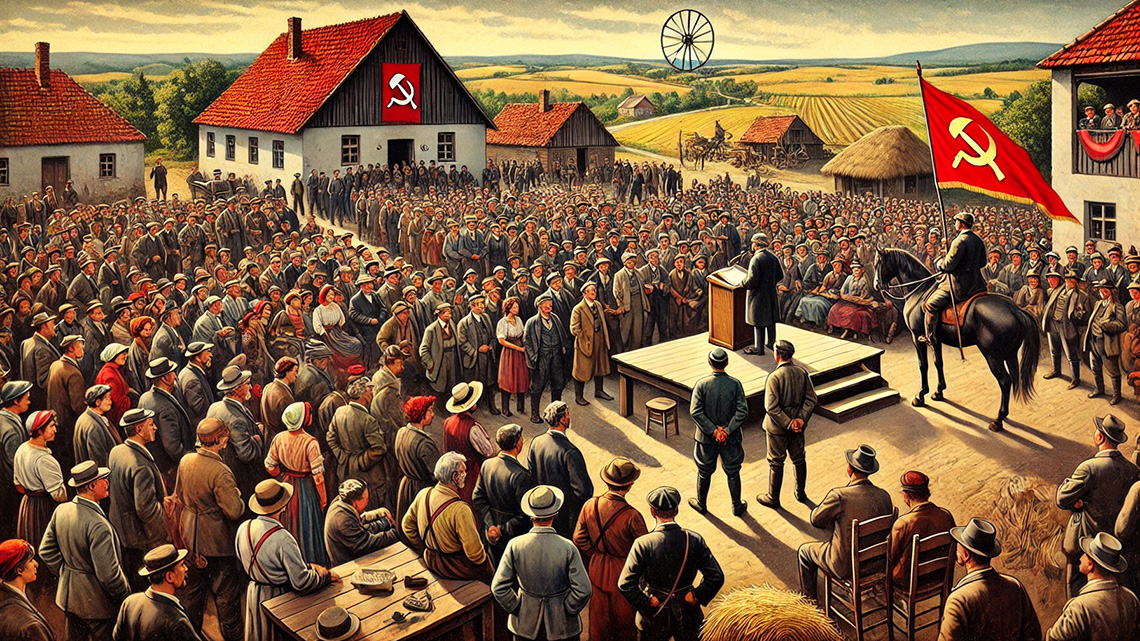
On January 14, 1920, a large public assembly of the Socialist Workers' Party (Communists) was held in Kumane in the presence of around 1,000 locals, where Pavle Pavlović spoke about political equality for women, agrarian reform, socialist press, and the need to establish a local organization. The assembly remained an unforgettable political event. Here are the comments made by "Radničke novine" regarding the assembly.
"Among the large landowners in these regions, there is a suppressed belief that a revolution in the countryside is a looming possibility and that every assembly, especially this first one, should signal a mobilization for an uprising. Those who do not understand what an uneasy conscience is among the landowners should visit regions where the agrarian issue is at the forefront. In Banat, in the former Hungary, where 'through merit' hundreds and thousands of acres of land were acquired from Pest, and from Vienna careers and titles of secret counselors—there is still this nobility in the rich Banat. It did not leave with Hungary but adapted to the 'new' state conditions.
Therefore, it is no surprise that the government with its bureaucratic lackeys is absolutely in the service of these former and current Banat magnates. In Banat, any political party can work and recruit followers, except ours. When this assembly in Kumane was held, the gendarmerie in the nearby village of Melenci dispersed peasant masses with horses, who were on their way to the assembly in Kumane.
On the very day the assembly in Kumane was scheduled, mounted gendarmerie appeared in Melenci to prevent their arrival in Kumane. This servile zeal of the police is a sign of a wild desire to thwart or at least diminish our Party's electoral work in the countryside. This is done precisely where no obstacles arise for the radicals and democrats when they gather 10 villages for an assembly... Here, the feeble excuse of national suspicion and caution from the authorities falls apart, as both villages are inhabited by Serb communities. In all of Kumane, out of 1,500 households, only 10 families are of Hungarian nationality.
However, it is futile for the landowners because the awareness of this village has been incredibly awakened, and there is no way to return it to slumber."
"Radnički list" number 1 reported that after the January 14, 1920 assembly, the Local Organization of the Socialist Workers' Party (Communists) was re-established in Kumane. The leadership was elected as follows: Ljubomir Čolić, president, Čedomir Stančić, secretary, Živa Đuričić (according to Kumane residents, Živa Ćurčić), treasurer, with Vlajkov and Živa Milankov as members of the Board, and Cvetko Lucić, Kariton Mučalov, and Blagoje Stančić on the Supervisory Board.
Immediately after the restoration of the party organization, on February 7, 1920, the great župan - the government commissioner of the Torontal district, prohibited the holding of communist party meetings and gatherings. Despite the ban, large peasant masses continued to join the workers' movement.
As a consequence of the fear of the revolutionary movement that had spread across Vojvodina, especially in the border areas with Hungary, the Zrenjanin military command received a report on February 12 stating that communists in Subotica were preparing for a state coup in all of Vojvodina on February 15. The report stated that the center in Subotica was connected with all larger towns, possessed weapons, and had a large number of supporters, counting on the help of demobilized soldiers and recruits. Therefore, the command was advised to stay alert and take the necessary measures. This report also applied to neighboring villages like Kumane, Melenci, Elemir, and others.
Even after February 15, the fear of Bolsheviks did not subside. Thus, on the 18th, the Minister of the Interior ordered the great župan in Zrenjanin to take strict measures against the increasing communist activity, as the Bolsheviks (communists) and their agitators were committing various criminal acts, and the police authorities, which were supposed to protect and defend the legal order of the state, were indifferent and not showing enough energy. On April 23, 1920, the Minister of the Interior prohibited the celebration of May Day.
The ban was issued because nearly all of Vojvodina was in a military zone, peace with Hungary had not yet been concluded, and there had recently been a rebellion and significant disturbances in Bačka. Therefore, it was "not possible to allow the opponents of this state to exploit the workers' celebration for their anti-state and anti-national purposes...". In connection with the ban, and based on the report from the district head about the situation in the Novi Bečej district, the great župan Jovan Bogdanov on April 24, 1920, requested urgent military reinforcement for May Day.
The great župan further explained that the gendarmerie stations' forces were very weak, with only 4-5 men who would not be able to oppose "a strong movement on a large scale." Therefore, he requested that the district military commander immediately allocate a squad of soldiers to the district head in Turski Bečej, who would distribute them as needed, especially in Kumane, Melenci, and other areas.
The extent of the fear of an alleged communist uprising can best be seen in the order of the Supreme Command on April 27, 1920, regarding the military's state of readiness, which at any given moment should be in contact with police and civil authorities regarding May Day, to secure important railway lines, telegraph, and telephone lines. To ensure troop transportation, one train should be ready at the railway stations in Subotica, Sombor, and Zrenjanin on May Day.
Despite all the bans and orders, the KPJ organization in Kumane continued to gather more of the village's poor. Preparations for the upcoming municipal elections were underway. Taking over the municipal administration was very risky because the municipal treasury had been looted. Administrations fled alternately because they couldn't do anything in a "collapsed house." The financial situation of this rural municipality is best seen from the following quote from "Radničke novine" number 15: "There is a large school building there, where before the war, 13 teachers worked. Now they can barely pay two teachers, and they do nothing because the children have no shoes to attend school. In rich Banat, in a place where 7,000 inhabitants have 18,000 acres of land, that is, 2.5 acres of fertile land on average per person, people cannot afford to buy shoes for their children so they can attend school. It is no wonder that even semi-wealthy people say: 'What do you doubt about our loyalty to communism when we cannot even work our plot or buy livestock for anything.'"
Comments