



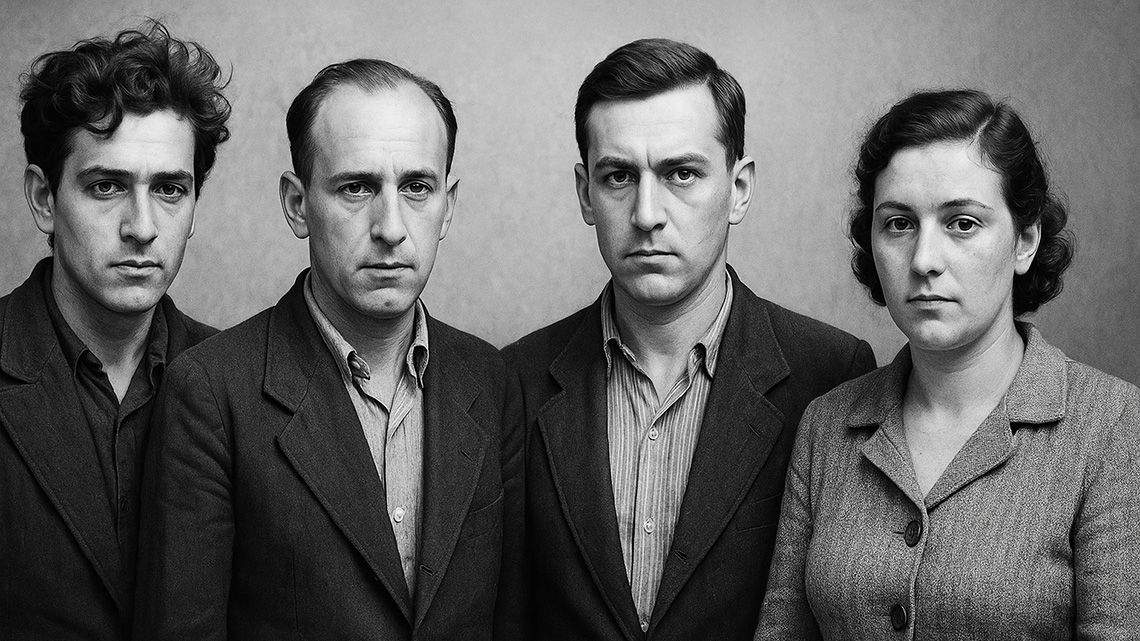
At the same time, from the synagogue in Novi Bečej, young Jewish anti-fascists were deported to a special prison near the District Court in Veliki Bečkerek. Among them were Đerđ “Đurika” Šlezinger, Herman Bergl, Ištvan “Pišta” Šlezinger, and Margita “Dunda” Huven. They never returned—on July 31, 1941, they were executed as part of the first large group of 90 hostages from across Banat.
Information about the anti-fascist orientation of Đerđ Šlezinger and Margita Huven was provided by Lazar Mečkić and Šandor Nađ, while the author personally knew about Herman Bergl’s public anti-fascist stance. No direct information could be found about Ištvan Šlezinger’s activities or political affiliations.
In the book "Zrenjaninske vatre" by Đorđe Momčilović, the arrest and execution of Banat’s anti-fascists on July 31, 1941, is described in detail. The aforementioned Jewish youth were among them.
From that time, we have a testimony by Zlata Raičević, now a dramatic actress from Podgorica, who was also imprisoned in the synagogue in Novi Bečej. At the time, she was the young wife of lawyer Raičević from Melenci, of Jewish origin herself, but was released because she was married to a Serb and was eight months pregnant.
She described the imprisonment in the synagogue as a form of torture. Women slept on the upper gallery, while men were on the ground floor—just as they once did during worship. The food was miserable: unsweetened tea in the morning, and in the afternoon and evening tasteless soup—essentially hot water with a few leaves or grains of vegetables, and a small piece of cornbread.
The Nazis would suddenly burst in during the night and beat the male prisoners or drag them outside to be brutally assaulted. Screams would echo through the night, preventing sleep. She remembered one man dying from beatings, though the local death registry recorded no Jewish deaths until September.
Zlata also recalled several women trying to bribe the guards with money and jewelry in order to escape. Those who did were quickly recaptured and returned. Zlata was eventually released, thanks to a hefty bribe her husband managed to deliver to the right people.
Her case represents one of the rare exceptions—similar to the earlier case of Helena Kiurski. However, both releases occurred before the mass transfer to the main detention facility: the LEO WEISS grain warehouse.
In July, all detained Jews from the Novi Bečej district (without exception) were moved to the KLEIN and HORVAT grain warehouse, located near the end of the main street toward the train station. Conditions there were horrific. People of all ages were packed into a building with only high vents instead of windows. They slept on thin layers of straw, rarely changed, and water was scarce. The food remained equally miserable—watery soup and small bread portions.
According to the memories of Šandor Nađ, Laslo Budai, Branislav Petraškov “Komoč”, Mihajlo “Miša” Kiselički, and the author, the Jews were first held in this warehouse before being moved to the LEO WEISS facility. In the courtyard, a shallow trench was dug for defecation—barely concealed—and the guards humiliated women by forcing them to relieve themselves in their presence.
Dr. Viktor Jordanić, one of the few surviving Jews from Novi Bečej, documented the testimony of Bella Weiss, daughter of the local cantor (b. 1915), who had briefly visited friends—the Pelikan sisters. She revealed the grim truth about the Klein and Horvat camp. Dr. Jordanić confirmed this during his visit to Novi Bečej in the autumn of 1945.
The only small relief in these circumstances came through rare bribed permissions to visit friendly homes nearby—for hygiene or a small meal. These moments were rare and entirely dependent on the goodwill of guards and the influence of outsiders.
We have no documented evidence about illness or death rates in these conditions, though the death registry of Novi Bečej does not mention any Jewish deaths until September, when three cases appear.
Although Jews were persecuted across occupied Europe, nowhere was the plan of total annihilation carried out as thoroughly as in Banat. The Banat Germans (Volksdeutsche), eager to prove their loyalty to Hitler, pushed hard for the complete expulsion of Jews. Eventually, the German Military Command in Serbia issued the order for the deportation of all Jews from Banat.
As described by Božidar Ivković in his book "The Destruction of the Jews and the Plundering of Their Property in Banat 1941–1945" (p. 384), this led to the establishment of three collection camps:
- Jews from southern Banat were sent to Pančevo,
- those from central Banat to Veliki Bečkerek (Zrenjanin),
- and those from northern Banat to Novi Bečej.
The designated camp for northern Banat Jews was the LEO WEISS grain warehouse—located at the far end of the left side of the main street in Novi Bečej. The facility, although spacious, was overcrowded, with people sleeping directly on the floor. The courtyard was fenced with barbed wire.
This was the final chapter for the Jews of northern Banat. They came from the districts of Kikinda, Novi Kneževac, and Novi Bečej. An official report dated September 2, 1941, listed 696 persons of all ages and both sexes imprisoned in the LEO WEISS warehouse.
Many facts about this camp were later provided by Senji Maćaš, a retired resident of Novi Bečej. His father owned the nearby tavern Kruna, whose backyard bordered the camp’s fence—allowing him to witness the horrors firsthand.
Comments