



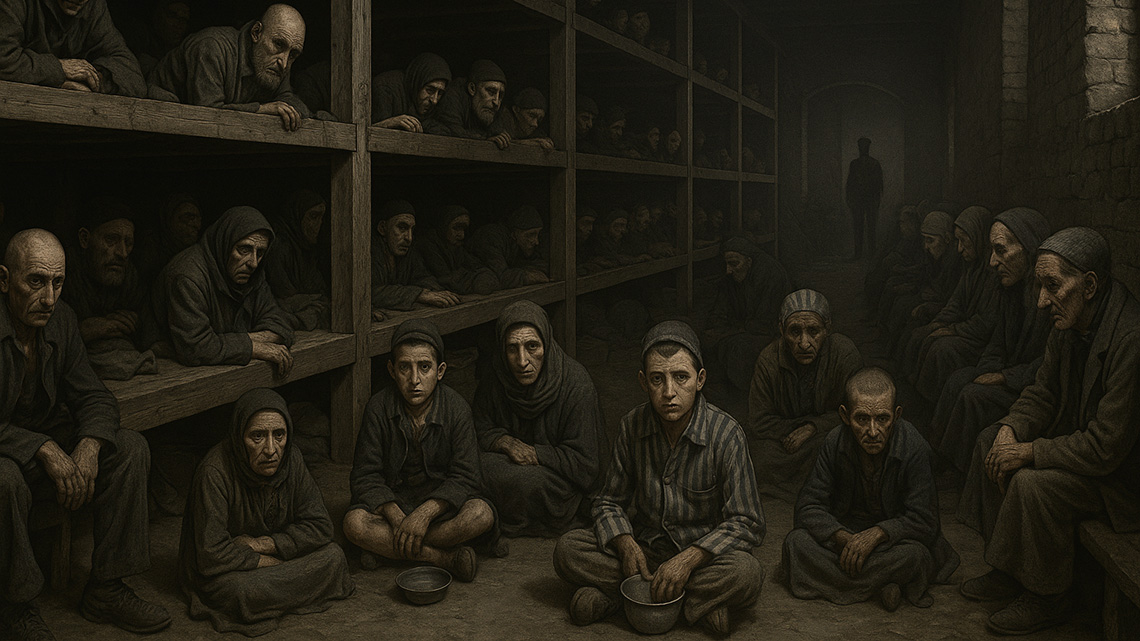
The only available testimony describing the living conditions in the Novi Bečej concentration camp comes from Tihomir Ungar from Novi Sad. At the time, he was a child imprisoned in the camp along with his entire family, who had been brought from Novi Kneževac to the temporary holding facility in Novi Bečej, where they awaited deportation.
Tihomir described the interior of the warehouse as a large, rather dark space with several wooden platforms. These platforms, once used to store grain or corn, were very low, leaving little room to stand upright. Prisoners were crammed together in overcrowded conditions. The elderly and sick were housed in pigsties beneath a long wooden corncrib located in the yard opposite the warehouse, near the main gate. Among them was Tihomir's ill grandmother, who died there before deportation.
He did not go into further details about camp life, but remembered that children—of whom there were many—were allowed to play in a designated area of the yard. He also recalled the disturbing sight of mentally ill inmates who received no help and were often beaten by guards due to their inability to conform to the camp's strict order.
The food, as in many such camps, was minimal—hot water served as sugarless tea or unseasoned soup, with only a small piece of hard, stale bread.
Tihomir remembered arriving in Novi Bečej in mid-August with others from Novi Kneževac. They remained in the camp for about a month. Around September 20, all detainees were marched to the river dock. He recalled that his family was placed on a barge pulled by a small boat, which slowly made its way to Belgrade.
Once in Belgrade, Tihomir, his sister, and mother lived as “free civilians.” With help and bribery, his mother managed to get them relocated under false identities to a village near Aleksinac. Grateful for the alias that saved his life, Tihomir Ungar (originally Tibor) kept the name Tihomir and only reverted to his real surname.
Life in the camp was inhumane. The camp was run by József Klapka, deputy mayor of Vranjevo, who was neither German nor Hungarian, but of Slovak descent. Eager to prove his loyalty to fascist ideology, Klapka governed brutally over nearly 700 women, children, and men. He ruled alongside eight guards who imposed strict control within and around the camp.
Hygienic and medical conditions were catastrophic. Food was scarce—if not worse than what prisoners received at the Klein and Horvat warehouse.
Some Hungarian locals who stood guard occasionally helped smuggle food, cigarettes, or money into the camp. For instance, Senji Maćš recounted that his father, owner of the Kruna Tavern, coordinated with a guard to discreetly pass packages over the wall. Prisoners would request food and money to bribe guards or even garlic, believing it offered protection from disease.
In one case, Tihomir’s mother-in-law sent a jar of jam to Gabriela Berger, hiding a large sum of money inside. Berger used it to bribe a guard and escape the camp. These acts of smuggling were rare and only possible when trustworthy guards were on duty.
Despite such efforts, most prisoners suffered, grew ill, and some died. Death records from the Novi Bečej municipality in September 1941 document several such cases:
- September 3: Jožef Deutsch, merchant, age 72
- September 8: Jožef Scheinberger, age 75
- September 19: Miksa Herz, merchant, age 80
Inmates were also forced to work daily—performing hard physical labor like digging, street cleaning, and loading/unloading at the river dock and train station.
Initially, some Jews attempted to escape by obtaining immigration permits to Bačka through relatives or acquaintances. However, these efforts were quickly shut down by the Public Security Department of Banat, which issued a directive:
“All efforts to obtain relocation documents and submit petitions must be stopped immediately, as such requests are pointless.”
(Source: B. Ivković – The Destruction of Jews and the Looting of Their Property in Banat, 1941–1945)
Comments