



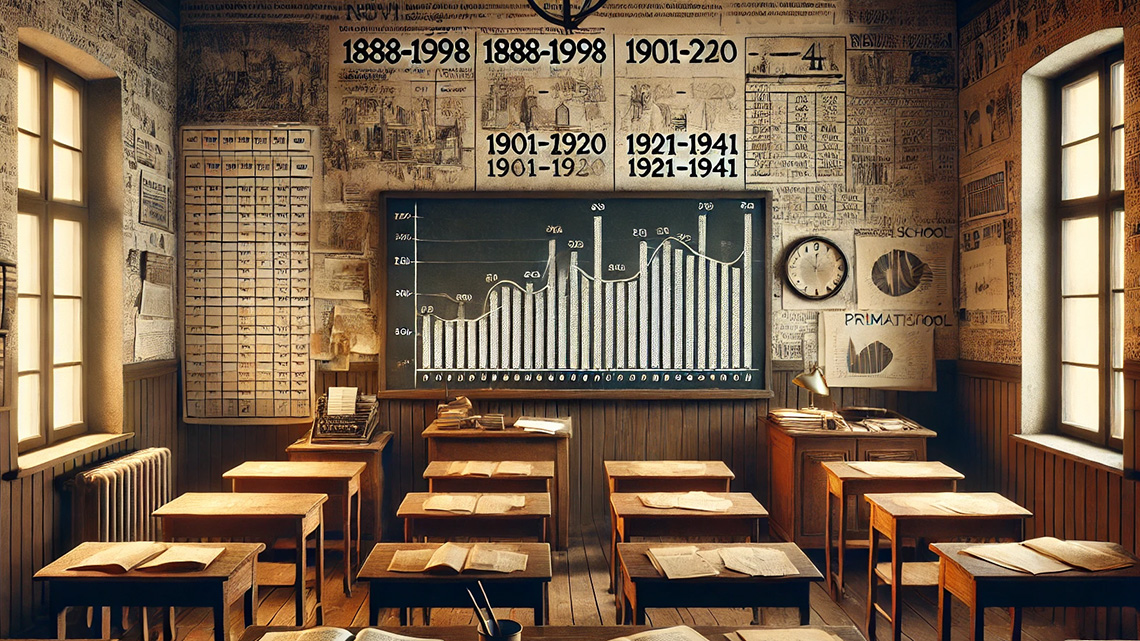
Data from the primary school registers of Novi Bečej and Vranjevo will serve as indicators of demographic trends within the Jewish community in our town. For clarity, our observations and analysis will be divided into three periods:
- The last decade of the 19th century (1888–1898)
- The first two decades of the 20th century (1901–1920)
- The last two decades before World War II (1921–1941)
Period 1888–1898
The primary school registers from 1888 to 1898 reveal key characteristics of the final formation and stabilization of the Jewish community. The number of Jewish students in primary schools during this period ranged from 31 to 53. The peak year was 1889/90, when 53 Jewish students were enrolled in all grades, representing 8.5% of the total number of primary school students in Novi Bečej.
In that school year, 14 Jewish students were enrolled in both the first and second grades. Of these 28 students, 15 were born in Novi Bečej, while 13 had migrated from other places. Among the total 53 Jewish students in all grades, 27 were born in Novi Bečej, while 26 came from other locations.
It is notable that two families had four children enrolled in school, while four families had three children each. Out of 29 families, 12 had one child in school, while 11 had two children. This trend indicates a gradual decline in the number of families with many children.
The average number of students per family during this period was 1.43, while in the particularly prosperous school year 1889/90, it was 1.83.
Parents' Occupations
Most families in this period made a living from trade. Merchants, traveling salesmen, and brokers accounted for more than 56% of the occupations of students' parents. Artisans made up about 12%, while innkeepers accounted for 6.5%. Independent businesses represented three-quarters of all occupations. The remaining occupations included clerks, accountants, carriage renters, employees of the Senćanska steam sawmill, a teacher, a cantor, a rabbi, and a lawyer. Additionally, there was one recorded day laborer and one servant.
Jewish parents predominantly chose independent professions, likely due to restrictions on employment in state service.
Migration
During this period, immigrant families made up around 40% of all families with school-age children. The lowest influx was recorded in the school years 1896/97 (27%) and 1897/98 (29%). Students came from 12 settlements in Banat, 9 in Bačka, and 17 from the broader Hungarian region. The most common places of origin included Beodra, Padej, Senta, Torža, Szeged, and Budapest.
The number of families that moved away during this period was 45, while between 1900 and 1918, this number increased to 71 families. From 1919 to 1940, 43 families left. These figures confirm the significant migration of the Jewish population in Novi Bečej.
Period 1901–1920
During this period, the number of Jewish students declined significantly. While the average number of students in the last decade of the 19th century was 40.8 per school year, it dropped to 17.5 in this period.
Families with more than two children in school became rare. The average number of children per family ranged between 1.15 and 1.41. The number of families with school-age children decreased from the previous 21–31 to 12–14 families per school year.
In terms of occupations, an increase in intellectual professions such as clerks, accountants, doctors, and lawyers was observed, now making up 12% of all recorded professions. However, trade, hospitality, and crafts still dominated.
Migration continued, with the percentage of families whose children were born in Novi Bečej fluctuating between 46% and 75%.
Period 1921–1941
In the last two decades before World War II, the number of Jewish students continued to decline. In the 1921/22 school year, the highest number recorded was 14 students, while just before the war, this number had fallen to only 3–4 students per year.
The total number of Jewish students who attended primary school between 1921 and 1941 was 50—fewer than in the single school year 1889/90, when there were 53.
Average number of students per school year:
- 1888–1898: 40.8 students
- 1901–1920: 17.5 students
- 1921–1941: 6.9 students
The number of families with school-age children during this period was 29. Four families had three children in school, eleven families had two, and fifteen families had only one child enrolled.
The decline in the number of students was a consequence of the general decrease in Jewish families, as well as the impact of antisemitism, economic crises, and the growing war anxiety caused by Nazism.
Comparative Overview of Demographic Indicators
| Period | Births (annual average) | Deaths | Marriages | Students in school |
|---|---|---|---|---|
| 1896–1900 | 7.4 | 4 | 2.7 | 40 |
| 1901–1919 | 4.0 | 3.5 | 1.6 | 17.5 |
| 1920–1941 | 1.7 | 2.3 | 1.7 | 6.9 |
The decline in the birth rate, coupled with an almost unchanged number of marriages, indicates a process of demographic stagnation and a reduction in the Jewish population in Novi Bečej.
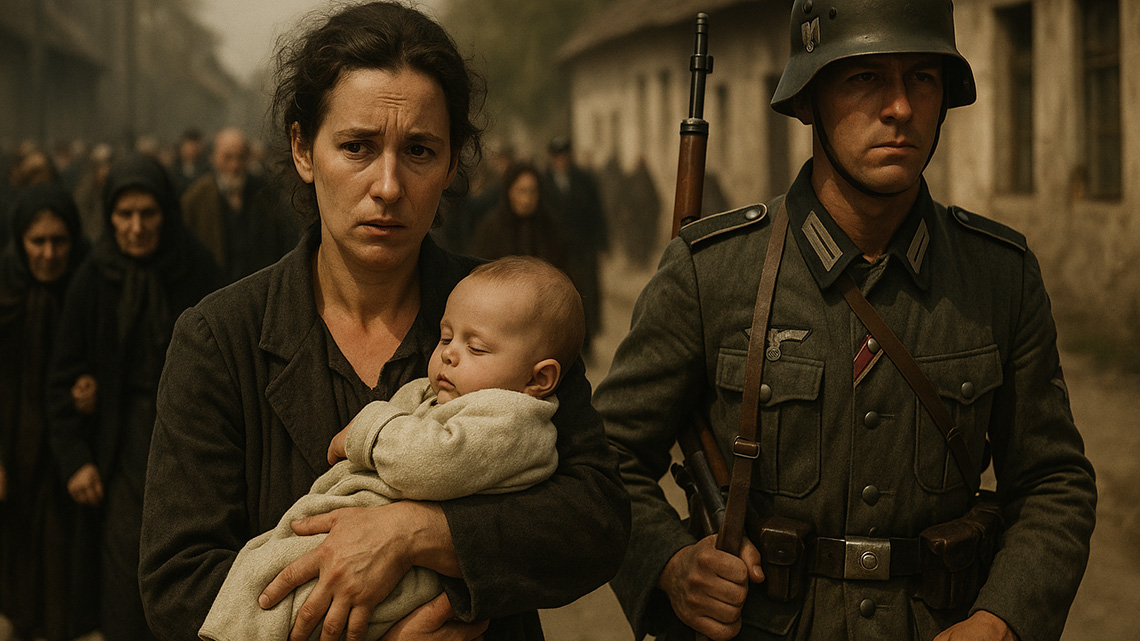
According to available data, the Jewish population in Novi Bečej peaked around 1910, reaching over 200 people. By 1931, due to the economic crisis, this number had fallen to 140. However, by 1940, it increased to approximately 180, as families gathered in anticipation of the war. Unfortunately, many of them faced tragic events in 1941.
Comments