



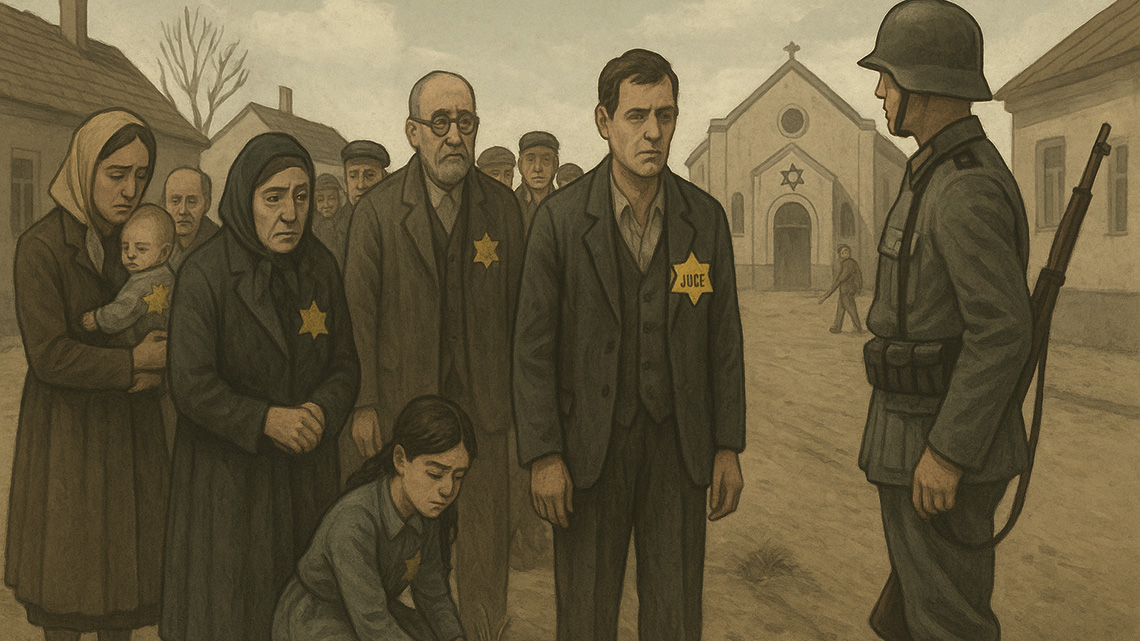
The only prominent Jew from Novi Bečej who was not arrested at the time was Dr. Dezider Kanic, a lawyer. He made direct contact with the military commander of the town and, proving that he had served as a German "Uhlan" officer, managed to obtain permission to move to Hungary (see the testimony of Dr. Viktor Jordanić).
The others were interrogated, mistreated, and blackmailed into paying large sums of money for their release. Having no choice, they complied and were temporarily released to return home. This brief freedom gave rise to false hope. According to Senji Maćaš, his father was approached by his neighbor, Alfred Berger, a Jew who had just been released. Berger said: “You know how it is – even when you pluck a goose, its feathers grow back! The same will happen to us!”
But that illusion was short-lived. Soon after, daily reporting and forced labor were imposed, accompanied by armed guards. All Jews were required to wear yellow armbands marked “JUDE” and the Star of David on their chests. They were only allowed to walk on the main road, never the sidewalks. Speaking with people of other nationalities was forbidden, and those who did were harshly warned: “If you like them so much, you can join them!”
Branko Petraškova ("Komoč") recalled trying to talk to his Jewish acquaintance, Kraus, in front of the elementary school in June 1941 and being publicly reprimanded. Rozalija Drapoš also recounted her husband’s conversation with their former employer, Dezider Hamburger (see testimonies of Petraškova and Drapoš).
From mid-May 1941, most Jewish men from the Novi Bečej district were detained in the synagogue courtyard under constant guard. They were forced to perform degrading tasks: pulling carts full of street garbage like draft animals, collecting manure and filth by hand, cleaning public latrines, and loading wagons and riverboats.
Jewish women were still living in their homes but mostly confined to utility rooms, as their main living quarters had been seized by local ethnic Germans (Volksdeutsche) and their collaborators. Women had to report daily to the police and were assigned duties like cleaning police offices, washing floors, windows, and laundry, or serving in Volksdeutsche households. When no other tasks were assigned, they were forced to weed grass from roadsides—often with their children.
Mirjana Velisavljev-Dragić recalled seeing her 10-year-old schoolmate Katica ("Kitika") Naftali, together with her mother, pulling weeds silently by the road, too afraid to lift her head or glance around.
Some of the most inhumane and sadistic abuse took place along the embankment leading to the ferry crossing. These public displays aimed to strip the Jews of every shred of dignity. The perpetrators often chose older, respected community members as targets. Mihajlo "Miša" Kiselički described witnessing Jožef Klapka’s son—an ardent Nazi—forcing 60-year-old Imre Déri to repeatedly run up and down the slope, whipping him with a riding crop until the man collapsed, bleeding and exhausted.
Živa Kiselički also recounted how Jewish workers had to crawl under horse carriages to clean up even the tiniest straw. On one occasion, as a horse began to defecate, a guard commanded the Jews to catch the manure with their bare hands so it wouldn’t dirty the cobblestones—laughing grotesquely at his own cruelty.
By early June, the situation eased slightly. Some Jewish youths managed to bribe guards to briefly visit friends or relatives and receive food or clothing. Occasionally, guards would escort detainees to bathe in the Tisa River. Sándor Nađ remembered that Đura “Đurika” Šlezinger, a clever and fluent German speaker, managed to attend a wedding dinner hosted by one of the guards.
However, on the eve of Germany's attack on the Soviet Union, a wave of arrests targeting communists and anti-fascists swept through Banat. During this crackdown, the remaining Jews of the Novi Bečej district were detained and subjected to even harsher conditions.
Živa Kiselički personally witnessed the arrest of clerk Kraus at the “Senćanska steam sawmill,” and also saw Dr. Dezider Kanic being taken away—contradicting earlier accounts by Dr. Viktor Jordanić and Sándor Nađ, who claimed that Dr. Kanic had avoided arrest based on information from his daughter.
Comments