



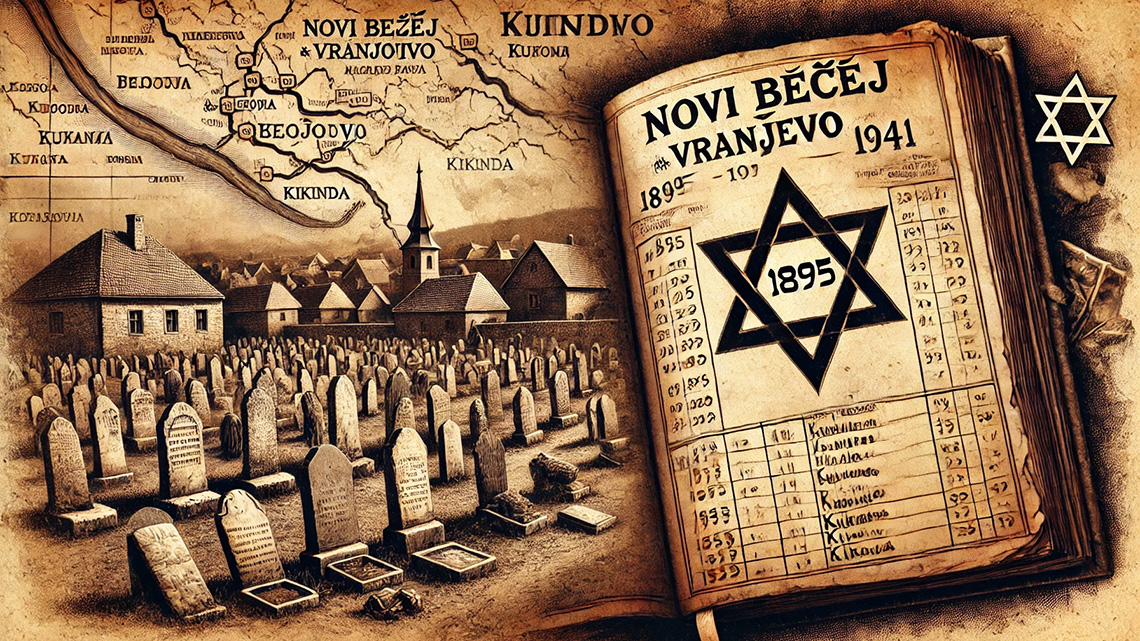
Since we do not have direct and reliable data on when and how the Jewish communities in Novi Bečej and Vranjevo were formed, we will use data from municipal registers of these municipalities for the period from 1895 to 1941, as well as from school registers of primary schools for the period from 1888 to 1941.
Although these data are not fully comprehensive, they still provide some insight into the community's demographic development. These data do not allow us to present Jewish families that had no births, marriages, deaths, or children in school.
We will also indirectly observe migration paths and their participants, with particular attention given to previous generations — the parents. This is especially interesting in the last decade of the previous century, when the Jewish community in our towns largely stabilized. If we compare the places of origin of the parents, which mostly show the direction of family migration, we will notice a clear gradient of distance. Places of migration were: from the Beodra, Kumana, and Melenci regions; from Banat: Mokrin, Bašaid, Padej, Kneževac, Veliki Bečkerek, Klek, Krstur, Omoljica, Sent-Đurađ, Modoš, and Kovin; from Bačka: Senta, Kanjiža, Topola, Bač, Petrovo Selo, Stari Bečej, Bačko Gradište, Torža, Kovilj, Sirig, and Stanišić. Immigrants also came from 23 different locations across other parts of Austria-Hungary (ANNEXES: List of places from which Jewish families migrated).
Looking at the places of origin of spouses who married in Novi Bečej and Vranjevo, we can see the process of migration settling at the beginning of the 20th century. For example, of the 13 marriages in the period 1895-1899, in 7 couples both spouses were from elsewhere, in 5 couples one spouse was from Novi Bečej, and in only one marriage both spouses were from Novi Bečej or Vranjevo. In the period 1900-1910, there were no cases where both spouses were from elsewhere; in 10 couples, one was from elsewhere, and in 8 couples, both were from the town. This was the period when the Jewish community fully formed and stabilized (ANNEXES - Marriage list 1895-1941).
It is not possible to determine the exact number of Jews in Novi Bečej (with Vranjevo). One of the main reasons is the high fluctuation of Jews, which was a consequence of their desire to move to economically more prosperous and tolerant environments. The large dispersal of the Jewish population is reflected in the fact that, despite the relatively small number of 76,654 Jews before the war, they were scattered across Yugoslavia (Encyclopedia of Yugoslavia - JLZ - Volume IV). As a result, the data for Novi Bečej and Vranjevo in the last 150 years shows very different numbers (ANNEXES: Statistical reviews - population count). According to the data, in the last decade of the community's existence, there were about 180 Jews in Novi Bečej (with Vranjevo), or around 60 families. In the entire church municipality, which covered Beodra and Kumana, there were 204 Jews. This is the last official data published in the Jewish National Calendar for the years 1940-41.
Although data from the registers cannot depict all the facts about the total Jewish population, they can reflect the life pulse of the vast majority of the Jewish population, as they show the number of births, marriages, and deaths. These data do not cover families and individuals where these family events did not occur, and it is very difficult to estimate the number of such families. Therefore, we will review and compare the data from these registers, as what is recorded there is indisputably accurate.
In the birth registers of the municipalities of Novi Bečej and Vranjevo, the following can be observed: Over the last 45 years, during which state records were kept, a total of 160 children were born in both places, of which the vast majority — 153 children — were born in Novi Bečej. Therefore, data about Novi Bečej as a settlement are more indicative. It is known that Novi Bečej and Vranjevo were very different places despite their proximity. Novi Bečej had a more dynamic economic development and was more suitable for Jewish work, while most Jewish families in Novi Bečej were of Hungarian origin. Also, the Hungarian school in Novi Bečej was better than in Vranjevo, so children from Vranjevo almost entirely attended school in Novi Bečej. For this reason, most of the data will be compared and analyzed for Novi Bečej, as this is where the most important events related to Jews in Novi Bečej and Vranjevo occurred.
During the mentioned 45 years, the number of Jewish children born in a given year varied greatly. From 1896, when 16 Jewish babies were born in Novi Bečej, to 1933, when no Jewish births were recorded, the number of newborns drastically decreased. Before World War I, the number of newborns ranged from three to six, while after the war, it fell to 1-3 babies per year, making up between 0.55% and 1.65% of the total number of newborns in Novi Bečej.
In 1933, 1935, 1938, 1939, and 1940, no Jewish children were born, which certainly reflected the psychological atmosphere of fear of war. The last Jewish child born in Novi Bečej was Ladislav (Laslo) Berger, the son of Alfred and Gabriele Berger, on January 19, 1941 (ANNEXES: Statistical data on newborn children).
Jewish marriages in Novi Bečej were mostly formed out of love, and rarely for practical reasons, such as material security or inheritance of trade businesses. Marriages were typically with spouses of Jewish nationality, and of all the marriages, there were only five cases in which one of the spouses was of a different nationality or faith. Marriages were often connected with migration or the inheritance of commercial businesses or crafts. During the official record-keeping period, 45 marriages were recorded in Novi Bečej, of which the newlyweds lived outside the town afterward (ANNEXES: Marriage list and List of Jews who married in Novi Bečej but did not live there).
Over a period of 46 years in Novi Bečej and Vranjevo, 81 marriages were recorded, with the last one being between Margita Naj, daughter of Bernat Naj, a merchant from Novi Bečej, and Eugene Špirer, a merchant from Budanica, on August 15, 1940. This number should also include marriages of Novi Bečej Jews that took place outside Novi Bečej, but we do not have data on those.
Jewish marriages were stable, but there were 8 divorces out of the total of 81 marriages during the 46 years. It is possible that the number of divorces was higher, as we lack data on divorces that occurred outside Novi Bečej.
Based on the data from the death registers, the number of Jewish deaths ranged from 1 to 6 annually, with no deaths recorded in the years 1911, 1924, 1934, and 1935 (ANNEXES: Data from the death register).
An interesting comparison is the number of deaths and the number of burials in the Jewish cemetery. The memorial monument states that 239 individuals are buried there, and during 46 years (1895-1941), 141 people died, meaning that 98 people died between the establishment of the cemetery in 1826 and the beginning of official records (for 70 years). This indicates that the Jewish community was small in the first half of the 19th century and increased in the last decade of the 19th century.
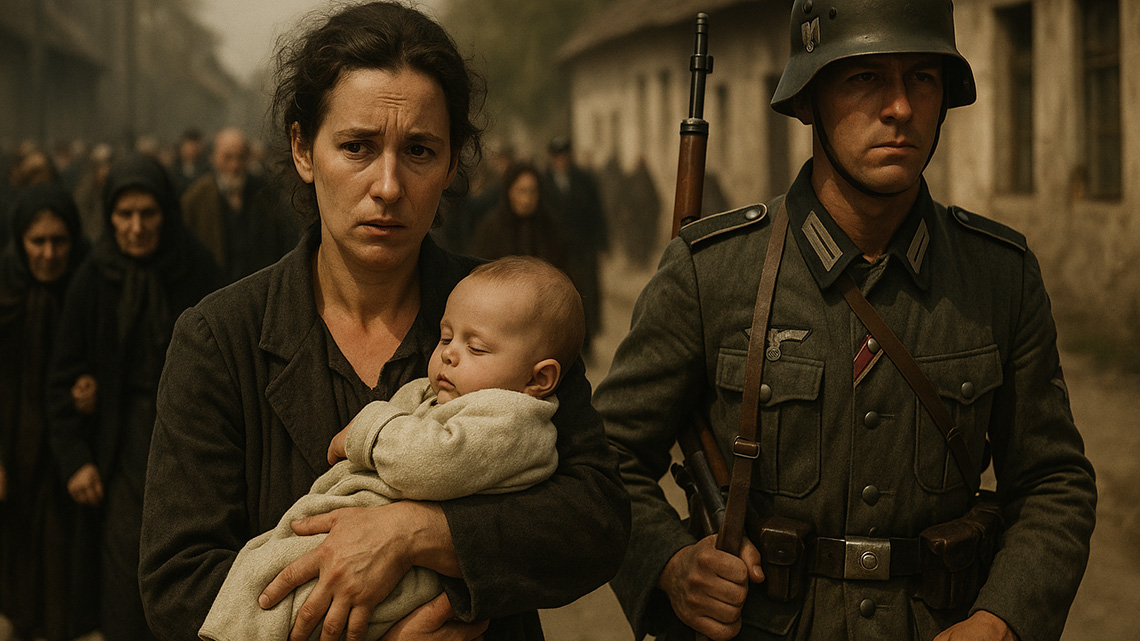
When comparing the number of newborn children and deaths based on municipal register data, there is a positive increase of 19 individuals. This data sounds paradoxical and tragic, as the overall balance shows:
TOTAL DESTRUCTION!
Comments