



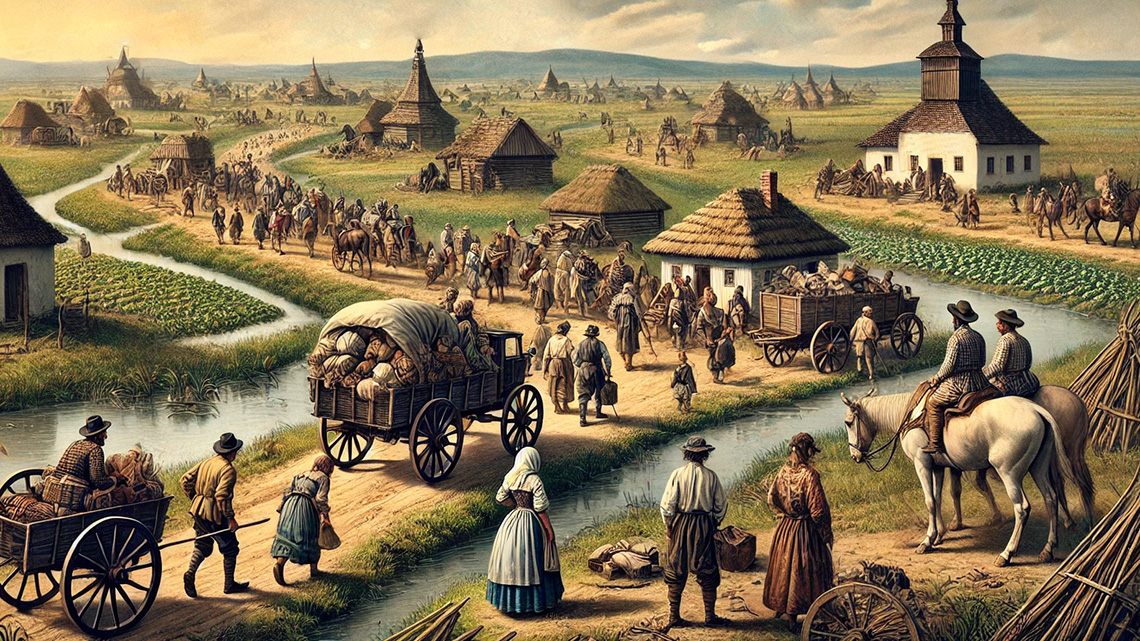
Banat, a vast and fertile plain, but densely dotted with swamps and river branches, became a hub of migration for various peoples in the second half of the 18th century. The indigenous peoples, Serbs and Hungarians, were greatly reduced after the Austro-Turkish wars and the plague epidemics, and the vast areas were empty.
As a result, the authorities at the time took measures to populate these regions and stabilize their population (Dušan Popović: Serbs in Banat, pp. 56-57).
Hungarians and Serbs from distant regions settled here, and there was also direct colonization carried out by the Austrian court, bringing Germans, French, Slovaks, Spaniards, and other ethnic groups from very distant lands (Lazar Mečkić: Novi Bečej and Vranjevo Through History, pp. 47-48).
The strengthening of Banat’s economic potential created the need for enterprising and capable organizers of economy and trade. This led to the gradual and cautious settlement of Jews from Austria, Upper Hungary, Slovakia, Silesia, Galicia, and Poland into Banat’s cities and villages by the mid-18th century (Dragoljub Čolić: The Role of Jews in the Economic Development of Banat, p. 112).
Dragoljub Čolić, in his unpublished monograph on Banat’s Jews, mentions numerous obstacles imposed by authorities at all levels: from municipal and district to county and state (Dragoljub Čolić: ibid., pp. 111-112).
However, the process of settlement continued, and, for example, the town of Veliki Bečkerek already had its first registered Jewish inhabitants in 1747 (Dragoljub Čolić: The Role of Jews in the Economic Development of Banat, p. 113).
We do not have data on when Jews settled in Novi Bečej and Vranjevo, but we can safely accept Dragoljub Čolić’s opinion that the first settlers arrived in the second half of the 18th century. The settlement process was slow, as Jews in both places had a hard time obtaining the status of full citizens with equal rights to work (Lazar Mečkić: Novi Bečej and Vranjevo Through History, pp. 57-58).
Namely, official approval for settlement – the "INKOLAT" – could only be obtained by a Jew who had proven himself as a good businessman and a proper citizen (Drag. Čolić: ibid., p. 112).
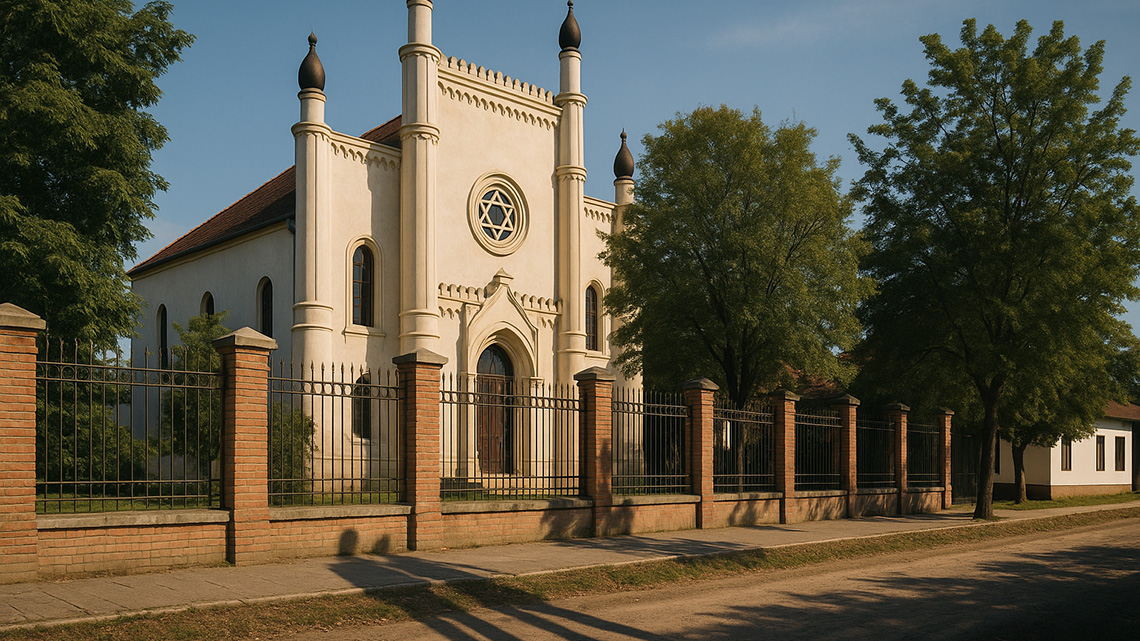
Their settlement was also hindered by the indigenous people, who were full of distrust and religious intolerance. For their still underdeveloped awareness, stories about the mysterious religious rituals of Jews, who were believed to sprinkle the foundations of their synagogues with the blood of Christian children, easily spread (B. Čiplić: Farewell to Rahav, Belgrade, 1960, p. 13):
"... The synagogue was torn down, its beautiful red color still clinging. The infidels say it's from the blood of Christians, with which we had to sprinkle the foundations when we built it – as our Jewish god requires."
These prejudices were spread by malicious traders and craftsmen from the town, who feared competition from the skillful and wise Jewish entrepreneurs, who were always satisfied with small profits but put great effort into satisfying their customers (D. Čolić: ibid., p. 112).
For all these reasons, Jews in Novi Bečej and Vranjevo were rare, and many of them lived semi-legally in small hamlets around the area, waiting for their opportunity to "insert" themselves into Vranjevo and Novi Bečej. Only from the beginning of the 19th century do we find data about their settlement.
Namely, both the county authorities and the authorities in the District, up until the end of the 18th century, made it difficult for Jews to settle, but from the beginning of the 19th century, there was a change in attitude toward them, as experience showed that the settlement of these valuable and enterprising people positively influenced the organization of economic life, which was the foundation for further progress in Banat.
Therefore, Jewish names began to appear more frequently in the documents of the time. They gradually settled first in smaller villages and hamlets, and then slowly moved toward larger economic centers. In his work The Great Kikinda District, Vasa Stajić mentions several such cases.
In Vasa Stajić’s work, the mention of Jews in Vranjevo comes relatively late, although Jews had already been living and were mentioned in other areas within the District. He cites the example of Moritz, a Jewish innkeeper from Kikinda, who on January 31, 1791, was accused of insulting the Kikinda clerk, a Serb, and on June 14, 1793, another Jew, Filip Volf, was accused in Kikinda of smuggling wine. On October 19 of the same year, Mihael Majtinski, a Jew from Krstur, requested the removal of a sequestration on his house and property. On May 31, 1802, the village of Taraš sued its Jew, Rozencvajg, for holding too much livestock and refusing to pay pasture fees...
However, the first reference to Vranjevo is not found until 1834, when Herman Polak, a Jew from Bereg, applied for settlement in Vranjevo, claiming to have rendered various services to the town. In the same year, Jozef Kraus, who had been living in the village for over twenty years, was mentioned as a quiet and honest man. If we interpret this literally, it would mean that Jozef Kraus was already a resident of Vranjevo around 1810, and he was certainly not the only one, as we have already mentioned that there were Jews in the surrounding villages from the very beginning of the 19th century.
Supporting this, we know that the Jewish cemetery in Vranjevo was established in 1825, which could not have been done unless there were at least 10-15 families in Vranjevo (L. Mečkić: Novi Bečej and Vranjevo Through History, p. 58).

Comments