



After several months, around April, he called me and explained that his food poisoning had complicated, and that he had been in the hospital for three months. That's why he hadn't contacted me, but now he wanted us to meet.
He told me how unhappy he was about his article in the Novi Sad Daily about "Golubnjača" and that he was afraid everyone in Vojvodina would reject him due to the political changes at the top, and that even the people of Novi Bečej might not want to contact him because of this. When I told him that this had nothing to do with the people of Novi Bečej and that he was always welcome here, he decided to come to Novi Bečej. He even arranged with Levai to stay at the "Tiski Cvet" hotel, at the expense of the Novi Bečej Cultural Community.
Unfortunately, a few days later, he told me that he had contracted jaundice and that his doctor, Dr. Lesić, had ordered him to come back to the hospital. She had arranged for a special room for him. She knew he was a seriously ill patient and that this was the final stage of his illness, manifesting itself through jaundice. He told me on the phone how attentive she had been toward him, and how everyone on her ward treated him with special care.
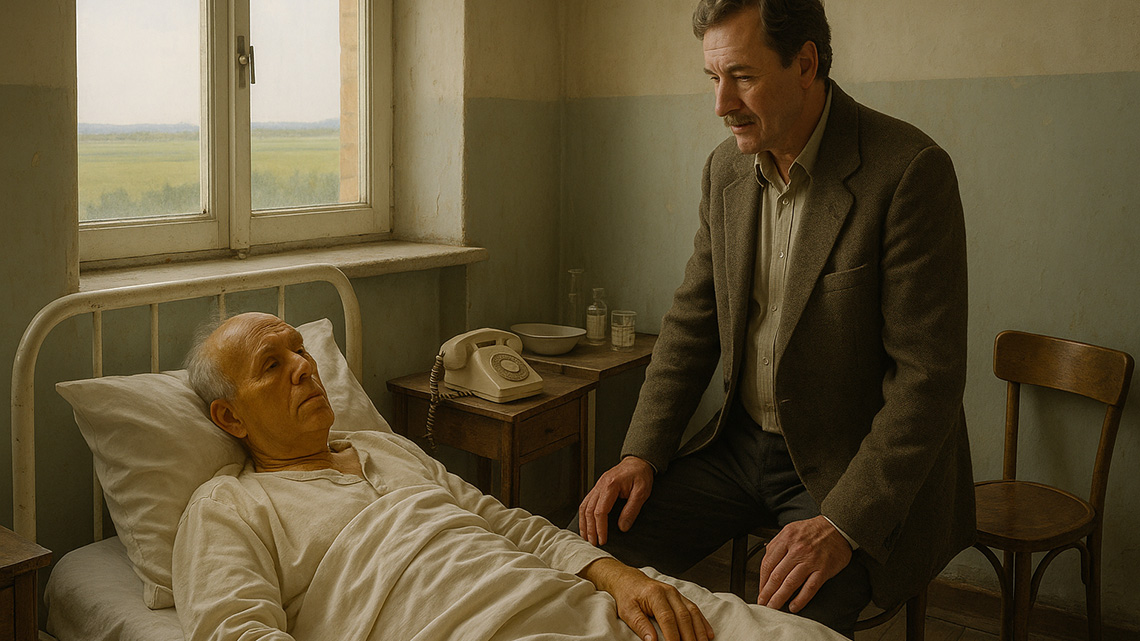
Although I didn't promise to visit him, I had already decided to go when we were talking over the phone. I visited him on June 8, 1989, in the afternoon. He had a special room (number 3) at the infectious disease clinic. When I approached two nurses standing in the hospital corridor and asked to visit Bogdan Čiplić, one of them immediately responded, "To our dear Bogdan, I will take you there."
It was two in the afternoon. He was lying on his back, staring at the ceiling. When I spoke, he was surprised but didn’t recognize me. Only when I said that I was Laza Mečkić did he smile like never before and said, “I was lost in thought, and the light is not helping, so I didn’t recognize you.” We talked about his illness and moved on to my books, especially the history of Novi Bečej and Vranjevo. I read him what I had written about his father. He cried and said, “My dear father, how beautifully you wrote. Thank you so much."
He asked me to call Dr. Dušan Popov, the secretary of the Serbian Matica in Novi Sad, to come and make his will, as he wanted to leave all his possessions to the Matica. I asked him what he was leaving to the Matica. He replied: books and manuscripts. He had three books in manuscript form, as he told me before going to the hospital. He added, likely to justify his decision, “I have been a long-time member of Matica, and now I am an honorary member. I think that my manuscripts will be best preserved there and accessible to others."
He also told me that Ervin Mareš, a pensioner from Vršac, was visiting him because he had taken on the task of creating a bibliography of Bogdan's published works.
Visitors were allowed until 3 PM, and when I was preparing to leave so the hospital staff wouldn’t remind me, he insisted I stay longer, explaining that since his visits were rare, they wouldn’t remind him to leave. He mentioned several times how happy he was that I visited him, as he hadn't expected it.
I informed the people of Novi Bečej: Bata Kiselički, Radi Popov, Zare Maljugić, and Dr. about Bogdan's serious health condition and the content of my conversation with him regarding his legacy, emphasizing that it was a matter of days.
On my return from Novi Bečej, I contacted Dr. Dušan Popov and informed him about Bogdan's wishes, stressing the urgency as it was a matter of days. A couple of days later, Dr. Popov informed me that the procedure had been carried out, and that Bogdan's legacy amounted to a modest sum of 10,000 German marks and ninety dinars (then equivalent to ninety million). Although this may seem a modest amount, it is the legacy of a great man, and as such, it holds more value than its monetary worth.
I learned of Bogdan's death on Friday, June 23, 1989, in the afternoon, right after his passing. That evening, Dr. Živojinović contacted me, referring to the previous obligation regarding the will. He couldn’t understand Bogdan’s actions, as he had never mentioned this to him.
On the evening of Bogdan’s death, around 9 PM, I spoke with Dr. Lesić, the doctor who had been treating Bogdan. She told me that he had passed away in the surgical department after an operation, more out of the doctors' curiosity than for medical reasons. Dr. Lesić was very disappointed that no one from Matica had come by, and she had Bogdan’s bank book, ID card, and keys to his apartment, not knowing to whom to hand them over.
Meanwhile, Bata Kiselički from Novi Bečej contacted Dr. Popov, which I immediately reported to Dr. Lesić, who was relieved that the funeral arrangements would soon be made. She told me that she had shared Bogdan’s tragic story with her husband, lamenting how terrible it was that a man had no family to support him at the time of his death.
Finally, I must briefly explain what caused Bogdan’s estrangement from Belgrade’s and Serbian literary figures, which was likely the reason why no one from their circle said goodbye to him, nor did they intervene in his funeral arrangements. To provide an objective account of his criticism of the play "Golubnjača," I will explain how the Vojvodina autonomists practically betrayed him. When I say objectively, I mean that I visited Bogdan the day after his article was published against "Golubnjača" in Novi Sad’s Daily. On that occasion, he read me his manuscript and explained how everything had unfolded, including the unpleasantness he encountered in Belgrade.
After several weeks of successful screenings of "Golubnjača" in Novi Sad, Bogdan attended one of these performances at the Serbian National Theatre with his ex-wife Vida. During the intermission in the lobby, Bogdan loudly expressed his dissatisfaction with the play. He wondered aloud, "Who needs this today?" He made his discontent clear even after the show when he was picking up his coat in the dressing room.
Vida’s friend, who Bogdan believed had some influence in the Novi Sad party apparatus, overheard him. The day after this performance, Bogdan returned to Belgrade. Shortly after his arrival, Novi Sad Daily editor Štajner called him, following instructions from Duško Popović and Žika Berisavljević, members of the Provincial Committee, requesting that he write a critique of the play that same day.
Caught somewhat off guard, Bogdan wrote an article that didn’t reflect his true standards. It wasn’t a critical assessment of the artistic quality of the play but more of a standard review. I didn’t mention this to him when he read me his manuscript, out of respect for him.
The article was published in the Daily, and soon after, all the controversy surrounding "Golubnjača" erupted. Bogdan began receiving threatening phone calls and many unpleasant encounters. Anonymous threatening letters followed. His play about Lola Ribar was canceled by the Sarajevo theatre, who refused to return the advance payment.
He was deeply saddened by this whole situation but firmly stated that as a non-partisan patriot and Yugoslav, he believed "Golubnjača" stirred up vengeful sentiments, and in such a time of escalating ethnic tensions, it was not something we needed.
"Golubnjača" had been his burden until his death, after the shift in Vojvodina’s autonomy leadership, and beyond.
This is a brief remembrance of a great man from Novi Bečej, who always held his hometown close to his heart. May his memory be eternal!
Comments