



After the war, in 1948, Bogdan Čiplić wrote a new play titled Nad popom popa ("A Higher Priest than the Priest"). It was performed around ten times at the Serbian National Theatre in Novi Sad.
His third play, the comedy The Swindler in Bečej, was staged during the centennial celebration of the Serbian National Theatre. His next play, A Treatise on Maids, was performed more than fifty times by the same theatre. Another of his works, The Corporal and the Emperor, was also brought to life on the stage by the Serbian National Theatre.
All of Čiplić’s plays are rooted in Vojvodinian life, often inspired by his native Novi Bečej.
His dramatization of Stevan Sremac’s story Pop Ćira i pop Spira ("Priests Ćira and Spira"), which he adapted while serving as director of the Serbian National Theatre in Novi Sad, enjoyed a long run—not only in Novi Sad but also for seven consecutive seasons at the National Theatre in Belgrade. Decades after its original Novi Sad premiere, the play was revived once again by the Serbian National Theatre.
I do not claim to be qualified to evaluate Bogdan Čiplić’s literary legacy in the broader context of Serbian or Vojvodinian literature. However, when it comes to his significance as a writer from Novi Bečej, I can speak with certainty. Even with caution, I would still argue that Novi Bečej has not produced a greater citizen than Bogdan Čiplić. Of course, it is always difficult—if not impossible—to measure the greatness of individuals across different domains of human achievement. How can one compare Miloš Obilić and Branko Radičević, or Čiplić and Aleksandar Berić, or Čiplić and composer Josif Marinković, when their contributions lie in completely different realms?
Still, in the field of literature and writing, I can confidently say that Čiplić has no equal. Ultimately, I leave this judgment to future biographers—those who will assess his work not only from a local perspective, but within the wider scope of Vojvodinian, Serbian, and even Yugoslav literature. This is all the more important because I believe that during his lifetime, he was not given the recognition he deserved, especially in Vojvodina.
Čiplić was likely one of the most prolific Vojvodinian writers of the second half of the 20th century. Yet such recognition was hardly voiced in Vojvodina, aside from the Zmaj Award from Matica Srpska for his poetry collection Sweet Orthodoxy (Slatko pravoslavlje), and two literary awards from the Republic of Serbia. No one thought to nominate him, at the very least, as a corresponding member of the Vojvodina Academy of Sciences, or to honor him with a lifetime achievement award.
He did not belong to any literary circles, cliques, or associations. Perhaps he engaged with them in his youth, only to become disillusioned—feeling sidelined or, at best, quietly pushed aside by those more adept at self-promotion in a system where, unfortunately, merit was not the main currency of value. In those days, one had to charm the public—not with thoughtful words, but with witty remarks, often aimed at the marginalized or those expected to fall out of political favor. One had to flatter the powerful, thus clearing a path even for modest works, which, with help from influential media, could be elevated to the level of supposed masterpieces.
This was not Bogdan's way. Though he never harmed anyone, and at times may have even shown deference, his dedication and creative output likely closed doors that—had envy not played a role—should have been wide open to him.
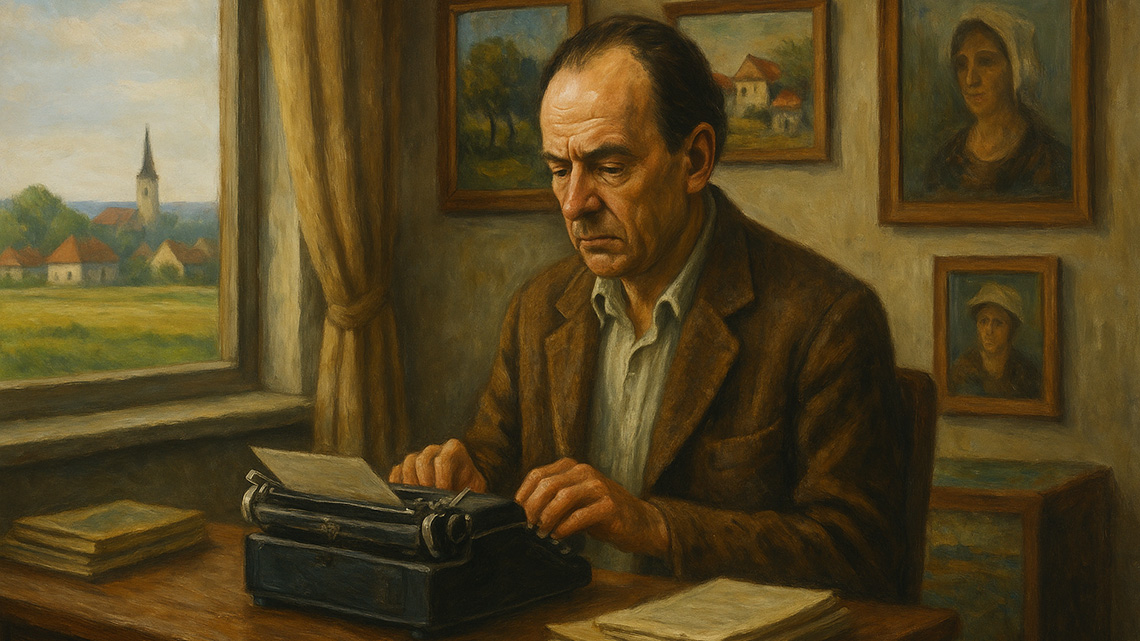
I never had a chance to ask him why he left Novi Sad—whether it was due to his parents’ move to Belgrade—or why, once in Belgrade, he confined himself to a modest studio apartment, his typewriter, and, for leisure, his paintbrush. He painted watercolors—later even using colored markers—with spontaneity and without regard for artistic rules. He painted as he felt, in the moment, sometimes completing three or four works in a single day. While many of these were modest in scope, from that volume emerged several outstanding pieces. This view was shared by Zoran Petrović, a professor of watercolor painting at the Academy of Fine Arts in Belgrade and a friend and admirer of Bogdan’s.
Bogdan wrote extensively, painted prolifically, and took great pleasure in displaying his artwork across every wall of his small room. Every couple of weeks, he would replace old paintings with new ones, refreshing the space—what he liked to call "changing the atmosphere of his life."
That was his world—shared with two or three younger friends, often former students from his days as a professor at the Novi Sad Gymnasium, or budding artists who learned painting from him. These friendships grew into lasting bonds.
He did not choose isolation. His nature was simply such—as he once jokingly told me, "I’m a lone wolf." Above all, he was a man of work. He considered time spent socializing in cafes a waste, unlike many other writers and artists who found companionship and promotion in the bohemian life. Bogdan never sought fame through such paths.
Comments