



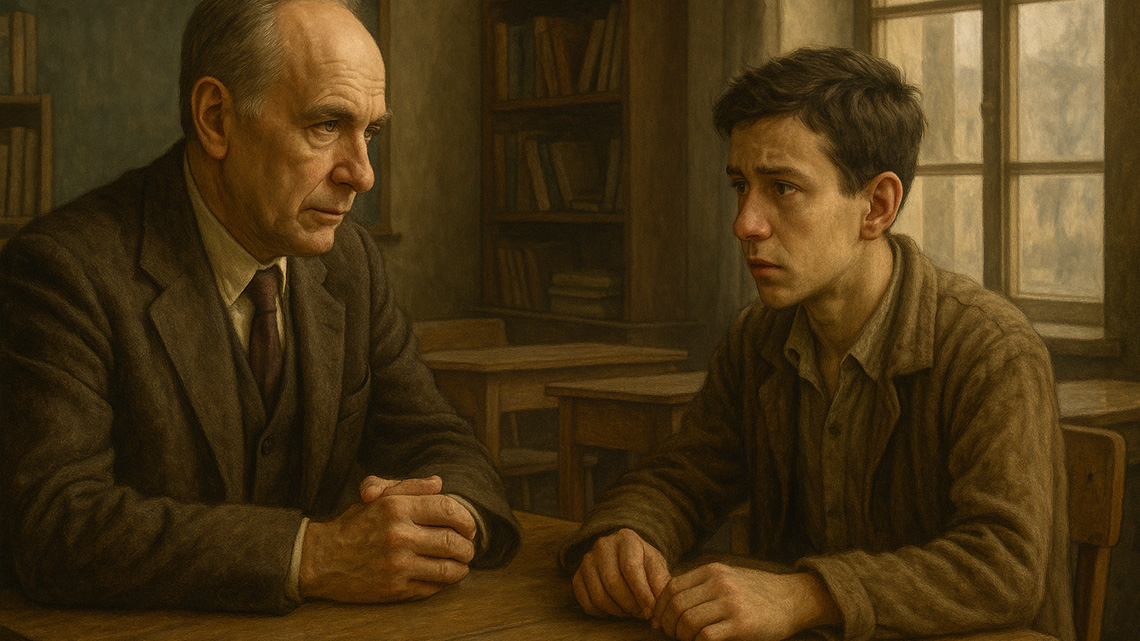
How honorable, courageous, humane, and brave Bogdan Čiplić was in crucial moments was illustrated by Ivan Ivanji in his speech at Bogdan’s funeral. Among other things, he recounted how, as a Jew, he managed to escape from Banat—where the Volksdeutsche were among the first to carry out genocide against Jews—and reach Novi Sad without any documents.
Wishing to continue his education, he approached Bogdan Čiplić, then assistant principal at the Novi Sad Gymnasium. He honestly told him that he was a Jewish refugee from Zrenjanin and had no proof of completing the second or third grade of high school, although he had. He wanted to enroll in the next grade. Bogdan listened carefully and told him to come to school the next day, where he would be placed in the appropriate class. And so it happened—Bogdan helped him continue his education.
What greater proof of Bogdan’s humanity do we need? In this case, it wasn’t just kindness that was required—great courage was also needed, especially considering his position at the school. Bogdan treated this act as completely normal and without hesitation. It wasn’t a decision he later regretted. Ivanji finished his schooling thanks to Bogdan, who risked a lot—but true acts of kindness often ignore danger. That’s exactly the spirit in which Bogdan acted.
Perhaps I have been bold in my assessments of Bogdan Čiplić’s character, based only on a few episodes from his rich life and creative work, but I do so consciously, hoping this can serve as a modest contribution toward a full and fair evaluation of him as a man and a creator.
As a special part of this account, I want to share Bogdan’s thoughts and dilemmas regarding his legacy. In the autumn of 1981, either by chance or by Bogdan’s design, the three of us—Dr. Živojin Živojinović, professor at the University of Novi Sad (formerly one of Bogdan’s students), Bogdan, and I—gathered at his apartment on Takovska Street 33, entrance 2, first floor, at 5 PM. Bogdan respected Dr. Živojinović deeply, as a wise and honest man. That’s perhaps best illustrated by the watercolor portrait Bogdan painted of him—nearly life-sized, from the waist up—one of his finest portraits.
During that meeting, Bogdan told us he saw death as a natural process, including his own. Quoting his mother Sara, he said, “It is natural for the old to die before the young.” As he was born in 1910, he expected to die before us. He was increasingly concerned about what would happen to his belongings after his death. Seeing no other solution, he asked the two of us to act as the executors of his will. Flattered and aware of the burden he carried, we accepted. He added that he had some distant relatives in Uljma, on his mother’s side, but since they had never shown interest in his mother, he had distanced himself from them as well.
Here are the main points of his verbal will (he had no written version until shortly before his death):
- He wished for no ceremony at his funeral, for the date not to be publicly announced.
- He wanted to be cremated in our presence only, with his ashes scattered—not stored in a columbarium.
- Only after the cremation could his death be publicly announced.
- He left all of his modest property to the "Miloje Čiplić" Elementary School in Novi Bečej.
After we accepted this, Bogdan was relieved. That autumn, he visited Dubrovnik and sent me several postcards. Upon his return, he mentioned consulting with a lawyer (Dr. Simić), who advised him that while a written will wasn’t mandatory, it was recommended. Bogdan said he would formalize it and include us in court proceedings.
Years passed, but he never mentioned the will again. I never heard from Dr. Živojinović again, except for occasional greetings via Bogdan.
On the day Bogdan passed away, Dr. Živojinović called me in the evening, reminding me of our role in managing the funeral and testament. When I told him that Bogdan had ultimately left all his possessions to Matica Srpska and that they were now responsible for the funeral, he was quite surprised—indicating that Bogdan had never told him about the change in his final wishes.
In early 1989—or possibly late 1988—Bogdan called me to say he had suffered from food poisoning and wanted to visit once he recovered, to see my paintings and talk about Novi Bečej. He mentioned he had recently been in Novi Sad, spending time at the Manuscripts Department of Matica Srpska, where he had written three books. Upon returning to Belgrade, he began writing another one, titled On the Literary School of Novi Bečej, beginning with his father Žarko and ending with Laza Mečkić.
Comments