



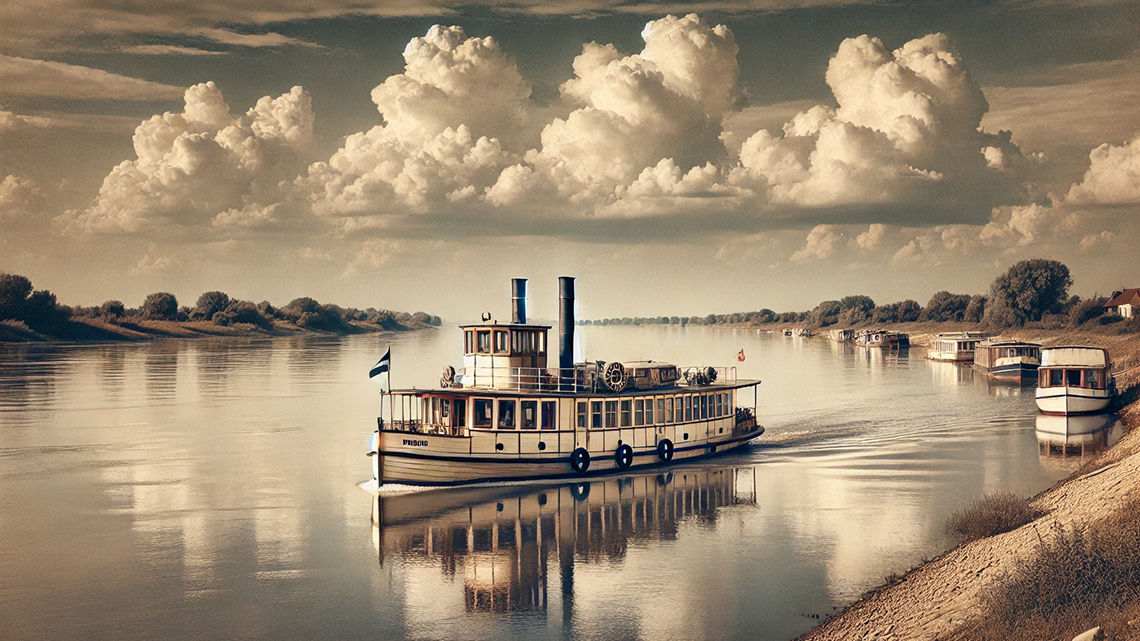
After the accident of the small ship Stari Bečej on September 12, 1931, Novi and Stari Bečej were left without daily passenger boat transport for a while. However, this situation didn’t last long, as the Belgrade shipowners Jezdić and Bakarić agreed to provide transport using their beautiful and almost new motorboat Tomislav.
The ship had a capacity of 250 passengers. However, Tomislav was too fast and expensive to operate on such a short route. Additionally, the crew came from outside the region, which made the service even less profitable. As a result, Tomislav soon left the Tisza River and found a more rewarding passenger route on the Danube and Sava Rivers.
Shortly after Jezdić and Bakarić abandoned the line, a small steam-powered ship called Srpče, which had previously operated on the Begej River between Veliki Bečkerek and Srpski Itebej, was brought in. However, Srpče also proved unsuitable. It was slow, and the large intervals between trips made coal consumption uneconomical, as the ship had to maintain steam pressure throughout the day, even during long waits between routes. By December or, more precisely, until the Tisza froze in the winter of 1931, Srpče returned to its original route on the Begej.
Fortunately, this left the Stari Bečej–Novi Bečej route with a new motorboat called Miroslav.
Miroslav was a beautiful, smaller motor-powered ship that could carry about 150 passengers. The journey from Stari to Novi Bečej took 30 minutes, while the upstream trip from Novi to Stari Bečej took 35 minutes. It was powered by generator gas and was economical for this route. Its owner, Crkvenjakov from Stari Bečej, kept the boat operating on this route until the outbreak of World War II.
With the war and the occupation of these areas by Hungarians (in Bačka) and Germans (in Banat), all transport links between the two Bečejs were cut off. The border crossing near Novi Bečej, operated by a ferry, was mostly closed and rarely used, except by official personnel of the two countries.
Returning to Miroslav, the boat was named after the owner's elder son, Miroslav Crkvenjakov. It was a lovely vessel with two decks—fore and aft—and two salons for first and second-class passengers. Both the decks and salons were spacious enough to accommodate all passengers, even during peak travel times. Passengers could choose to sit in the salons or on the decks. First-class tickets cost slightly more, which often left the first-class salon nearly empty, averaging only two or three passengers. In contrast, the second-class salon was quite crowded, especially in the mornings and afternoons, as over twenty students from Novi Bečej traveled daily to the gymnasium in Stari Bečej.
A monthly student ticket cost 60 dinars, which was a considerable sum at the time, considering that an agricultural worker earned a daily wage of 10 dinars for a full day of labor from sunrise to sunset. In effect, six days of wages were needed for a student’s monthly pass. A regular one-way ticket cost 8 dinars, which was also expensive. Despite the high prices, the owner, Crkvenjakov, managed to cover his expenses and live a modest life, slightly above average.
The ship made 7–8 trips daily between Novi Bečej and Stari Bečej, with a timetable synchronized with train arrivals in both towns. The vessel, about 25 meters long and 4 meters wide, was powered by generator gas. In addition to the regular exhaust chimney for gas emissions, there was a similar but slightly shorter chimney that served as an aesthetic imitation. In reality, it was used for fueling the generator, where coal for gasification was loaded.
The boat was not only visually appealing but also comfortable for travel. The decks featured well-maintained benches, while the salons were kept clean and equipped with two rows of benches with an aisle in the middle.
The ship was reliable, punctual, and adhered strictly to its printed schedule, which was adjusted annually in coordination with the railway timetable. Hundreds of copies of the schedule were printed and distributed in cafes and shops in both Novi and Stari Bečej, providing travelers with a practical tool that included train schedules alongside the ship's timetable.
I traveled on Miroslav for two years as a student and can hardly believe that the boat never broke down or missed a scheduled departure. The crew, including Mladen “Mlađa” Krstonošić as helmsman and ship captain, Jožika Švajcer as engine operator, Bandika as stoker, and the owner Crkvenjakov, who often collected fares himself, treated passengers with great respect. They were particularly kind to us students, tolerating our occasional mischief.
For us students, Miroslav was more than just a boat—it was a refuge during storms and bad weather, and the crew were like protectors and benefactors.
Unfortunately, I must end this story about the beloved Miroslav with some bitterness. The administration of the Stari Bečej gymnasium treated us traveling students with little regard, particularly those coming from Novi Bečej and other surrounding areas. To minimize the number of traveling students, the school implemented a split schedule, with three morning classes and two in the afternoon. This arrangement forced us to leave Novi Bečej at 5:30 a.m. and return at 6:00 p.m., spending over 13 hours away from home each day.
The lack of proper facilities, such as a waiting area at the docks or school, made our experience even more challenging. Despite this, Miroslav and its crew remained a bright spot in those difficult days.


Comments