



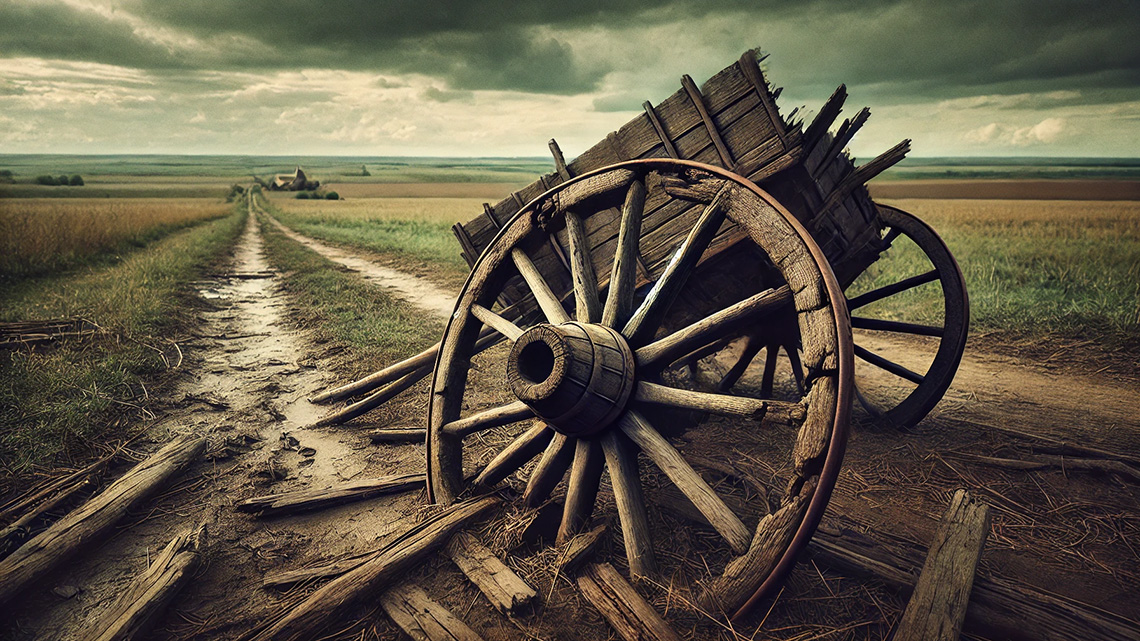
Unlike today's farmers, who work the land with tractors and usually keep at least some minimal spare parts like spark plugs, a fan belt, and similar items, in the time my memories refer to, farming was done with horse-drawn plows, and all transportation relied on wagons.
Back then, no rural household had any spare parts for wagons, except for a dručanik, which was often added to hitch a third horse, as it was called on the logov. I don’t know if anyone in our neighborhood even had a spare levča, let alone a čivija, and as for a wheel—no household, not even the wealthiest ones, had a spare.
This wasn’t negligence; rather, it was known that there were enough wheelwrights or blacksmiths in the village who were capable and willing to repair a broken part or make a new one in the shortest time possible. Wheelwrights had ready-made wheel rims and spokes, shafts, yokes, dručanik, and levči in their workshops, which could be immediately provided to the customer while they waited for a specific part of the wagon to be replaced. Blacksmiths could repair a broken part quickly, and they also had spare tuljci, tops, čivije, and even wheel rims.
Everything was repaired or replaced swiftly because wagons were standardized. There were short, long, and ox-drawn wagons, as well as tarnice. For each of these types, parts were standardized so that any blacksmith or wheelwright could provide the necessary replacement or repair in no time. This is why farmers seemed careless about keeping spare parts.
They didn’t have spare parts for other agricultural tools either, not even for seed drills or binders, let alone harrows or cultivators.
Yet, despite the fact that a craftsman was, so to speak, always at hand, many farmers neglected the maintenance of their wagons. It may sound exaggerated to talk about “wagon maintenance,” but in practice, it was as relevant as any other life problem.
All of us who grew up in rural families and were surrounded by farming neighbors know that some farmers treated their wagons the same way some people today treat their tractors or cars. As long as it “works,” they’ll use it, and only when it breaks down—often in the middle of the road—will they seek help. Only after experiencing all the trouble and hassle of borrowing a wheel or another part will they visit the wheelwright or blacksmith, and then continue using their wagon with the same carelessness as before.
A wagon wheel only breaks when the wagon is full, or even overloaded. In such cases, no makeshift solution—like using a wooden beam instead of a wheel—will help. The load must be removed from the wagon, the wheel replaced on an empty wagon, and then everything reloaded. If transporting wheat or corn, this means handling twenty or so sacks, each weighing about sixty kilograms, before continuing the journey.
Now imagine a broken wheel when a full load of wheat is on the wagon—or worse, hay or clover. Just as with wheat sacks, the bundles of hay or clover must first be removed, the wheel replaced, and then the load repacked. That’s a huge amount of work, but without it, the repair cannot be done.
The biggest issue isn’t the effort or time lost in unloading and reloading the wagon. A much greater problem is finding a replacement for the broken wheel.
As I mentioned earlier, no one had a spare wheel—not even households with multiple wagons—which meant borrowing one was difficult, especially during peak times like wheat transport or corn harvests. In such periods, every wagon in a household was in use. One had to go around not only the neighbors but also close friends to find someone willing to remove a wheel from their own wagon and lend it. But everyone knew the borrower wouldn’t rush to return it, and they might need their wagon themselves. That’s why people often made excuses, saying they had urgent work to do that day, and often, this was true—during those busy times, wagons were essential.
During peak seasons, wheelwrights and blacksmiths were overwhelmed with work. If someone wasn’t a regular or “good” customer, they might not even be attended to immediately but instead told to come back in a day or two, or directed to another craftsman.
If a breakdown happened far from the village, say on a remote field road ten kilometers away, the farmer had to ride back to the village on horseback, making an extra round trip of twenty kilometers. Carrying a wagon wheel on horseback was another ordeal. One hand couldn’t hold the reins while the other balanced the wheel—its protruding hub could injure the horse. Holding it to the side wasn’t an option either, as no one has the strength to keep a several-kilogram wheel lifted at arm’s length for a long time. The only way was to strap the wheel onto one’s back, tying it with a rope or bridle, which meant the horse could only walk slowly to prevent the wheel from bouncing uncomfortably. A huge waste of time—yet unavoidable.
Upon reaching the broken-down wagon, the load had to be unloaded, the new wheel installed, and everything reloaded. The entire process took at least half a day. Still, this wasn’t enough to teach some people a lesson—they would continue neglecting their wagons as before. This attitude wasn’t limited to wagons but extended to other things in life as well.
I wanted to highlight the importance of maintaining wagons—not a demanding task like maintaining a car or tractor, but one that requires at least minimal effort to avoid such situations.
It was also puzzling that when a breakdown occurred near a farmstead, the owners were rarely willing to lend a wheel. The unfortunate farmer had to knock on many doors before finally finding someone willing to help. One might wonder why there was such reluctance to offer help in villages known for their solidarity. Many might disagree with me until they hear about my father’s experience, which made him—and others who heard the story—refuse to lend a wagon wheel ever again.
One September afternoon, a man from Taraš broke a wheel near our farm while returning home with a wagonload of flour. He was a grain trader who regularly transported wheat from Taraš to the Novi Bečej mill “Buda” and brought flour back. He made this trip every week, covering about 35 kilometers in both directions.
In good weather, he used two horses, but in rainy seasons, when the dirt road turned into deep mud, he had to hitch a third horse to pull the heavy load. We often saw him stuck in the muddy road, whipping his horses as they struggled in vain.
That fateful day, after breaking his wheel, he had no one nearby to turn to for help. Desperate, he remembered that my mother had a cousin in Taraš and used this connection to plead with my father for a wheel. He promised to return it the next day. Moved by his persistence, my father lent him the wheel.


Comments