



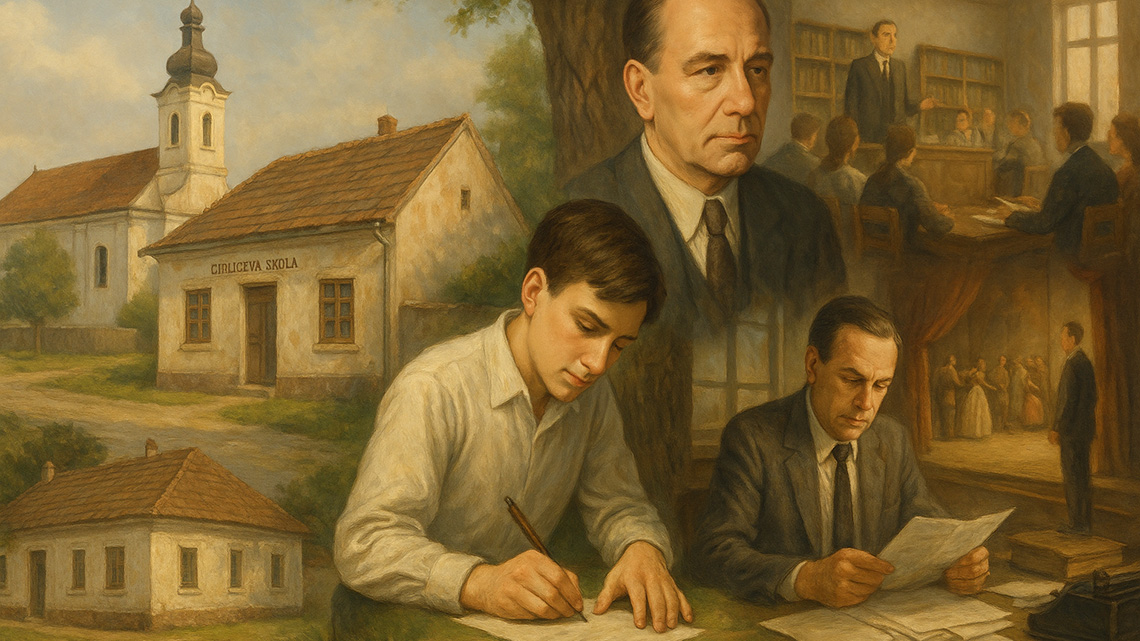
I do not consider myself an expert qualified to critically evaluate the literary work of Bogdan Čiplić. However, out of respect for him and from the memories of our friendship during the last ten years of his life, I will attempt to present—in the broadest terms—what I observed of his literary output.
Without intending to assess these works, I will instead present the recognitions he received for his creative contributions up until 1981. It is worth noting that he continued to create even beyond that year, perhaps more intensely than during his so-called most productive period.
Biographical Details
Bogdan Čiplić was born on November 2, 1910, in Novi Bečej, the middle of three sons of teachers Žarko and Sara Čiplić. He passed away on June 23, 1989, in Belgrade. The Čiplić family home, located next to the Orthodox church in what is now Lole Ribara Street, is still referred to by locals as the "Čiplić School," even though the family moved out more than sixty years ago. Bogdan was born in that house.
Education and Career
He graduated from the Faculty of Philosophy in Belgrade in 1932 and briefly worked as an assistant at the Department of Ethnology. From 1935 to 1937, he was a teacher at the Serbian sections of the high school and teachers’ college in Timișoara, and later briefly at the high school in Velika Kikinda. From the end of 1937 until the end of World War II, he taught at a high school in Novi Sad.
After the war, from 1945 to 1949, he worked as secretary, dramatist, and eventually director of the Serbian National Theatre in Novi Sad. He later dedicated himself entirely to literature and, from 1956 to 1964, worked as a proofreader for Večernje novosti. He left that job to care for his ill mother, to whom he was devoted.
Literary and Theatrical Work
Bogdan began writing at the age of twelve. As a high school student, he published poems in various newspapers across Yugoslavia—from Novi Bečej and Kumanovo to Kruševac and Subotica. His first poetry collection, Poljana, was published in Novi Bečej on June 2, 1930.
He published over 50 books, including more than 20 poetry collections and 9 novels. A total of 18 of his plays were broadcast or performed on stage, on radio and television.
He received numerous awards:
- Republic of Serbia Award for the novel Naveliko i namalo,
- Matica Srpska's Zmaj Award for the poetry book Slatko pravoslavlje,
- Republic of Serbia Award for the drama Surova apoteoza.
His books were published in Belgrade, Novi Sad, Subotica, Vršac, Kikinda, and Novi Bečej. His plays were performed in cities across the former Yugoslavia, including Belgrade, Sarajevo, Ljubljana, Subotica, Maribor, Osijek, Priština, Vršac, Užice, Kikinda, and Novi Bečej.
Contribution to Theater
My personal interest in his theatrical work led me to pay special attention to that aspect of his career. He was involved in nearly every aspect of theater except acting. He founded and edited the journal Naša scena in Novi Sad and, as director of the Serbian National Theatre, helped establish the opera division there.
Upon arriving in Novi Sad in 1937, he offered to write the theater critique column for the daily newspaper Dan, free of charge. His consistent and principled critiques not only influenced the theater’s repertoire—introducing more progressive artistic content—but also earned him respect among progressive youth, while provoking opposition from more conservative circles.
Professor Jovan Stojković, in his book History of Serbian Theater from the Middle Ages to the Modern Era, praised Čiplić’s critiques for their perceptive insights, dramaturgical analysis, stylistic correctness, and modern, realistic understanding of theater.
First Drama and Censorship
Bogdan’s first play, the comedy Neverstva (Infidelities), was staged by amateur actors in Novi Bečej, directed by his younger brother Miloje Čiplić. In late 1939, he submitted his drama Uspomena na Sorento (A Memory of Sorrento) to the theater in Novi Sad. Premiering in February 1940, the play drew great interest across Vojvodina. The first act ended with an unusually enthusiastic applause, though there were also whistles from nationalist youth fearing the play’s impact. The second act provoked increasingly loud applause, particularly for lines that could be interpreted politically. It turned out to be both the first and last performance—the police banned any further staging of the play.

Comments