



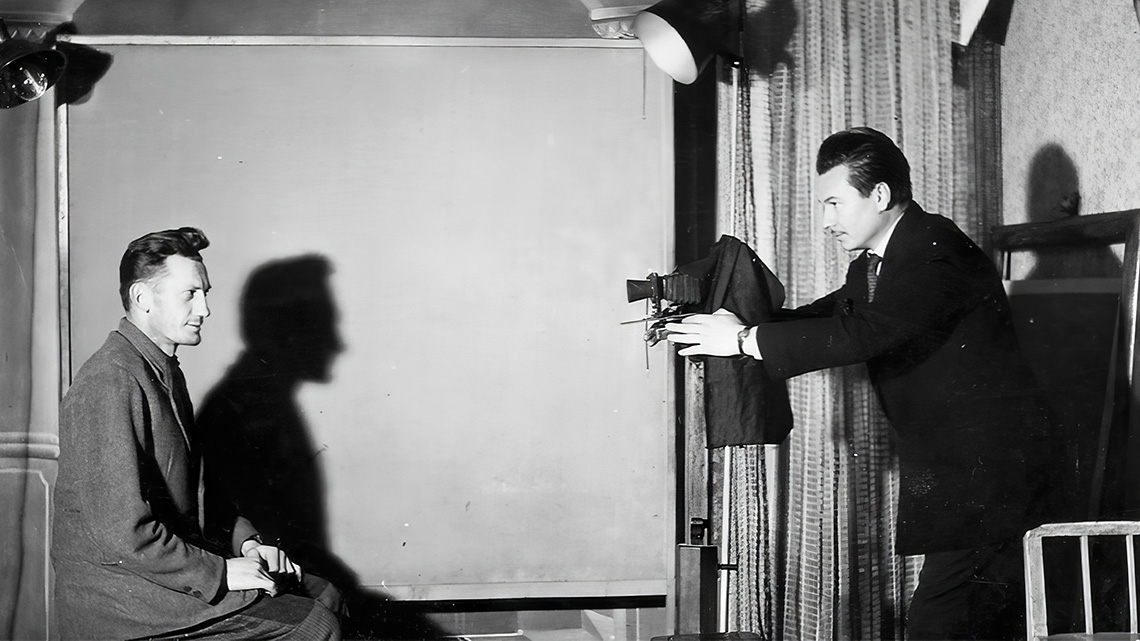
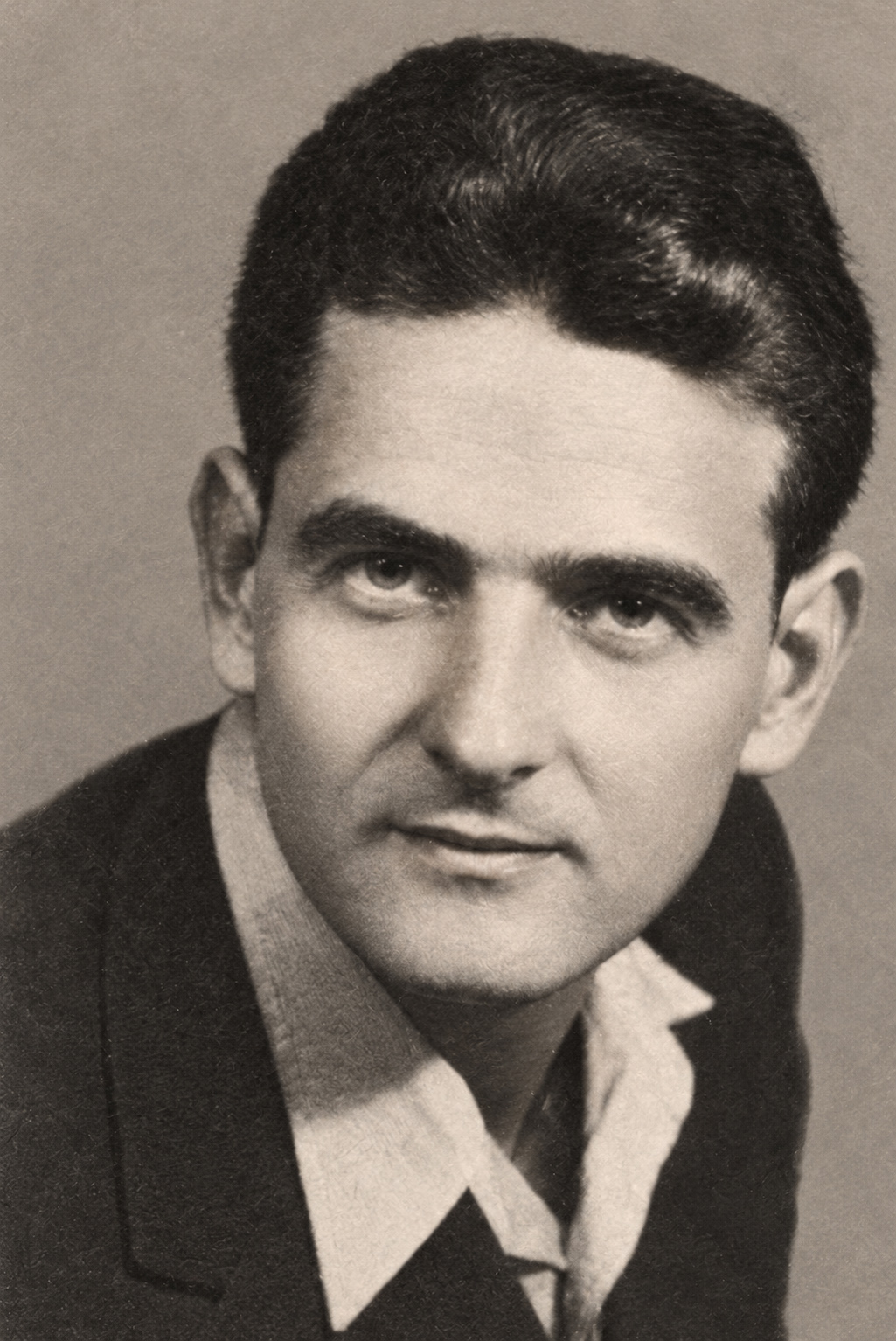
Geza Sakač was born in Novi Bečej on February 11, 1928. He attended both elementary and high school there. After completing his education, he apprenticed in photography under the well-known local photographer Jožef Kožik from 1944 to 1946. He passed his master’s exam in 1952 before a committee that included the prominent master photographer Konstantin Vukov. As a young photographer, after his apprenticeship, he worked part-time in the photography section of the People's Technique and in “Dekor” until the end of 1954.
 The photographs from this period bear the stamp "PHOTO SECTION of the City Board of the People's Front Voloshinovo," later Novi Bečej. After marrying Etelka Stari, full of energy and ambition, he opened his first independent studio in 1954 in the house of leather merchant Franjo Janković at 23 Maršal Tito Street. Just a year later, he and his brother Karolj purchased an old building with the inn "Bela lađa" from Jew Đula Beron at 10 Maršal Tito Street. After demolishing the old structure, they built a two-story house with two storefronts, separated by an entrance gate, according to the design of Franjo Vajda Sr. The project was carried out by builder-technician Franjo Vajda Jr.
In 1957, after moving into the new photographic studio (on the right side of the gate), Geza and Karolj worked together with the help of their wives. Geza Sakač's photography studio consisted of four rooms. From the main street, one entered the room where orders were received and photos were issued. From this small hall, one door led to a large semicircular studio, while the other door led to the workroom. The workroom contained a retouching table, an electric photo dryer, equipment for coloring, and various scissors for trimming photos. This room was connected to the darkroom, which housed chemicals, film development trays, an enlarger, photo papers, and films. The studio’s display window was quite large and reflected Geza’s meticulousness and professionalism in arranging it.
During the 1950s and early 1960s, he regularly attended church festivals throughout Banat to sell photo reproductions with religious motifs and images of saints. These photographs were produced in various sizes in black and white and hand-colored with aniline dyes. Other major projects included making school yearbook portraits, group photos of graduating students, and wedding photographs. Fieldwork was mainly handled by his brother Karolj, who traveled by various motorcycles: a Victoria, a DKW, a green Pannonia (to which he sometimes attached a trailer), or a Fiat 500 (with doors opening forward), and later a Ford Taunus 15M. Geza used an MZ motorbike of 180 and 250 cc, a Mazda car, an Opel Manta, and later a BMW.
In the mid-1960s, Geza’s brother moved to West Germany, and from then on, Geza imported cameras, enlargers, and other equipment necessary for his profession from West Germany. He took full advantage of this connection with the Western world and always strived to be among the first to apply the latest advancements in world photography technology. He used photo papers from the Zagreb company EFKE and the Hungarian FORTE, while he purchased chemicals from a medical depot in Novi Sad. From the beginning, he used ORWO films, later switching to Agfa and Kodak.
He was the last typical representative of studio photography in Novi Bečej. He did not go to homes to take photos but was often seen strolling around town and along the Tisa River with several cameras around his neck and hanging from his shoulder. These walks allowed him to disconnect from daily obligations while fulfilling his passion for capturing artistic frames of his hometown. He often visited the Novi Bečej countryside with its farms, the Old Town, and Arača, where he would shoot several meters of film. From minor to significant changes in our town, virtually nothing escaped Geza’s lens. Geza documented the construction of the Tisa Dam from 1972 until its completion in 1977, taking 10 to 15 photos per month under contract. He also documented the creation of the new Tisa Quay, the Workers’ Home, the Health Center, and the Sports Hall. His industrial photography series includes "1. Maj Printing House," "Polet," "Kluz," and "Shipyard." He collaborated with the local urban planning office and various companies and institutions from our municipality and surrounding towns. In the 1970s and 1980s, he worked extensively for the cities of Zrenjanin and Belgrade. His son Imre, whom Geza tried to introduce to the secrets of the photographic craft, greatly assisted him in these jobs. Geza also dabbled in commercial photography, as evidenced by the numerous negatives for clients throughout Banat.
Geza Sakač took great pleasure and satisfaction in exhibiting his artistic photographs. In addition to numerous group exhibitions (Belgrade, Novi Sad, Pančevo, Niš, Zagreb, Portorož, Sarajevo, Banja Luka, Moscow, Bekeščaba, Gmunden), Sakač held about twenty solo photography exhibitions in Novi Bečej, Belgrade, Zrenjanin, Novi Sad, Torda, Pančevo, and in Hungary.
He became a member of the Association of Independent Photographic Artists of Serbia (USUF) in 1972, and in 1980, he received a diploma with the title of Yugoslav Photography Artist. For his outstanding contributions as a professional photographer, he received the gold badge "Anastas Jovanović" in 1989 in Novi Sad.
Among his many awards and recognitions are the 1977 Belgrade Fair Award, the Best Photo of Vojvodina Award in 1982, and the Gold Plaque of Belgrade in 1994. The international association awarded him the diploma of Master of Artistic Photography in 1998, and he received recognitions from Niš, Sarajevo, and Portorož. The Federation of European Professional Photographers declared Geza Sakač a Professional Master of Photography, PPofE, in 2003.
He was not a publisher of postcards, but his photographs were used on postcards issued by the Novi Bečej Public Library in 1995, and in 2003 by the "Bačkalić" printing house. Several of his photographs were used as postcards, which he himself released, made using digital techniques in early 2002.
He retired in 1996 but continued to spend time with his camera. He often traveled to Hungary to visit his younger son Tibor. After retiring, he devoted more time to painting, using oil on canvas. He mainly painted portraits of his family members and landscapes that now adorn the walls of Geza Sakač's family home. However, until the very last days of his life, he continued making photographs with his son Imre.
Comments