



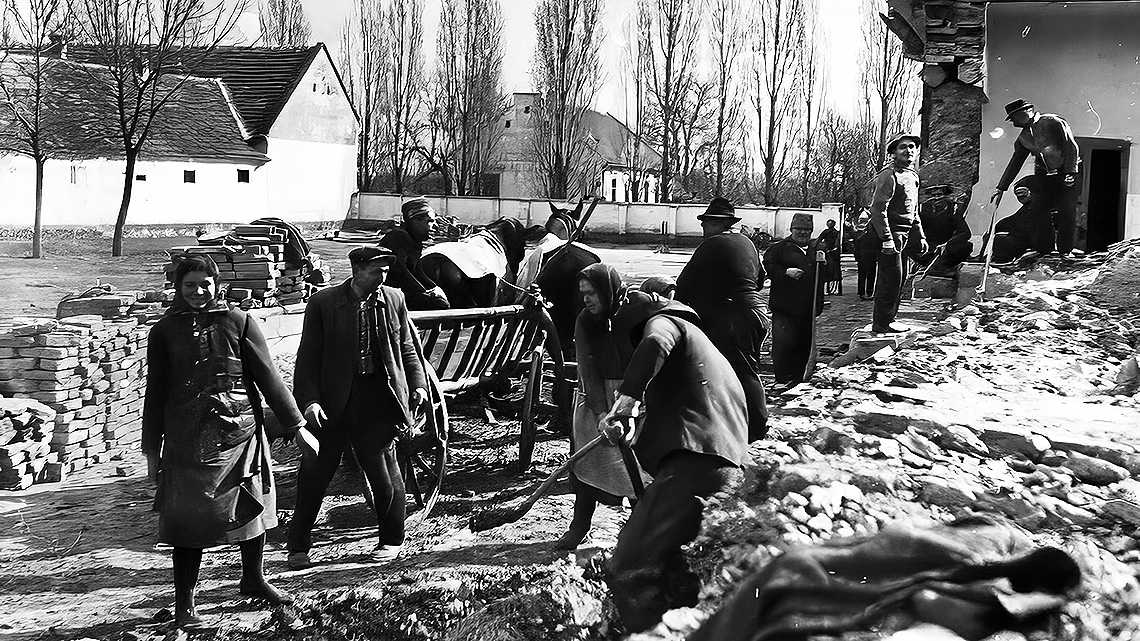
Immediately after World War II, a Photography Section was formed in Novi Bečej under the People's Technique and the Institute for Agitation and Propaganda. The section consisted of young people who were already directed towards the photographic profession or wanted to study the craft. Among the members were the aforementioned Geza Sakač and Miroslav Tornjanski. Olgica Dragić, born Pušić (1929–2016), a young enthusiast, also made her first contact with photography and photo development there, aspiring to master the skills of the craft.
Unfortunately, after less than two years, she had to abandon the profession due to an allergy caused by the chemicals used for developing and fixing photographs. Thanks to her, several dozen film and glass negatives have been preserved, documenting post-war activities in the restoration of our town. In a later period, the Photography Section changed its name to the Photography Section of the City Committee of the People's Front in Vološinovo. From the 1950s to the mid-1960s, the Photography Section under the People's Technique was located in rooms next to the old fire station on P. Drapšina Street 5. It had a lab for developing films and producing photographs. Many amateur photographers of that time used the services of the People's Technique. Ivan Kovačev was born in Novi Bečej, where he attended primary school.
He then finished high school in Zrenjanin and later graduated from the Faculty of Technology in Banja Luka. After his education, he moved to the Federal Republic of Germany, where he started a family and continues to live and work to this day. His first photographs were taken with Janoš Mesaroš in the 1950s using Janoš’s Altix camera. He began to take photography more seriously in 1973, and by 1977 he achieved great success in the artistic photography competition "BLENDE 77" in Hamburg, where his photograph “Little Gypsy Boys,” taken in Novi Bečej, won the gold medal. He has traveled the world, capturing his impressions through the lens of his Nikon camera. His favorite memories are certainly from his hometown, which he wished to confirm with a solo exhibition of his photographs in Novi Bečej (his first solo exhibition was held in 2009 in Hamburg). His first camera was a Voigtländer, and in the early 1970s, he used an Exakta. His first professional camera was a Nikon F2, which he acquired in 1975. Following that were the Nikon F3, Nikon F5, and Nikon F6. The digital camera he now works with is a Nikon D-200.

Comments