



It is well known that sports began and continue to develop in socially and technologically advanced communities. For that reason, Novi Bečej must also be considered from this perspective.
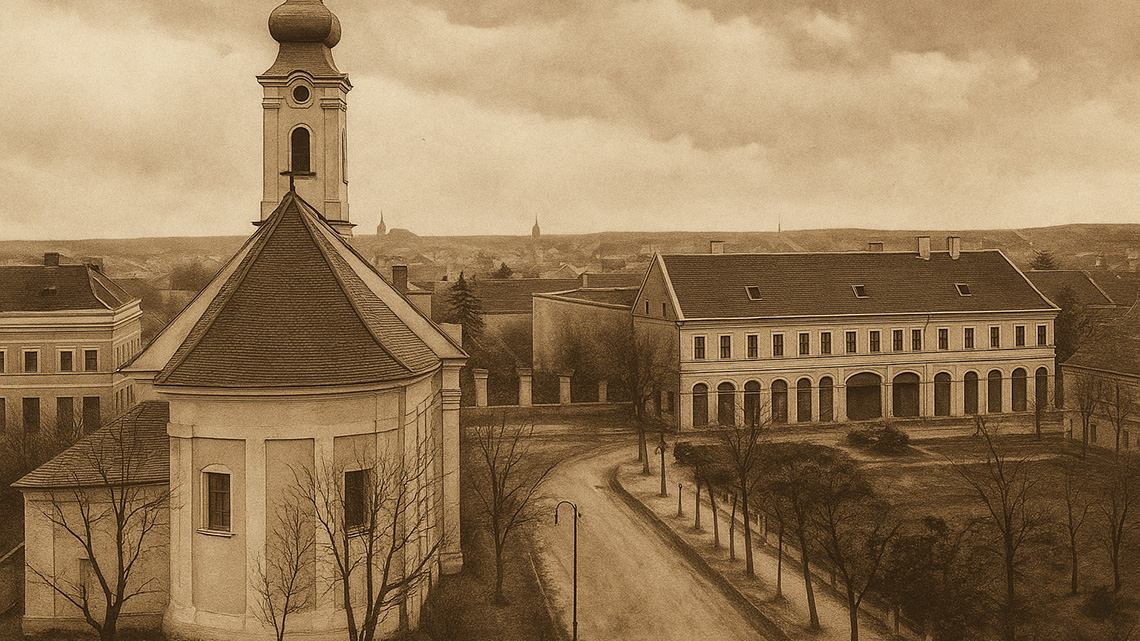
Novi Bečej is located in the central part of the western border of Banat, adjacent to Bačka. Because of its geographic and communication position, it has always had commercial and strategic importance, which influenced its development. The exact date of its founding and naming is unknown, but a written record from the year 1091 mentions its name. That is why the people of Novi Bečej proudly say: "We are older than Berlin." This is only relatively true. At that time, in the location of today's Berlin, there was a Serbian town called Brljin, named after its muddy streets covered in “brlje” (mud). When the Germans expelled the Serbs from that area and settled it in the 13th century, they kept the original name but adapted it to their phonetic system, calling it Berlin.
The oldest settlement in the territory of Novi Bečej is the prehistoric site of Arača. Archaeological research has confirmed the existence of a settlement as early as the early Christian era. Since further excavations were halted, scientists, based on findings so far, presume that a human settlement existed there several millennia before Christianity. In 1228, a Benedictine monastery was built at the site, and its impressive ruins still stand today.
As early as 1320, the only fortified town along the entire course of the Tisa River was built near Novi Bečej. Initially called Bečej, it was declared a royal free city in 1331. During the 15th century, it was held by Despot Stefan Lazarević and at times by Đurađ Branković, who became a Hungarian noble and member of the national assembly. He received the title of count of the Torontal County, with its seat in Novi Bečej. This remained the case until the Turkish conquest in 1551–1552.
Immediately after the conquest, the Ottomans resettled the area. Novi Bečej became a central outpost on the western frontier of the Ottoman Empire, bordering Austria. For this reason, in 1665, the famous travel writer Evliya Çelebi visited and wrote the following:
“Bečej, a vakuf (endowment) settlement. It houses a military garrison of 40 soldiers, a tax collector, a customs inspector, and a janissary serdar. The town on the Tisa is splendid, rectangular, built of brick, covering an area of 500 paces. One gate is called the port gate, and the other is the Ogrun Gate. Near the port is a tavern and 50 shops. There is a mosque converted from a church, a madrasa, three primary schools, a monastery, a bathhouse, 100 houses, and a large port for ships. The population trades in salt and fish, is very hospitable, and the town is charming, full of gardens and vineyards.”
After the Treaty of Karlowitz between the Austro-Hungarian Empire and the Ottoman Empire in 1699, the fortress was demolished in 1701. In 1771, Novi Bečej expanded with a new, purely Serbian settlement called Franovo.
The most detailed accounts of Novi Bečej were published by Lazar Mečkić, and some facts relevant to this study are mentioned here:
After 1699, Banat became part of Austria. The population began to return, and colonization started. First came Germans, then Hungarians and Jews. It is recorded that Novi Bečej had only 20 homes in 1717, and by the 1930s, the town had around 17,000 residents. Due to this rapid growth, Banatski Bečej soon became known as Novi Bečej (New Bečej), while the part that remained in Bačka became Srpski Bečej (Serbian Bečej), later renamed Stari Bečej (Old Bečej). However, in 1896, Novi Bečej was officially named Turski Bečej (Turkish Bečej).
- River transport was the first to develop. The first steamboat docked in Novi Bečej in 1832. The “Little Boat” ran between Novi and Stari Bečej, and the “Big Boat” between Titel and Szeged. After 1918, passenger transport extended via Novi Bečej to the Danube. Large steamships like "Zagreb" and "Princess Jelena" sailed between Belgrade and Senta. The arrival and departure of these ships stirred great excitement among locals, especially the sound of the bell from the "šteka" (wharf), rung by the stekner "Uncle Sava Lekić". Freight transport also increased, especially in salt, fish, wheat, bricks, and tiles via barges, and wood via rafts.
- Fifty years later, in 1884, the railway line from Veliki Bečkerek to Kikinda was completed, and Novi Bečej received a shared railway station. After a major flood in 1895, the construction of the dike (dolma) began.
- Agricultural production, especially grain, expanded. Mechanization increased as well, and by the 1930s, Novi Bečej had about forty wheat threshers, ranking among the leading wheat producers.
- Fishing was also well developed. Around twenty families in Novi Bečej were engaged in fishing and selling fish, significantly boosting household incomes.
- In terms of commodity production, craftsmanship was most prominent, but industry also developed: brick and tile production, grain processing, and woodworking. This was followed by the growth of trade and banking, leading to the opening of trade centers, credit institutions, and banks in Novi Bečej.
In 1798, the first pharmacy opened, and in 1882, the Volunteer Fire Brigade was founded.
- Naturally, with such development, by the late 19th century, two Serbian primary schools (for boys and girls) were opened, followed by a Jewish school. In 1908, a Civic School was established, and in 1924, a gymnasium. In 1920, the Kharkiv Institute, a Russian women’s boarding secondary school, opened.
- In Vranjevo, in 1830, a Serbian amateur theater group was founded, and in 1860, the first professional theater among Serbs was established. The following year, a Serbian reading room opened, and in 1925, the first newspaper "Novobečejac" was published, though it was short-lived.
- The Tisa River was the most attractive part of Novi Bečej, where people often gathered. Besides swimming and sunbathing, Novi Bečej had a large and beautiful floating bathhouse on the river from the late 19th century until World War II, called "Roža Bači". Neither Stari Bečej nor Veliki Bečkerek had such a facility. It was one of the largest and most beautiful on the Tisa, possibly even in Hungary. Szeged had several smaller floating bathhouses, but Novi Bečej’s had two flowing pools – one for men and one for women – and a smaller one for children.
- Religious communities also expanded. The people of Vranjevo demolished their wooden church from 1752 and built a new one on the same site in 1807. Novi Bečej residents built an Orthodox church in 1774, a Catholic church in 1809, a Lutheran church in 1861, and a Jewish synagogue in 1868. Additionally, a monumental medieval sacral structure called Arača already existed in the area, although it was not in use at the time.
- Sports developed slowly in Novi Bečej. In the 1880s, Vladislav Laci Kostić, a local student from London, brought the first football. The first football club, "Turskobečejsko Sports Association", was founded in 1912. In 1927, FK "Jedinstvo" was formed but disbanded by 1935, and children's clubs "Zvezda" and "Banat" were started. Under the influence of the pan-Slavic "Sokol" movement based in Prague, gymnastics began to develop, and with the establishment of the Kingdom of Yugoslavia, so did volleyball and athletics. "Sokol" was directly supervised by the state and led by King Alexander Karađorđević. Swimming and water polo began developing in 1934. During the occupation, sports activities were limited, but after the liberation, the state invested heavily in sports. New sports such as basketball and handball developed in Novi Bečej, the STV "Partizan" was founded, and mandatory spring and autumn cross-country races, ZREN badge competitions, and mass physical education events were held. However, this lasted about ten years, after which Novi Bečej returned to pre-war conditions.
As for some lesser-known facts, historian Kasaš notes three. After the creation of the Austro-Hungarian Monarchy in 1867, Emperor Franz Joseph Habsburg himself visited Novi Bečej aboard his royal boat in 1872. Another little-known fact: Joca Savić from Vranjevo, son of wealthy parents, became one of the most renowned directors of the Munich Theater at the turn of the 18th to 19th century. He also noted that the name "Vološinovo," used for Novi Bečej from 1946 to 1952, was the only widely accepted name at the time.
Comments