



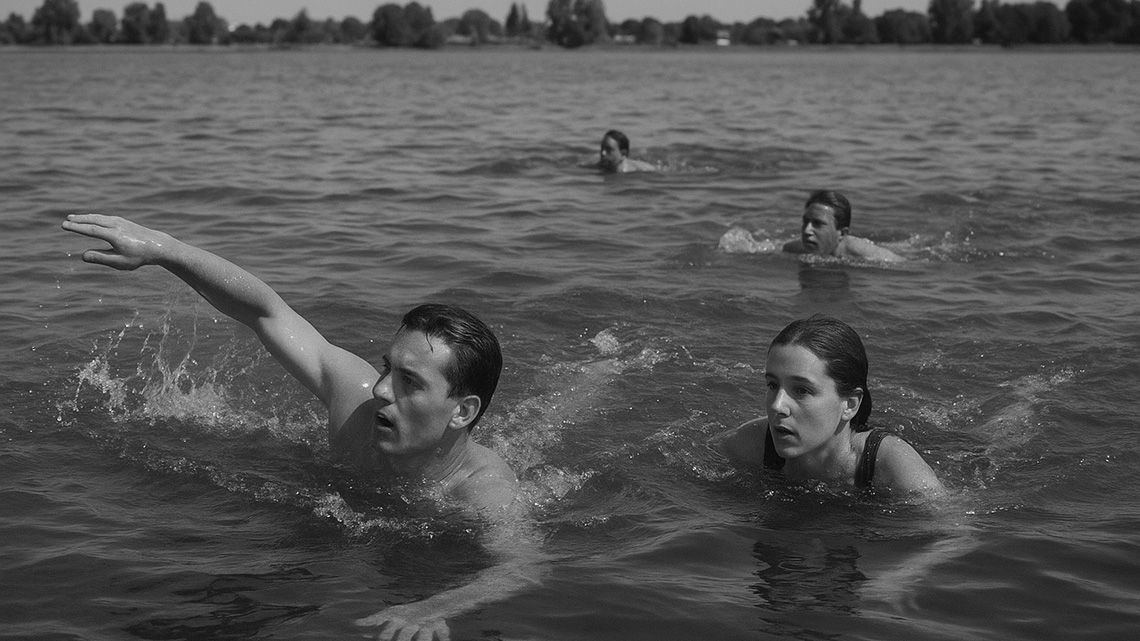
In Novi Bečej, before World War II, four swimming styles were practiced: men’s, women’s, backstroke, and dog paddle.
Men’s swimming was characterized by arm strokes with the arms lifted above the water, scissors-like leg movements, and the head always kept above the surface.
Women’s swimming resembled today’s breaststroke.
Backstroke had its own specific technique – after a simultaneous arm stroke, both arms were swung over the head to begin a new movement, while the legs moved in the same way as in breaststroke. This style was called Germanium.
Dog paddle got its name from the imitation of a dog’s swimming (locally in Novi Bečej, a dog is called “kera”). The front legs kept the swimmer afloat, while the back legs provided propulsion. This technique was especially common in teaching beginners.
At that time, there was no organized or professional swimming instruction. Children in Novi Bečej were taught by parents, siblings, or older friends. The method was very simple – with or without a “dob.” The “dob” was a tin container with two handles, through which a belt or rope was passed. Beginners tied the dob to their waist, with the container on their back, and entered the water. Those who could not afford one made similar floats from millet stalks, reeds, bulrush, or even used dried gourds. In all cases, the dog paddle technique was the foundation of learning. Another method was in shallow water, where the “teacher” held the learner while encouraging them to swim like a dog.
Until 1934, Novi Bečej had no training in sport swimming techniques or water polo. That year, Imre Kelemen, a radio technician from Senta and an enthusiast of swimming and water polo, moved to the town. He opened the first shop for selling and repairing radio sets, and in his free time gathered children and youth, teaching them swimming and water polo techniques, as well as the rules of the game. Interest grew quickly, although competitions were not yet possible due to the lack of a club.
The first swimming and water polo club in Novi Bečej, “Jedinstvo” (Unity), was founded in August 1935. Among its main initiators were pharmacist Oto Kinezl, radio technician Imre Kelemen, and the Sauer brothers, who were students at the time. Already by July that year, the club organized its first match between athletes from Senta and Novi Bečej. Surviving documents include a poster announcing the event and a photograph of local swimmers – one of the first recorded photos related to swimming and water polo in Novi Bečej.
The number of swimmers soon grew, and the club changed its name several times:
- SC “Jedinstvo” (1935),
- SC “Banat” (1936),
- Swimming Section of SC “Zvezda” (1939),
- SC “Tisa” (1940),
- Swimming Section of SC “Jedinstvo” (1948),
- SC “Polet” (1952),
- Swimming Section of SC “Jedinstvo.”
The club’s first official appearance was on August 11, 1935, in Petrovgrad, at the Banat Championship, which was effectively a championship of Serbia. Naturally, Novi Bečej swimmers had little chance for success, but Karolj Kelemen managed a respectable third place in strong competition.
The following week, on August 18, they took part in the traditional competition in Senta, with clubs from Senta, Subotica, Sombor, and Novi Bečej. Swimmers Pavle Sauer (backstroke) and Karolj Kelemen (freestyle) achieved solid results. In water polo, “Jedinstvo” drew 3:3 with Sombor’s SSU, but lost in overtime due to the opponents’ better preparation. The home club from Senta won the city championship and received the silver challenge cup donated by landowner Stevan Lederer from Čoka.
The competition ended with a gathering in the garden of the “Royal” Hotel, where the Women’s Catholic Association hosted participants with the famous Senta ice cream. Medals and cups were awarded by jury president Konstantin Zavišić, and the atmosphere was festive and joyful.
Just a week later, on August 25, Novi Bečej hosted its first promotional swimming meeting, which was in fact the first and only open championship of Novi Bečej in swimming and water polo. Participants included: “Jedinstvo” (Novi Bečej), “SAK” (Senta), “Vojvodina” (Petrovgrad), and swimmers from Stari Bečej.
For the first time, a children’s race (under 15 years) was organized in the 50 m freestyle, won by Stevan Kiurski, who later became Novi Bečej’s best swimmer and a leading figure in both swimming and water polo until the end of World War II.
Other recorded results include:
- V. Bojić (Jedinstvo) – 3rd place in 400 m freestyle,
- Bela Hafner – 3rd place in 50 m freestyle,
- Pavle Sauer – 2nd place in 100 m breaststroke (later disqualified for technical irregularities).
In the women’s program, only one race was noted: the 50 m freestyle, where Elizabeta Vitman (Vojvodina) won first place, Ilona Šafranj came second, and Roza Šafranj (both from Jedinstvo) placed third.
These events mark the very beginnings of swimming and water polo in Novi Bečej and remain an important part of the town’s sporting history.
Comments