



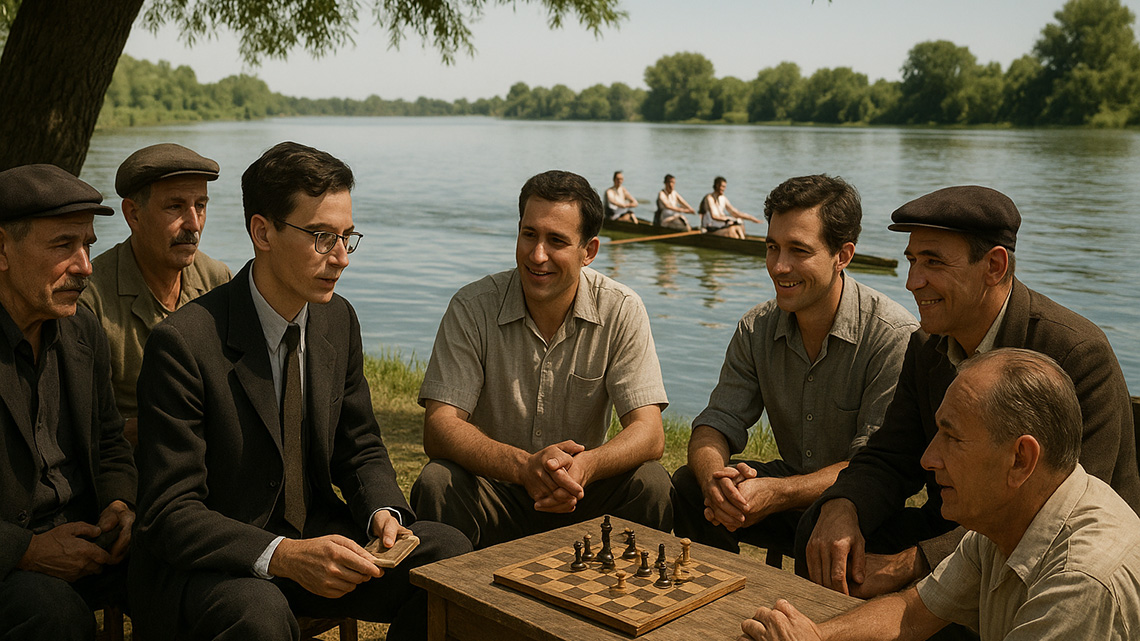
Rowing, once a popular and beloved skill before the war, was not practiced during the occupation, as the occupiers forbade citizens from owning boats on the Tisa River. Only professional fishermen — and there were very few of them — were allowed to keep and use boats.
During that time, the “Boathouse” on the banks of the Tisa became, especially in summer, not only the center of sports but also of social life in Novi Bečej. Whenever the weather was nice, the town’s elite gathered there. Heated debates were held on many topics — except politics. Philosophers such as Hegel and Karl Marx were often discussed, not in a political sense, but rather through the lens of logic and philosophy. The main promoter of these discussions was a student named Mita Pivnički.
Besides intellectual debates, people played chess, dominoes, and mice, but never cards. The most prominent chess player among them was Janošević, who later became a Yugoslav grandmaster.
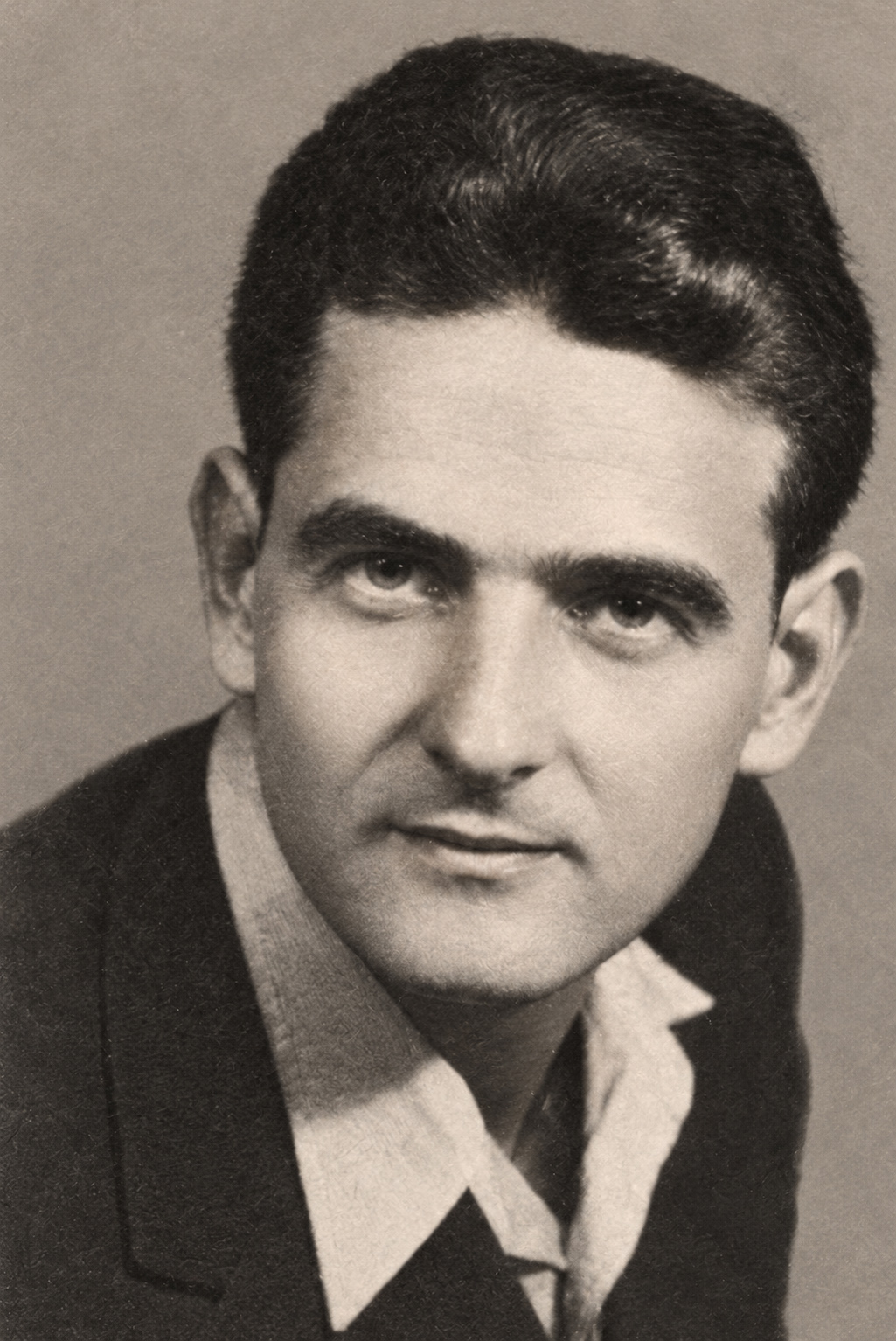
Mita Pivnički, known by the nickname “Max”, got it from a comic book hero — a super-intellectual who knew everything about everything. The resemblance between Pivnički and the comic character was so striking that it seemed as if the author had used Mita as a model. He was a refined young man — pale, thin, always wearing elegant glasses. At the time, he was a student with interrupted studies, which he later completed, earning a degree in medicine. He worked in Sarajevo before moving to Canada. His daughter later married the man who would become the Prime Minister of Canada, while she became the First Lady. A generous benefactor of the Serbian Orthodox Church, Mita was, by his own wish, buried with his wife in the yard of the Monastery of the Holy Virgin on the Tisa River in Novi Bečej.
Alongside intellectuals, the Boathouse also attracted black market traders who controlled the flow of scarce goods, as well as underground resistance members, intelligence agents, counterintelligence operatives, propagandists, tricksters, and gamblers. Throughout the summer months of the occupation, the Boathouse remained the heart of all activity in Novi Bečej.
The illegal workers, as they were called, were members of the Communist Party of Yugoslavia (CPY) who operated in the occupied territories. In Vojvodina, they hid in towns, villages, and especially on remote farmsteads scattered across the plains. Communication with them was often maintained by members of the SKOJ — the League of Communist Youth of Yugoslavia. My older brothers were among them: Duša was responsible for maintaining contact with the farms on the Banat side of Novi Bečej, while Braša, born in Nadalj and well acquainted with the Bačka region, worked on the opposite side of the Tisa.
To fulfill his assignments, Braša had to cross the border river — the Tisa — at night, often being away for several days. The CPY sometimes involved children in its missions, often without their awareness. I clearly remember one such moment from my childhood when I, too, was unknowingly used for that purpose.
One summer day in 1943, after training at the Boathouse, Olga Marticki approached me and said that I would be going to Petrovgrad (today’s Zrenjanin) for a swimming competition that Wednesday. When I asked if I was the only one going, she replied: “You’re the best.”
I told my grandfather, who allowed me to go. When we arrived at the Brankovan swimming area, only a few swimmers were there — no lanes had been set up. Olga said she would go ask about it. When she returned, she told me the competition had been canceled and that I should train while she took care of some things. She came back around noon, and we took the afternoon train back to Novi Bečej. When I told my grandfather what had happened, he was furious, shouting:
“It’s not enough that your brothers have already put their heads in danger — now you want to risk Sava’s too!”
As for the town’s social and sporting life during the occupation, it unfolded much like this. There were no swimming competitions until the end of the summer of 1943, when something truly remarkable happened — the Great Swimming Day was organized.
The main organizer was the Swimming Section of Sports Club “Zvezda” from Novi Bečej, which managed to attract the participation of the Swimming Club “BOB” from Belgrade. For the occasion, an improvised 25-meter swimming course with four lanes was set up on the Tisa, near the Boathouse. Two barges used for transporting sand served as the start and turnaround points.
After the swimming events, the inner lanes were removed, while the outer ones — tied to the barges — marked the area for water polo. Two goals were lowered into the water, secured to the barges, and the match could begin.
The swimming program included the following disciplines:
- 200 m and 50 m freestyle
- 50 m breaststroke
- 50 m backstroke
- 4x50 m freestyle relay
- 4x50 m medley relay
Women competed in the same events, except for the 200 m freestyle and relays. The competition was held in two parts — morning and afternoon — and the results were preserved.
The event was officially opened by Đorđe Paljić from “BOB” and Rada Aćimčev – Bakar from “Zvezda,” who greeted the participants with brief welcoming speeches.
Comments