



After the capitulation of the Kingdom of Yugoslavia, the country was occupied by the Third Reich and divided according to the occupiers’ interests. Banat, inhabited by a large number of ethnic Germans, received a special status as a protectorate of the Third Reich. Under this protection, life was somewhat calmer and freer than in other parts of the occupied country.
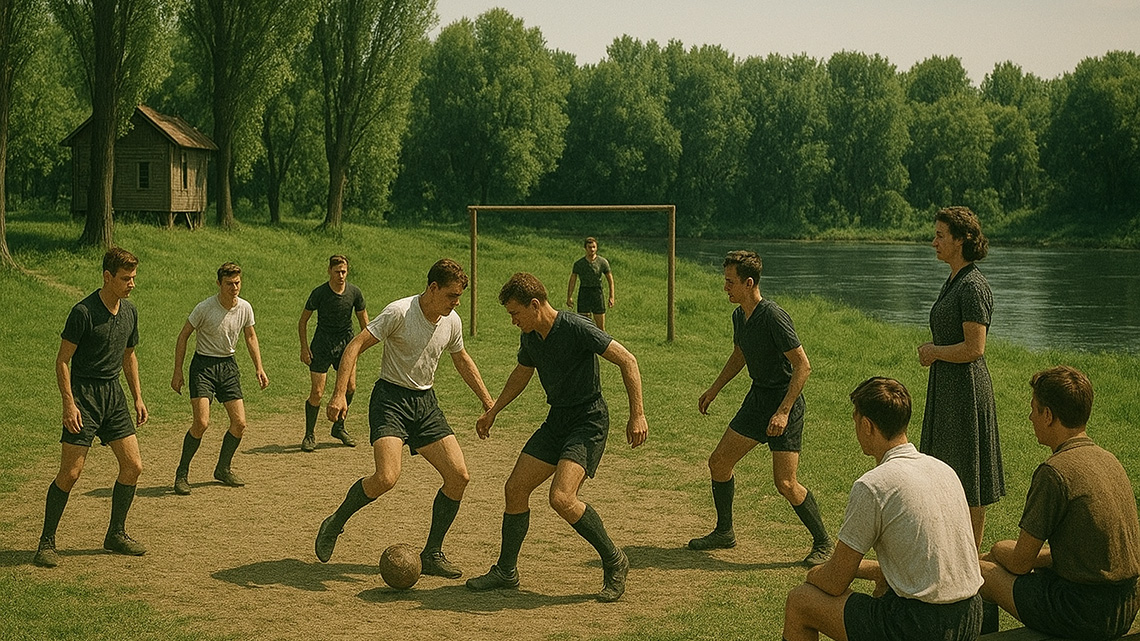
During the occupation, all sports activities took place in the northwestern part of the town, between the ferry crossing, the embankment, and the ruins of the medieval fortress on the bank of the Tisa River. This area, covered with poplars, willows, and oak trees, featured a forester’s house built on a raised mound to avoid flooding, and was known as Gradište.
On that same spot, beside the Tisa, were the ruins of a significant medieval fortress that everyone simply called “Grad” (“The Fort”). In the summer, since swimming on the rocky beach was prohibited, locals from Novi Bečej bathed near the “Little House,” while residents of Vranjevo swam near the “Fort.”
The owner of the land, Mrs. Ivanović, allowed the Football Club to clear part of the forest to create a football field. Gradište thus became a well-organized modern sports center. In addition to the football pitch, the area contained two notable buildings: the forester’s house, where the FK “Zvezda” caretaker named Slavko lived, and a wooden house on concrete pillars, known to everyone as “The Little House in Gradište.”
The “Little House” covered about 100 square meters and consisted of a hallway and three rooms. Two larger rooms were used by athletes, while the smaller one served as an office, a referee changing room, and a storage area for sports equipment. The field hosted various athletic activities such as short- and long-distance running, long jump, high jump, shot put, javelin, hammer, and discus throw. Swimming, water polo, and diving were practiced on the Tisa River, while football and volleyball were the most popular team sports.
Sports were mainly seasonal, practiced in late spring, summer, and early autumn — winter was considered a “dead season.” During the colder months, people played table tennis, billiards, bowling, and chess. Before the war, gymnastics and volleyball were organized by the “Soko” association, which was banned during the occupation.
At that time, the traditional game “Šoranje” was very popular throughout Vojvodina. The name comes from the local word šor, meaning “street.” The game was played outdoors whenever the weather allowed, requiring no equipment other than a stick and a homemade rag ball called a “krpenjača.” The ball was made of cloth wrapped around a small stone and tied with string. Rules were simple, well-known, and respected, so no referee was needed.
“Šoranje” provided children and youth with a way to compete and express themselves — and interestingly, the Americans later developed their most popular sport, baseball, from a similar street game.
Comments