



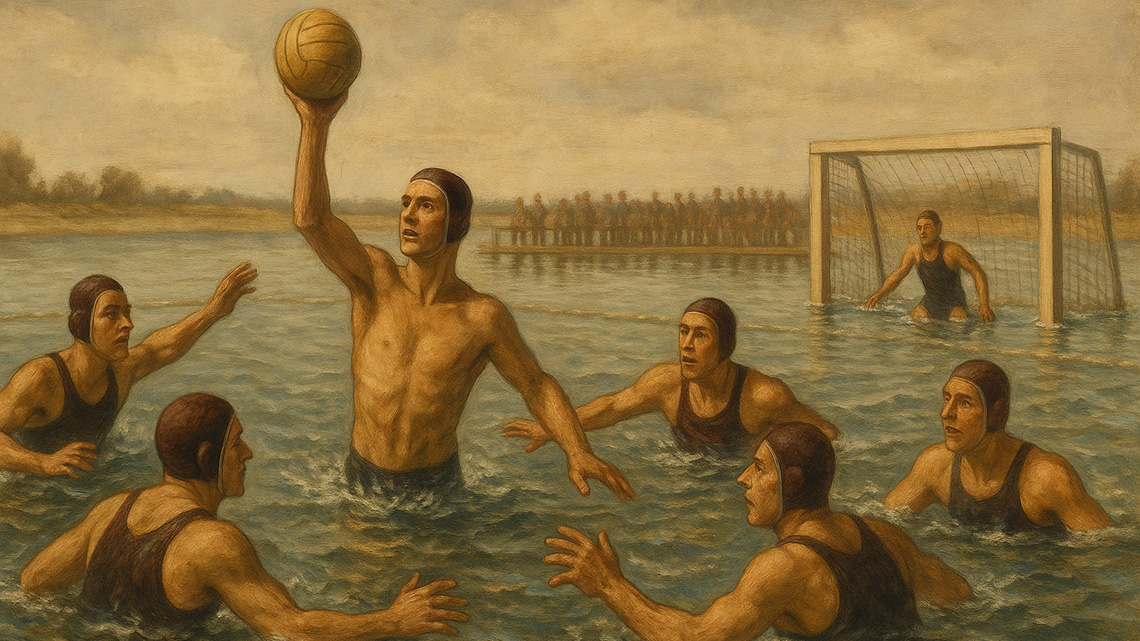
Those who were involved in organizing swimming competitions quickly noticed that such events were rather monotonous and failed to generate much excitement. They lacked attractiveness and didn’t draw large audiences. To solve this problem, they decided to create a game played in water. Since football was already an established sport at the time, they came up with the idea of "football on water." This first took place in London in 1869.
Naturally, that game bore little resemblance to modern water polo. For one, it wasn’t played with goals. Instead, the aim was to swim with the ball and pass it among teammates to reach a raft located on the opposing side and place the ball on it. That was how points were scored. The game was played on an improvised field, with 12 players on each team. There was one referee, and the match lasted 20 minutes.
As early as the following year, the London Swimming Association issued an order for formal rules to be drafted. The first official water polo rules were written by William Wilson in 1876 in Glasgow. The first match using these rules was played in 1877 on the River Dee in Glasgow, on a clearly marked field with two goals. Teams consisted of seven players, including a goalkeeper. The game was officiated by one referee with two assistants and lasted 20 minutes.
Although the London Swimming Association adopted the rules, strict enforcement did not begin until 1885. Since then, the rules have been revised several times but remain well known to all involved in the sport.
Water polo gradually gained popularity. By 1894, it was being played across Western Europe. It became part of the Olympic Games in 1900.
Yugoslavia first participated in the Olympic Games with a water polo team in 1936 in Berlin and won its first gold medal in 1968 in Mexico.
The first European Championship was held in 1926 in Budapest, and the first World Championship took place in 1976 in Belgrade.
Water polo was introduced in our region by students returning from studies at Western universities. In Serbia, it was first introduced in 1907 by the Sombor Sports Club, which also organized the championship of Southern Hungary in 1911.
The Swimming Federation of Yugoslavia was founded in 1921 in the Kingdom of Yugoslavia, with its headquarters in Zagreb, and water polo was included as part of it.
In post-war Yugoslavia, the first national swimming championship was held in 1946, and the first winter championship in water polo, known as the Yugoslav Cup, took place in 1961.
For enthusiasts and connoisseurs of the sport, it is important to note that water polo was always closely tied to swimming. This remained the case in Yugoslavia until 1971, when the Water Polo Federation of Yugoslavia was founded in Herceg Novi, with its headquarters in Belgrade. Since then, the Swimming and Water Polo Federations have operated independently.
Comments