



The ambitious and persistent club "Bakar" expanded its activities even outside the competitive season. On February 22, 1941, it organized the "Miss Sport" contest of Novi Bečej. For this occasion, a magnificent ball was held in the "Sokol" hall, featuring a rich cultural and entertainment program.
After much anticipation and excitement, the beautiful Angelina Kišprdilov was crowned Miss Sport. The event brought the club a significant income of 1,800 dinars, further fueling plans for the upcoming season.
Unfortunately, these plans were soon cut short. On April 6, 1941, the occupation halted all club activities— the occupiers banned its work, confiscated the seal, and seized the hard-earned income. This marked the end of an important period in the development of swimming and water polo in Novi Bečej.
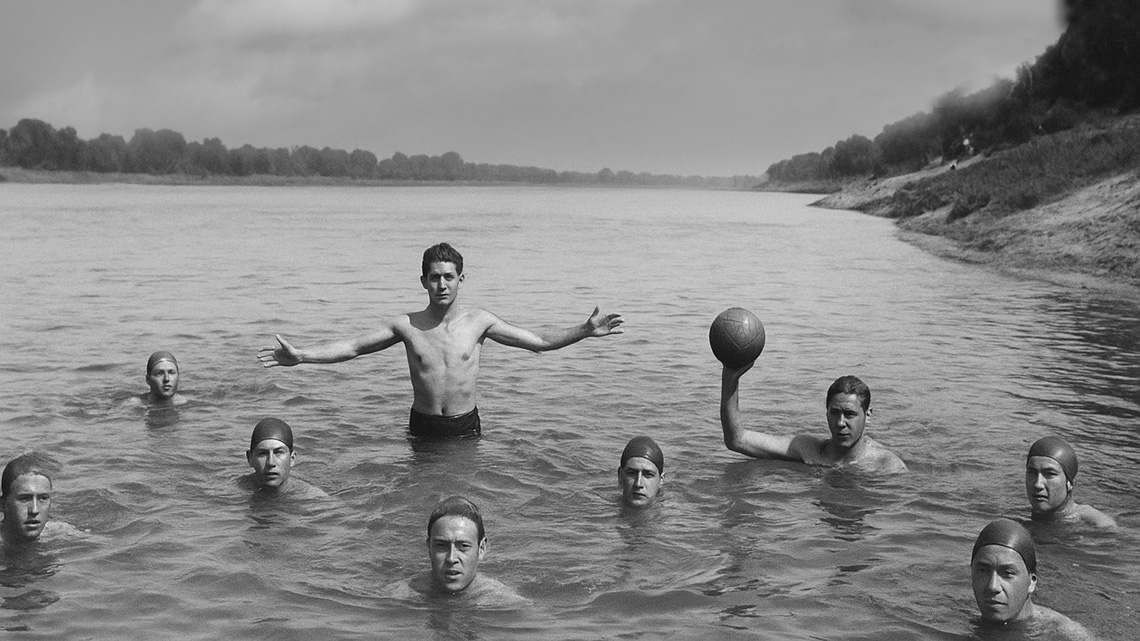
Alongside organizing competitions and training, special attention was dedicated to the professional development of coaches. In the beginning, this responsible role was taken on by prominent swimmers who had taught themselves techniques from available literature. Passionate about the sport, they shared their knowledge and experience with beginners, thereby expanding the base of future athletes. Training sessions were held on the banks of the Tisa River, as there were no permanent swimming facilities. Among those most devoted to this work were Imre Kelemen, Oto Kniezl, and Herman Bergl.
In 1940, Novi Bečej welcomed its first professional coach, Herman Bergl. Sadly, his work was tragically cut short—during the occupation, as a Jew, he was arrested by the Germans and executed.
Training took place on the Tisa River, between the public bathhouse of soda-maker Paja Janković and the ferry crossing. This improvised course stretched about 200–300 meters. Swimmers practiced upstream and downstream swimming, while some preferred crossing the river and back instead of going to the ferry. Such challenges were undertaken at their own risk, while the coach supervised the others. The main focus was on endurance swimming, while speed training was largely neglected.
Water polo practice took place downstream from the bathhouse to the beach. The goal was tied to the riverbank, with the goalkeeper in place while others practiced passing and shooting techniques. The game itself could only be practiced with one goal.
During those summers, until the occupation, swimmers often gathered on the sandy islet across the Tisa. The atmosphere there was more pleasant, the beach was nicer, the Tisa’s current slower, which made upstream-downstream swimming easier, and the view of Novi Bečej the most beautiful.
Comments