



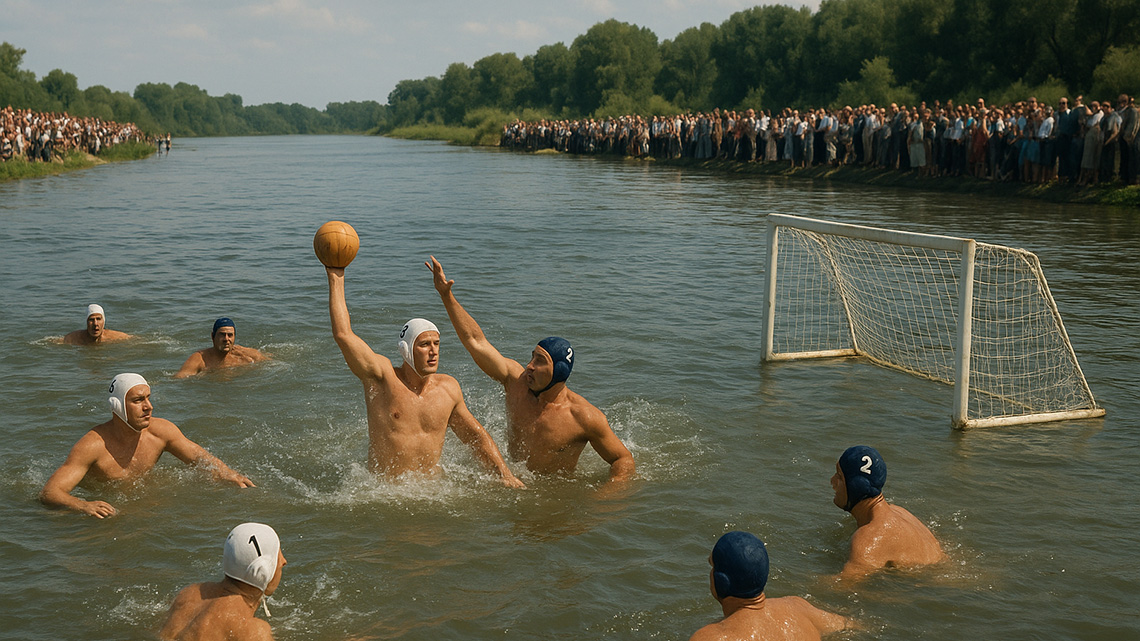
Since Novi Bečej did not have water polo players who could compete on equal terms with those from Belgrade, the organizers wisely decided to hold the contest between two mixed teams. Thus, the “White” and “Colorful” teams were formed.
The result of the match, expressed in goals scored, was 9:2 for the Whites.
The match was successfully refereed by P. Džigurski.
With this game, the morning competitions came to an end.
Afternoon Competitions
The afternoon events began precisely at 3 p.m. with the following program:
3 × 50 m medley (juniors)
- “BOB” (Stojanović, Vukosavljević, Radonić)
- “Zvezda” (Boberić, Nićin M., Cvejin)
50 m backstroke (women)
- Krstić
- Tolmačeva
100 m breaststroke (men)
- Bjelić
- Srećković
- Marčić
4 × 25 m relay (sub-juniors)
- “BOB” (Mihajlović, Stojanović, Bisanić, Plavšić)
- “Zvezda” (Janković, Cvejin, Padežanin, Ćirilov)
3 × 50 m medley (women)
- “BOB” (Petrović, Bjelovuk, Krstić)
- “Zvezda” (Tolmačeva, Marticka, Ćeremova)
4 × 50 m freestyle relay (men)
- “BOB” (Filipović, Radonjić, Nikolić, Bjelić)
- “Zvezda” (Kiurski, Rackov, Nićin V., Džigurski)
The Rematch
In the water polo section of the program, a rematch was held between the “Whites” and the “Colorfuls.”
Team lineups:
- Whites: Vučo, Ivanić D., Marčić, Ćirić, Vukosavljević, Paljić, Tica
- Colorfuls: Terzić, Srećković, Ivanić R., Filipović, Kiurski, Higl, Đukić
This time, the result was a draw — 3:3.
Outstanding players in both matches included Nikolić, Đukić, Kiurski, Vučo, Paljić, and Higl.
The match was once again excellently refereed by “our old ace,” Kiselički, who, according to the recollections of living witnesses, was actually P. Džigurski, nicknamed “Sivonja.”
Best Competitors
The best swimmers were named Sjeverin Bjelić and Beba Krstić (“BOB”).
The most successful Novi Bečej competitors were Stevan Kiurski, Radomir Ivanić, Pera Džigurski, and Olivera Tolmačev.
The youngest participants were Plavšić and Mihajlović (“BOB”), and Vladimir Kiselički (“Zvezda”).
Sjeverin was a true sensation — “three lengths ahead” of everyone else — and amazed the crowd by demonstrating the butterfly stroke, a technique never before seen in Novi Bečej.
Swimming and Water Polo During the Occupation
During the occupation, the following young men were engaged in swimming and water polo:
S. Kiurski, R. Ivanić, D. Ivanić, A. Marčić, V. Nićin, B. Kiselički, V. Kiselički, Z. Tolmačev, I. Farkaš, B. Hafner, D. Cvejin, F. Rigo, M. Rackovan, A. Berbakov, S. Janković, I. Jovanović, B. Padežanin, R. Miloradović, Ž. Simić, P. Džigurski, and boys: B. Vojnov, the Žarin brothers, the Simić brothers, A. Cuka, S. Ivanić, B. Miloradović...
Women: O. Marticki, J. Padežanin, N. Ćeremov, B. Boberić, N. Aracki, M. Glumac, M. Stajić, D. Nešović, A. Bukinac, J. Bukinac, O. Tolmačev, V. Nikolić, Ž. Boškov, A. Janković...
The main organizers and community leaders were Rada Aćimčev “Bakarm,” Branislav Kiselički, Vasa Nićin, Imre Farkaš, and Stevan Kiurski.
Historical Context
Looking back at the event of August 29, 1943, in Novi Bečej, it must be acknowledged that a true miracle occurred that day.
Naturally, the question arises: Why did such an event take place in Novi Bečej, and at that time?
To find a realistic answer, one must consider the historical context of that period.
It was World War II. Germany and the Axis powers were at the height of their strength, yet by mid-1943, it was becoming increasingly clear who would ultimately win.
- On November 18, 1942, the Battle of Stalingrad ended with a Soviet victory.
- On August 23, 1943, the Battle of Kursk concluded — the largest tank battle of the war — resulting in the irreversible decline of the German army.
- The Allies expelled the Germans from Africa and landed in Sicily on July 7, 1943.
- In Yugoslavia, the final German offensive against the Partisans failed, leading soon after to Italy’s capitulation on September 18, 1943.
In this context, the Third Reich likely sought a “peacetime” event for propaganda purposes — to show the world that life continued normally in occupied territories and that people even had time for sports.
Supporting this theory is the fact that the entire event was filmed by the renowned German film company “UFA,” directed by Klara Rosenstein, and later screened as a newsreel in Novi Bečej.
The Role of the Communist Party of Yugoslavia
It is easy to assume that the Communist Party of Yugoslavia (CPY) also took an interest in the event.
The first reason was the freedom of movement and assembly that the event provided — something the Party desperately needed for its operations, since Banat, as a protectorate of the Third Reich, had strict restrictions on gatherings.
The second reason was the existence of the black market.
At that time, the CPY supported around 300,000 fighters, who could only be supplied through illegal trade. Novi Bečej was one of the black market centers in Yugoslavia.
Everything was bought and sold — from food, clothing, and medicine to tools, machinery, and likely even weapons.
The main organizers of this major event were the leaders of both sports clubs, who later became prominent communist officials after the war.
The Author’s Recollections
The author of this monograph was a participant in these events — a nine-year-old boy at the time — with vivid memories, as his whole family took part.
Two particular episodes from the black market period remained deeply etched in his memory:
“Throughout the war, a man regularly visited our home, buying harness equipment for horses. When he learned that my mother was an excellent seamstress, he began ordering dozens of men’s undershirts and drawers, bringing his own fabric and paying in cash.
After the war, one day, an officer entered our yard. At first, we didn’t recognize him, but as he approached, my grandfather greeted him warmly. During the conversation, the officer asked my father, ‘Do you know who used your harnesses and straps?’ My father replied that he didn’t. The officer said, ‘For the First Proletarian Brigade.’
He then told my mother, ‘Comrade, your shirts and drawers were worn by officers of the Yugoslav People’s Army.’”
Conclusion
The number of spectators was large — approximately as many as could fit within a space of 500 square meters.
Visitors came from all over Banat, from Belgrade, Stari Bečej, Bačko Gradište, Čurug, and Žabalj.
And so, as the saying goes, “to please both wolves and sheep,” during a time when such things seemed impossible, on the banks of the Tisa River near the “Kućica” in Novi Bečej, on August 29, 1943, took place The Great Swimming Day.
One thing is certain — this was the only swimming and water polo event in Novi Bečej during the occupation, and indeed the greatest swimming and water polo manifestation in Novi Bečej from its founding until the end of the war.
Comments