



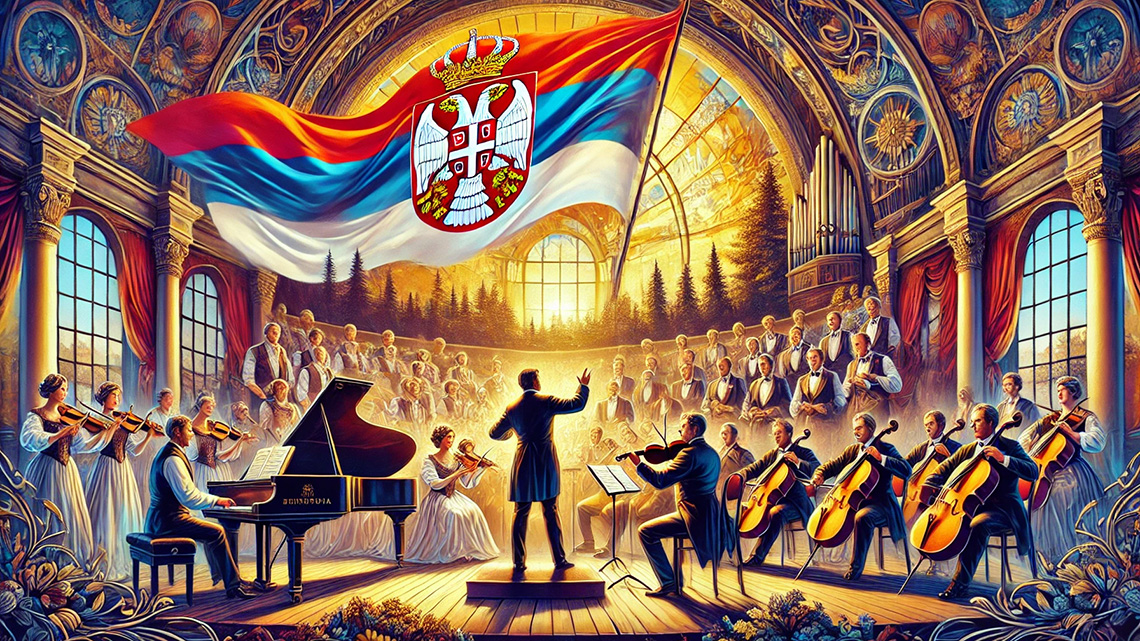
The musical works of Josif Marinković belong to the highest achievements of Serbian Romanticism in the 19th century. They reveal various aspects of his personality—cheerful and sunny in solo songs, and patriotic, sometimes even tragic, in choirs. The stylistic frameworks he embraced in his youth remained with him throughout his life, though he always enhanced them, particularly in terms of harmony. His first compositions emerged during the period of the "rise of the youth movement ideology" and the "flourishing of Romantic patriotic poetry," as well as the "refined and sensitive moods of Romantic lyricism."
Continuing, like his predecessors, to compose suites or blends, Marinković completed eleven *Kolos*—vocal rhapsodies for male and mixed choirs—from 1881 to 1897.
Marinković's patriotic choirs played a significant social role as symbols of the national ideology of the young Serbian bourgeoisie. They surpass the pathos of the texts they were based on through their inventiveness and freshness of expression: they are homophonic, march-like, expressive, and unconventional. The most popular is *Narodni zbor*, which begins with the words "Hey, trumpeter": it is a symbol of struggle and resistance, earning the title of the Serbian *Marseillaise*.
Mixed choirs, such as *Proletnja zora*, are characterized by more intimate lyrical themes. They demonstrate the composer’s ability to deeply, sincerely, and psychologically immerse himself in the poetic text, interpreting it with bold harmonic solutions that brought him closer to contemporary Central European music.
With his mixed choirs featuring soloists and instrumental accompaniment, Josif Marinković opened a new chapter in Serbian music and remains one of the most significant representatives of this genre. These compositions have broader contours, Romantic emotions, a tendency towards a balladic tone, and dramatic qualities. Many of them are, in fact, cantatas due to the complexity and monumentality of their structure and the contrasts between soloists and choirs: in *U Zadovolјnoj reci*, the solo parts are assigned to soprano and tenor, while in *Na Veliki petak* and *Potočara*, four soloists participate.
In his emotionally and stylistically pure solo songs, the most beautiful lyricism of Serbian Romanticism, Marinković worked with a warm, broad melodic line. It is not always innocently Schubertian, as it approaches the more dramatic world of Schumann, yet it retains Marinković's personal expression. The piano part is rich in figurations, as in the choirs with piano accompaniment, and by supporting the melody, it emphasizes the sound architecture of the soloist, introduces the composition’s main atmosphere, describes programmatic details, and underscores dramatic moments.
Of the 22 pieces of music for the play *Suđaje* (1894) by Ljubinko Petrović, intended for choir, soloists, and orchestra, the lullaby for voice and orchestra and the monks' choir are known from concert performances.
Marinković also composed instrumental works such as *Svatovac*, *Banatsko kolo*, and *Sonatina* for piano, as well as *Fantasy*, *Serbian Dance*, *Kolo*, and *Nocturne* for violin and piano.
Marinković's contributions to church music, partially based on folk and stylized folk church motifs, but also influenced by Russian church music, include the *Divine Liturgy* and *Pomen* (or *Requiem*).
Source**: Program Booklet No. 9, "Horizons on the Tisza" 2001.
Comments