



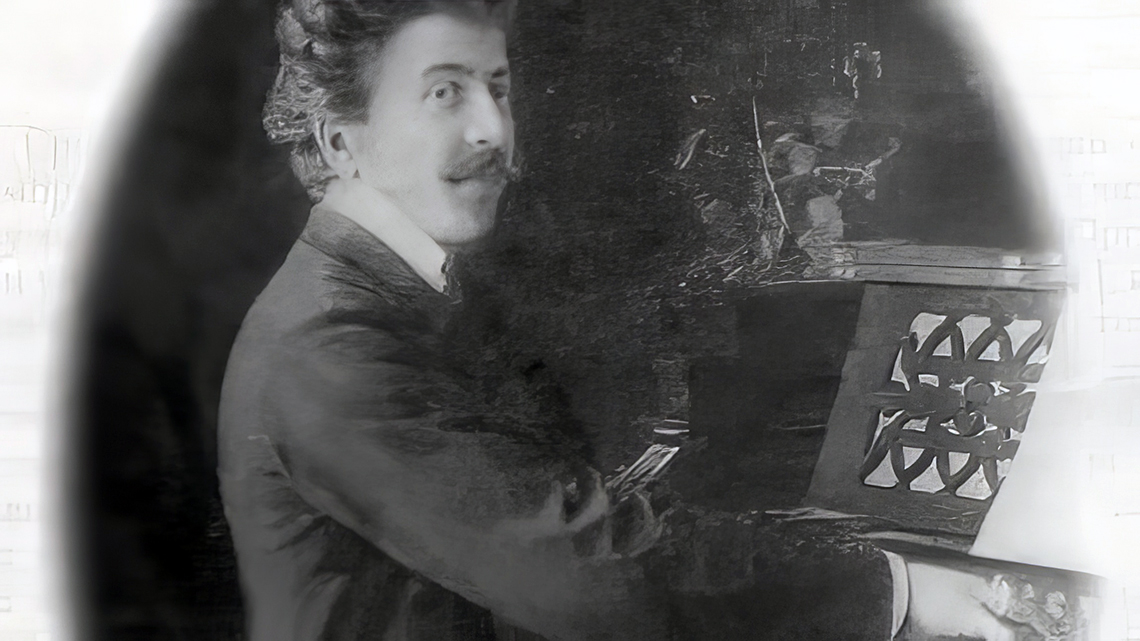
I was born in Vranjevo (Banat) on October 11, 1851, to father Jovan and mother Mileva. After finishing primary school and lower secondary school, my father wanted me to continue with high school and then attend university. However, I was drawn to studying music, as from an early age, singing and playing were my favorite pastimes—I grew up with them.
My father played the tamburica, and my mother played the guitar, and both of them sang with joy and skill. My aunt (a Russian by birth) was musically educated and often sang arias from various operas, praising music as the most sublime art. I had the opportunity to listen to the famous folk song singer St. Bošković (an engineer from Stari Bečej), and I also frequently heard Hungarian gypsies and military music in Varaždin, where I was studying in the 5th grade of primary school. All of this had a deep impact on me, and I was determined to study music. I taught myself to play any instrument that came into my hands. I played tamburica, guitar, accordion, and piano. Sometimes I would play, not even knowing what I was playing, and if someone asked, "What are you playing?" I would respond, "Just whatever came to me."
This caught the attention of my aunt, and to further encourage me to study music, she spoke highly of music and its practitioners, which only strengthened my resolve. During school breaks, I formed a tamburica orchestra with my classmates and, with older people (merchants, craftsmen, clerks, and peasants), I put together a choir, which I taught folk liturgy by ear, and we sang in the church on holidays. (I know two of the singers who are still alive: Pera Kikić and Svet. Popović).
When I finished lower secondary school, I asked my father to send me to Prague, but he was not willing to hear of it, as although he loved music himself, he saw it as entertainment rather than a life’s goal. To achieve at least part of my goal, I decided to study at the Teacher’s School in Sombor, because I heard that music was a compulsory subject there. At school, I diligently studied music and spent all my free time practicing on the school harmonium. It didn’t take long before I was already substituting for the music teacher Blažek during services, funerals, etc. During school breaks, I still had a choir, but I no longer taught them by ear; we prepared "sermons" in Vranjevo and Turski Bečej for the benefit of a poor student and the National Theater. – When I was in the third year of the Teacher’s School, I composed "A Selection of Serbian Folk Songs" and "Rise Up," both of which were sung by my friends at the St. Sava celebration in Sombor (1873), and I taught and conducted them; I also played "Banatsko kolo" and "Svatovac" on the harmonium, imitating bagpipes. The audience received both the songs and the performance very well; they encouraged me, and I owe this success to the fact that my father, after I passed the teaching exam, sent me to Prague, but only for a year; he could no longer resist the insistence from my friends, mother, and sister, who were also at the celebration. When I went to Prague, I then saw what it meant to study music, and that one year would be nowhere near enough for studying music. The following year, my father did not want to send me to Prague, so I stayed home for a year, studying and practicing on my own. After that, I convinced my father to send me to Prague for another year, and after that year in Prague, I again stayed home for a year; this continued four times, so I completed the organ school in Prague only in 1881. My father hoped that this would persuade me to take up something else, but it was all in vain, as nothing could divert me from music. In the last year I spent at home (in Vranjevo), I persuaded my father to let me go to Kikinda to oversee our estate (later, my parents also moved to Kikinda), but more importantly, I wanted to revive the choral society in Kikinda, which was called "Gusle," and I became the choir leader.
I was still in Prague when the Belgrade Choral Society invited me to be their choir leader, and after passing the exam at the Organ School, I came to Belgrade, took on the duties of choir leader, and that November, I was appointed as a singing teacher at the Theological School, but immediately the following year (January 25, 1882), I was transferred to the Teacher’s School, where I remained until September 7, 1885.
– When the Belgrade Choral Society celebrated its thirtieth anniversary, I wrote "Greetings to the Singers" for the occasion; at that event, my songs "At the Monument to Prince Mihailo," "Greetings to the Crown Prince," "II Kolo," and "Song to the Heart" were also performed; the last one was sung by 300 singers. For the celebration, the Belgrade Choral Society received a flag from Her Majesty Queen Natalija, and the society awarded me 50 #.
– I spent the 1885/86 year in Vienna, studying music privately; I also attended pedagogical lectures at a higher course and lectures by Haizlik (a famous music critic) at the University.
– In 1889, the Academic Choral Society "Obilić" invited me to be their choir leader and to immediately come and prepare them for the celebration of the 500th anniversary of the liberation of the Serbs from the Turks. I was then at home due to illness, and as soon as I recovered, I responded to the invitation, and for the celebration, "Obilić" learned two of my songs: "Greetings to the King" and "Kosovo Hymn." In Kruševac, the society received a flag from His Majesty King Alexander.
– I was the choir leader at "Obilić" from 1889 to 1900, traveling through Serbia with them, arranging concerts. "Obilić" celebrated my 25th anniversary on November 29, 1897.
– I was also a choir leader with Davorja, Radničko Choral Society, Serbian Jewish Choral Society, etc.
– In 1891, I was appointed as a singing teacher at the second Belgrade gymnasium, where I still serve.1
1 In the continuation of the autobiography, Marinković lists all the compositions he had written up to that time.
Comments