



Between 1945 and 1963, two Water Management Organizations covered the area of the municipality: the Upper Banat Water Organization, with its headquarters in Kikinda, north of Novi Bečej, and the Tisa Water Organization, based in Zrenjanin, south of Novi Bečej. Thus, two water communities existed:
- Upper Banat Water Community (1945-1963)
- Tisa Water Community (1945-1963)
The Upper Banat Water Community had its supervision offices in Novi Bečej and Novi Milošev, while the Tisa Water Community had a section based in Novi Bečej. The supervision offices and sections performed their field work, while technical and other services were located at the community headquarters, led by directors.
This period marks a new chapter in the work of water management communities in a liberated and war-torn country. The decision to form water communities was made by the Presidency of the Main National Liberation Committee of Vojvodina. Several smaller water cooperatives were abolished at the time, and larger water management organizations were formed, taking on greater responsibilities.
A key characteristic of this period was the post-war reconstruction of the country. Particularly, the drainage systems were outdated, and financing was budget-based. During this time, water management stagnated, and the works carried out were modest in scope. The focus was mainly on maintaining drainage systems and some minor work on embankments. However, later in the period, investments were made to regulate watershed areas (channels and pumping stations).
It is also generally agreed that not much was done in water management during this period, given the agricultural needs and the demands of new technologies. Therefore, there had to be radical changes in the organization of the entire water management system to address these issues quickly.
Upper Banat Water Community (1945-1963)
Embankments (Flood Protection)
Flood protection was provided by the previously built Tisa embankments, which protected the area and were generally in relatively good condition at the time. The well-maintained condition of the inherited embankments was due to the fact that earlier experts focused on ensuring the embankments were as secure as possible, still mindful of the catastrophic consequences of earlier floods.
In the area north of Novi Bečej, about 25 km of Tisa embankment was found, with a telephone line and six watchtowers.
Summer embankments along the Tisa River floodplain, protecting the areas of Ljutovo and Libe, should also be mentioned. The Ljutovo summer embankment, 9.67 km long, protects 900 hectares, while the Libe summer embankment, 10.85 km long, protects 800 hectares.
The areas protected by these summer embankments were some of the most fertile agricultural lands. During this period, little attention was paid to these embankments as their maintenance and flood defense organization were not prioritized. Only during flood defenses did the water community provide expert and technical assistance, while the remaining support personnel were the landowners themselves.
The forestry activity involved protecting windbreaks and producing defensive materials, which was still relevant at the time.
In addition to regular yearly maintenance, significant works during this period included:
- 1954-1959: Stone cladding of the main Tisa embankment at Novi Bečej (Vranjeva),
- 1959-1962: Minor reconstruction of summer embankments and closing of breaches.
In 1962, a significant flood defense was recorded, though no major consequences occurred.
Channels (Drainage)
The state of the drainage system, i.e., the channel network and drainage facilities, immediately after the war was far worse than that of the flood defense embankments. The poor condition of the drainage system was evident in areas where there were no channels, even though they were necessary. The weak drainage network led to gradual drainage via permeable devices, as the pumping stations were outdated, low capacity, and steam-powered.
The Vranjeva watershed lacked a pumping station, and drainage was performed siphonically. The Galadski watershed, although it had the Kerekto pumping station, was inefficient due to the length of the main drainage canal and the large water inflow from distant watersheds. The pump operation time during critical periods was measured in months, and there were cases where the water was raised and pumped twice to be drained.
This weakness in the undeveloped drainage system became particularly evident during the massive internal flooding of 1956, when the land became heavily flooded and led to the destruction and displacement of the Molina village east of Novi Bečej.
In addition to regular maintenance performed every year, there were more significant reconstruction and new construction works. From 1955-1962, a canal guardhouse was built at Krstašica, and wells were drilled along the embankment guardhouses, which somewhat improved living conditions in the field.
During 1955-1956, when the Vranjeva drainage system was built and reconstructed, the new Burza pumping station, powered by electricity, was installed, solving the drainage issue for the area for a time. In addition to the canal network, several masonry bridges were constructed.
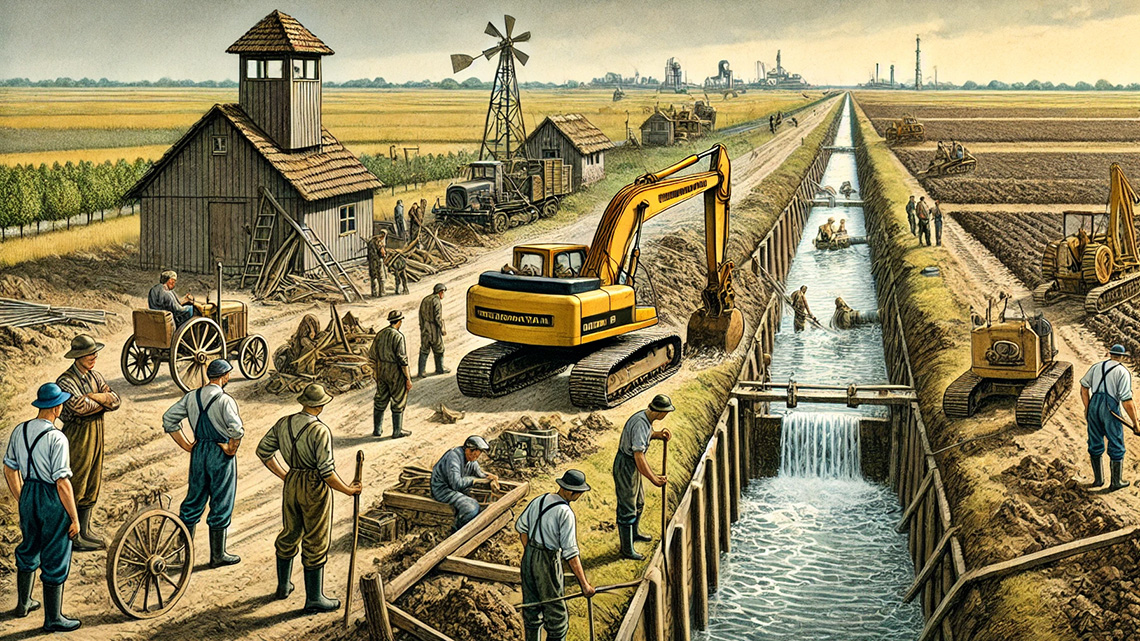
It is important to note that in 1957, the first excavators and bulldozers were acquired, which replaced the labor-intensive work of manual laborers.
If we were to assess the past period regarding drainage, it can be concluded that insufficient work was done, considering the agricultural needs and technological developments, as well as investments made in them. Certainly, more attention should have been given to the removal of excess water, which was not done, leading to radical changes in water management organization.
In the period from 1945-1963, directors in Kikinda were: Eng. Ivan Živković, Eng. Lazar Alasov, and Eng. Milan Gavrić. The technical staff in Novi Bečej consisted of Dušan Aćimović, and in Novi Milošev, Svetozar Belić.
Tisa Water Community (1945-1963)
Section in Novi Bečej
Embankments (Flood Protection)
In this area, previously built embankments were also in place, and their condition was generally good. The embankment started at Vranjeva and extended south to the high land of Bereg, then from Borđoš to the high land of Babatovo, though it was recorded only up to the Ruman pump station, i.e., the southern border of the cadastral area.
The total length of the embankment was 11 km, and three embankment guardhouses were found along it. There was also a telephone line connecting the section headquarters with the guardhouses. The embankment in the urban area had supporting structures made of durable material. Gates were placed along the embankment to prevent uncontrolled traffic, and in general, the embankments were carefully guarded against any damage.
On the water side, the embankment had a protective forest belt that shielded it from waves. During the winter, defensive material, mainly made from willow branches and rods, was produced.
In addition to regular maintenance, no major investment works on the embankments were undertaken during this period.
Channels (Drainage)
The state of the drainage system was unsatisfactory compared to the flood protection embankments, though better than the area north of Novi Bečej, controlled by the Upper Banat Water Community. The pumping stations were mostly outdated and steam-powered. The operation time of the pumps during critical periods was very long because the water drained slowly due to low channel gradients and long, stretched-out watersheds. This became most apparent in 1956, during catastrophic floods, when settlements were threatened. Moreover, the pumps had small capacities relative to needs, and in critical situations, they operated day and night.
After the liberation, the drainage system included:
- 150 km of canals,
- 121 km of bridges and culverts,
- 5 sluices,
- 3 pumping stations.
Besides regular maintenance, some reconstruction and new construction occurred between 1945-1957, but no significant work took place.
Between 1957-1962, the canal network of the Kuman watershed was reconstructed, with canals being widened and deepened. This reconstruction made drainage possible in part of the Novi Bečej watershed. Two concrete bridges were also built on the main canal.
As part of the Kuman watershed reconstruction, a new pumping station, powered by diesel, was built alongside the existing one. The Novi Bečej pumping station, also diesel-powered, was reconstructed in 1962, increasing its capacity.
Here, too, the assessment is that more could have been done to regulate drainage watersheds. Despite this, the work done during this time, especially the excavation and reconstruction of channels, was not insignificant.
Directors of the Tisa Water Community in Zrenjanin were: Eng. Vladimir Živković and Eng. Karlo Rezniček. The technical staff at the Novi Bečej section included: Section heads: Eng. Ljubomir Katić, Varga Imre, Bašić Franja, and Vartuš Ferenc. Technical chiefs: Batalov Dušan, Eremić Vasa, Majinski Milutin, Popović Vasa, and Tadin Dušan.
Novi Bečej, Vranjevački Rit - First excavator works began in 1957.


Comments